Brisbane Arcade, Queen Street Entrance, 2023. Photographer: Nicole Davis

This year the wonderful Brisbane Arcade celebrates the 100th anniversary of its opening!

In February 1924 Brisbane’s Daily Mail celebrated the progress of the city through the many new buildings constructed over the previous 12 months. Only five years after the end of World War I, the enthusiasm for improvement, demolition of the old city and construction of the new was felt throughout Australia.

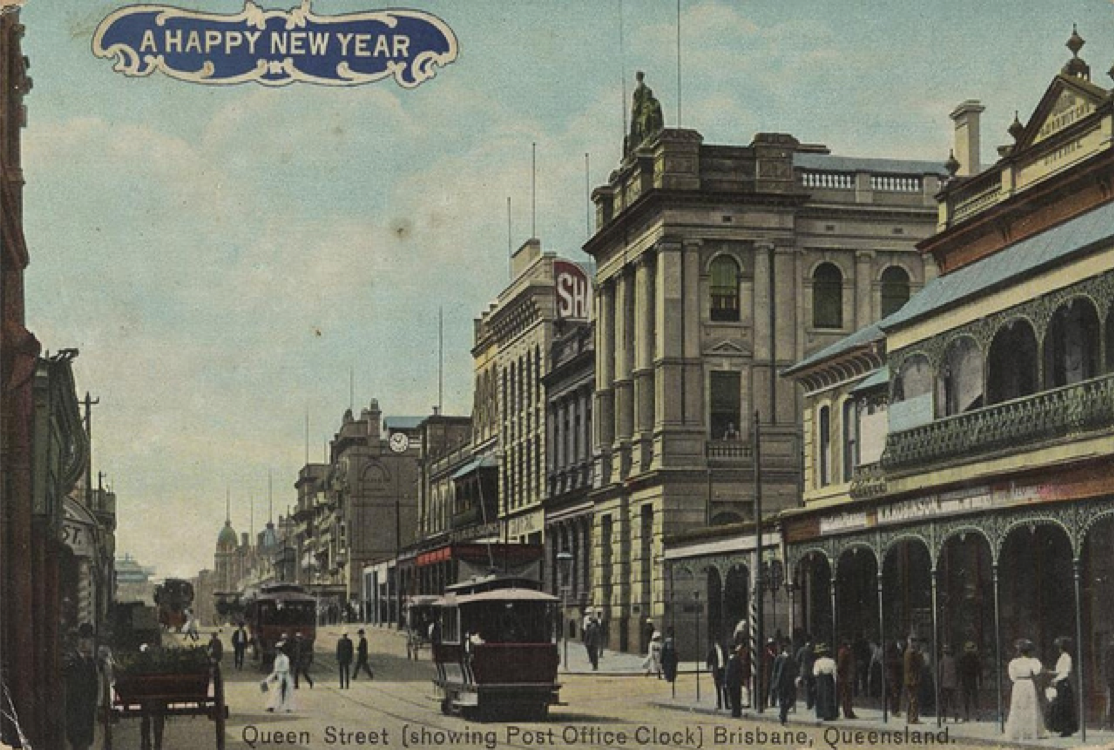
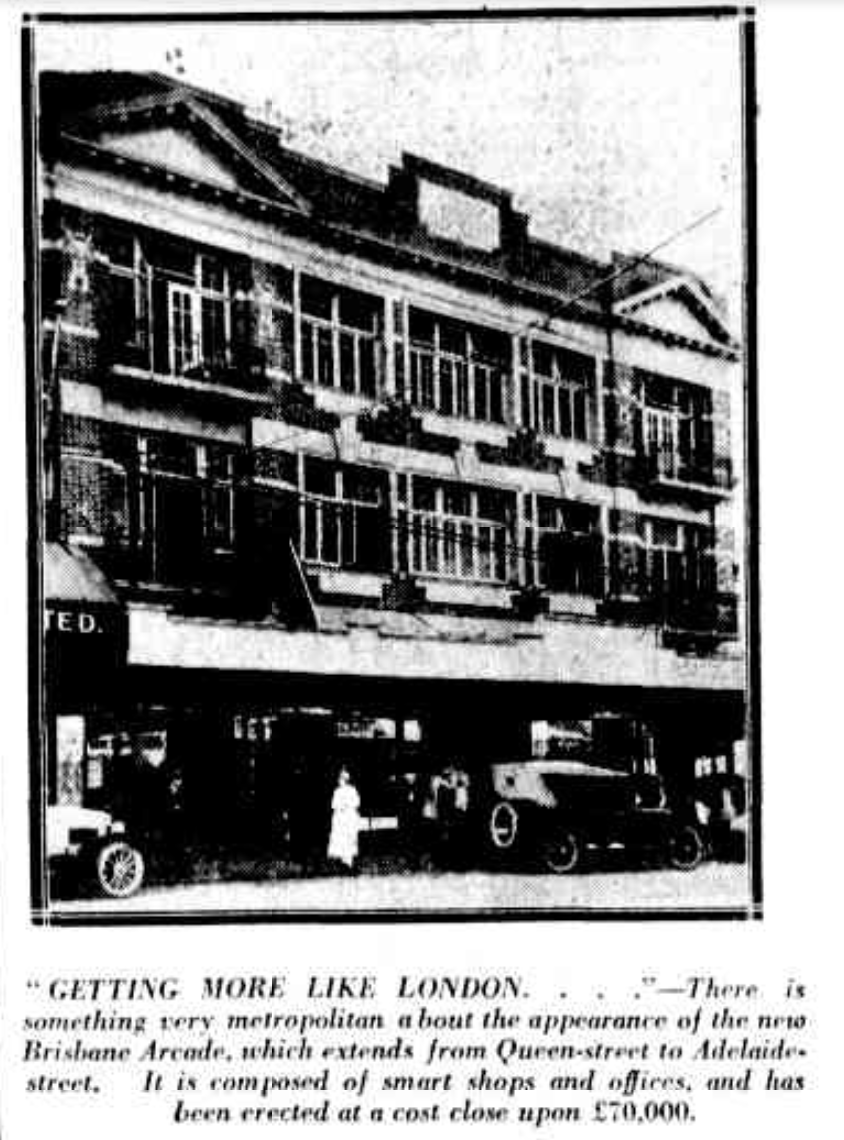
In Brisbane, this included the new Brisbane Arcade ‘of brick, with modern shops and plate-glass windows, this is considered equal to the best Sydney and Melbourne arcades, … [which] cost close upon £70,000’ (5 February 1924, 11).

A similar refrain to stories written for seventy years about arcades in Australia – comparing them to those in Britain, Europe and the United States and equating them with urban progress – is to be found in the stories surrounding this new example:

The arcade, leading from Queen to Adelaide streets, is an attractive addition to the city’s architecture. Arcades are a feature of most large American, Continental and English cities—the one now in the course of construction may one day become the Burlington of Brisbane.

Daily Standard, 3 January 1924, 7.
The Brisbane Arcade has delighted generations of Brisbane residents and visitors throughout the years. I remember walking through as a young child, thinking what a magical place it seemed to me – particularly the Darrell Lea chocolate shop!

As a teenager, it became a regular thoroughfare as I made my way to meet friends at the Hungry Jacks on the corner of Queen and Albert Streets (the regular meeting spot for generations of Brisbane kids). When I started my first job – Bookworld in the Myer Centre – at the age of 16, it again became my route to and from Central Station. It always seemed quite glam and very expensive at that time in my life but still endlessly fascinating.

Being originally an ancient historian, I sadly didn’t pay much attention to Brisbane’s heritage buildings until a few years after I moved to Sydney and morphed into a museum professional working in Australian history and heritage. It once again became a site that I visited and wandered, now taking more scholarly notice of its architecture and stories.

My PhD thesis on Australian arcades was originally planned to look at those built into the 1920s, including this wonderful arcade, the Johnston Arcade in Terang, Victoria, and the many examples built in regional towns in the early twentieth century. But the sheer proliferation of arcades built in this period meant I had to restrict my study to the five decades from 1853 (the first arcade built in Australia) to 1901 (the year of Federation).

Despite having to move away from this period, I still wanted to hear more about the stories of this building, which has always been a special place for me. This year I’m able to do that, as a Griffith University Harry Gentle Resource Centre Visiting Fellow. After a bit of a hiccupy start to the research a couple of months ago, I’m back in Brisbane beginning the project in earnest.

Group of women modelling fashions from Paul’s millinery, Brisbane Arcade, at race day fashions at Ascot races, Brisbane, 1935. Photograph: The Queenslander, 6 June 1935. State Library Queensland, Neg: 191045

The work focuses on women business owners who occupied shops in the nineteenth-century Queensland arcades, focusing on businesses present from the 1870s to 1920s. I’m hoping to uncover the histories of these women: where they came from, how they financed their businesses, what motivated them to open their own establishment, what the experience was like for them, where they got their stock from, the networks they leveraged to do all of this, what happened to them after they left the arcades and, generally, to bring their stories to a broad audience.

At the end of the research, there’ll be a public talk, a website, a journal article, and a couple of conference presentations, all talking about these women. It will also contribute to a chapter in the book I’m writing based on my PhD thesis.

Brisbane Arcade was in fact built nearly 50 years after the city’s first example, the Royal Exhibition Arcade, down the road on Queen Street, and its successor, the 1885 Grand, straddling the corner of Queen and Edward streets (Tattersalls Arcade today sits on its footprint). Also earlier in Far North Queensland were the Royal Arcade in Charters Towers, built in 1888, and the 1901 arcade built as part of the Townsville Municipal Council buildings in 1901. For more on these earlier arcades, you can see my discussion of them in some earlier blog posts.

While I’m technically not researching the 1920s arcades, I likely will research the Brisbane Arcade for the project because I’d really like to compare both the usage and representation of this arcade with its nineteenth-century predecessors. We’ve already seen above in the list of store owners, many more shops aimed at women customers than those earlier examples. I also suspect when I look at the percentages, there will be a greater number of women owners as well. Many of those discussed above were at least run by women and there is a high likelihood many were owned by them as well.

With the 100th Anniversary celebrations, this week seemed an auspicious time to start on my research, and I’ve done a little on the Brisbane Arcade over the past few days, looking at newspapers and other sources.

Like a number of earlier examples, the Brisbane Arcade had a woman owner: Mary Emilia Mayne and her brother, Dr James Mayne, commissioned architect Richard Gailey Jr to design the building, with construction beginning in 1923. The Maynes were significant benefactors in Brisbane, helping to establish the University of Queensland Medical School at Herston and, in 1926, the land at St Lucia, where the main university campus is still located today. On their deaths, in 1940 and 1939 respectively, they left the proceeds of their estates in trust for the medical school, including the income from the arcade.

Mary Emilia Mayne, 1890 [1870s?]. University of Queensland Archives, S908 p541

Nearly two months after that first article in the Daily Mail, the same newspaper informed their reader about some of the businesses about to open there (30 March 1924, 6). These included a wide variety of women’s clothes and accessories shops such as the Arcadia Shoe Salon; Myrtle Power Salon, selling frocks and table linens; Luxor Shoe Store; Miss Morrie McLoughlin, who sold frocks and gowns; Dulcie Decor’s frocks and wraps; Frank Brennan and Miss Brennan, tailoring and ready-to-wear for women; Jenny Salon, run by Esme Davis [or Davies], high-class costumier; SB Heiser, fine jewellery; Searl’s, ‘well-known Sydney florists’; The Women’s Exchange, with knickknacks and lingerie; and Britton and Williams Cutlery Co.

Unlike the arcades of the nineteenth-century, which aimed at a diversity of businesses to attract both women and men, the Brisbane Arcade seems to have focused quite closely on shops that would attract women clientele.

There is a distinct divide in the March article between the relatively feminine boutiques and the seemingly more masculine real estate agents and brokers and so forth. This may have reflected the changing idea of who a shopper was expected to be, or who the advertising and retail industries were targeting as their audiences, and the emphasis on shopping as a woman-centric pastime.

Staff behind the counter at George E Adams’s cake shop, Brisbane Arcade, c1938. Photographer unknown. State Library Queensland

Looking at the Wise’s Directory for 1924-5 demonstrates that this article gives a good overview of the tenants, but mainly those on the ground floor. There were several other businesses there also, including refreshment rooms: Mrs Edge’s White Swan Café and a restaurant run by the Misses Alford and Watts.

On the first floor this continued with more dressmakers and similar businesses aimed at women, as well as the workrooms of some of the stores on the ground floor such as those of Jenny Salon and Brennan & Co. However, there were quite a few others that would have attracted male visitors.

These included a number of agents, also listed in the newspaper article, on this level (accessed via the balcony that runs along the entire outline of the void). This included AJ Hoye, estate agent; DB McCullough, real estate; John McCormack, house, land and business agent; and Allsop and Taylor, real estate. Also to be found upstairs were Cranfield’s Sports Depot, the Committee of Direction of Fruit Marketing, the Queensland Lawn Tennis Association, the Financial Aid Co and a number of (likely men’s) tailors on the first and second floors.

It seems then that there was an apparent spatial divide along gender lines in the building, at least initially. The ground floor was largely aimed at women clientele or more ‘feminine’ pursuits and interests, while the upstairs tenancies were those more traditionally associated with males or a mixed clientele. This is not to say that men didn’t accompany their female relatives to downstairs stores or food outlets, but that the division of interests by gender was apparent.

Of relevance to my current research project, one noticeable difference between nineteenth-century arcades and the Brisbane Arcade appears to be the real shift in gender balance of those running businesses. Here we see an overwhelming majority are run by women, unusual for the arcades of the previous century, particularly those in Brisbane. We do see women-run businesses to varying degrees in those earlier arcades, but they are by no means in the majority and, in Brisbane, there are in fact far more men listed as tenants.
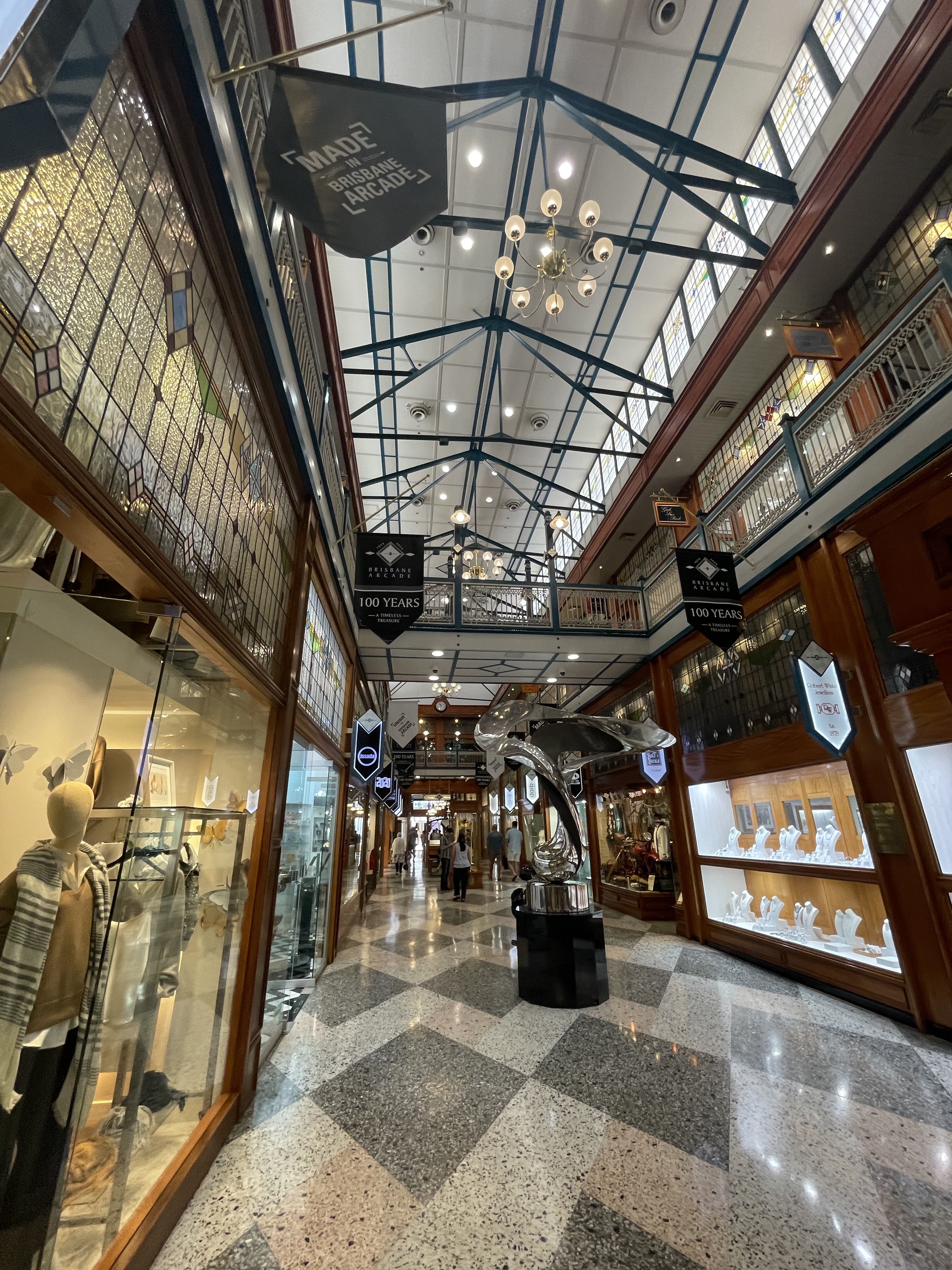
Brisbane Arcade, interior, 2024. Photographer: Nicole Davis

I’m looking forward to exploring more about these changes over time, and when, where and why differences might occur, including looking through newspapers and perhaps business records of shops or business associations, when I can find them.

For the next fortnight, I’m working in the State Library of Queensland and the Queensland State Archives to start to unpack the stories of the Queensland arcades and their businesswomen and I’m very excited to bring you along with me on this research journey. I’ll be posting on my Instagram a bit along the way, so please join me!

Meanwhile, there is loads of stuff happening to celebrate the Brisbane Arcade’s 100th birthday. They have a great range of historical stories about the building on their website, including visitors’ memories of the arcade over the years. This Friday, 19 April, will see a special celebration on the Queen Street Mall, outside the building, with a radio broadcast, special gifts, entertainment, cake (!) and more during the day to celebrate the occasion.

You’ll definitely see me there and, while Darrell Lea is sadly gone, I’ll be stopping by their successor, the Noosa Chocolate Factory. Yum!
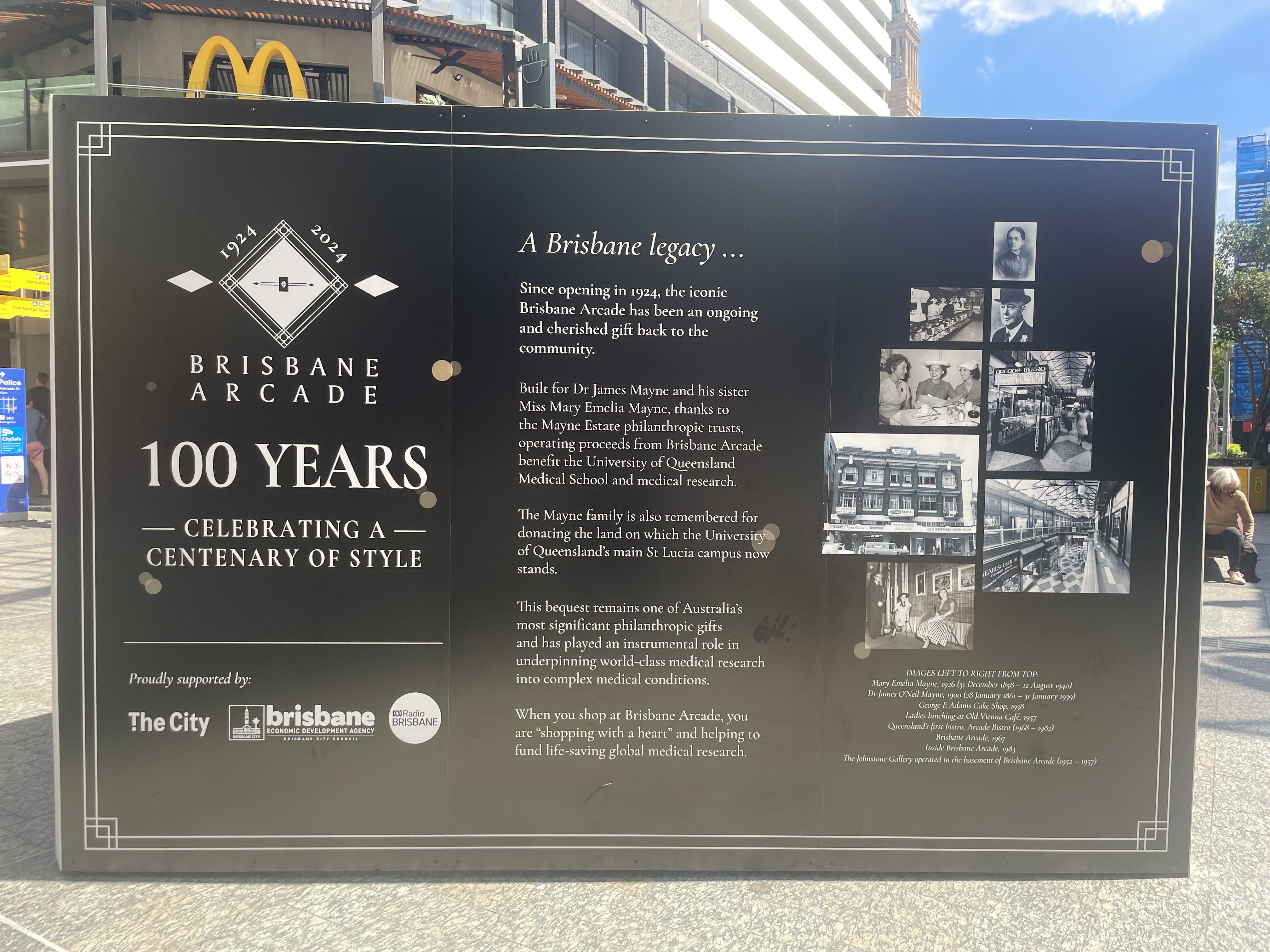
Brisbane Arcade Centenary history display, Queen Street Mall, 2024. Photographer: Nicole Davis

I still have a bunch of three-quarter drafted posts, which are actually about the history of arcades, but thought today I’d give an update on research life lately.

I’ve been working hard with my fellow authors, Richard Broome, Andrew J May and Helen Stitt on a thirtieth anniversary edition of Weston Bate’s Essential but Unplanned: The Story of Melbourne’s Lanes, which will be released later this year by Royal Historical Society of Victoria and State Library Victoria. Bate also included the city’s arcades, many of which join up with the lanes, an essential part of the way we move through and experience the city.

For me, this has involved two seemingly diametric activities. Often it has consisted of sitting at a desk staring at directories, maps, and spreadsheets to work on tracking the histories of the lanes. But it also means extensive walking around Melbourne’s CBD to see if certain lanes actually still exist in our rapidly changing cityscape or determining some other aspect of their location past or present. On those days, my 10,000 steps are easy to achieve!

Working away at Royal Historical Society of Victoria on Melbourne laneway histories with very old and very modern sources!
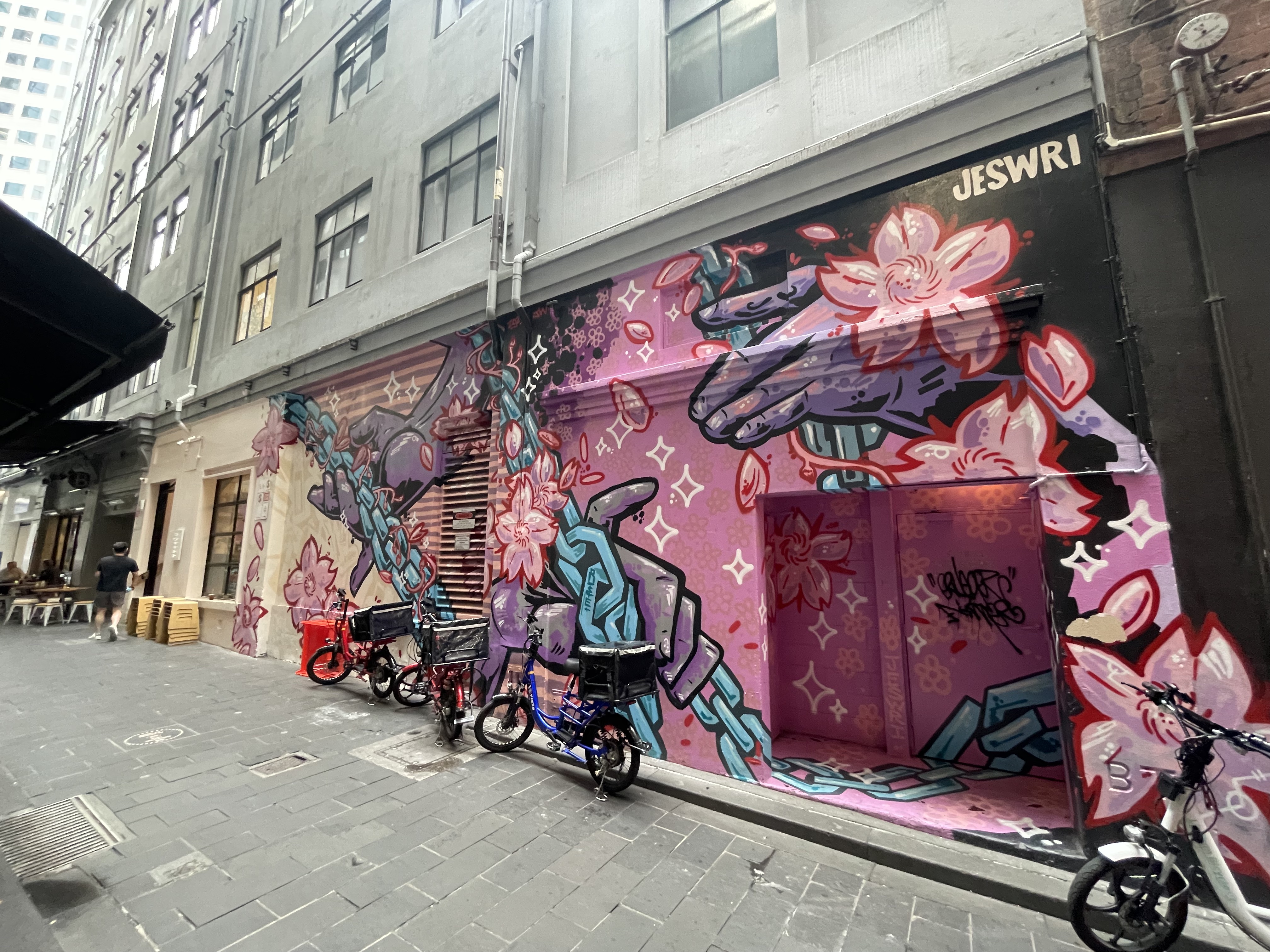
Exploring Melbourne’s lanes on foot is rewarding … but gosh my feet get sore! Amazing mural by Gadigal artist Jeswri (Jesse Wright) in Equitable Place.

It’s been really amazing discovering unknown corners of Melbourne, as well as seeing the history of its arcades: from the long-gone 1853 Queen’s Arcade to the most recent iteration, the Melbourne Walk, a combined arcade and laneway complex, which should open towards the end of 2024.

The book is accompanied by an exhibition at RHSV, Melbourne’s Storied Laneways, curated by David Thompson, which opens 11 April. Further details can be found on the RHSV website.

There’s actually an important story for me with this book, but I’ll reveal that when we launch!


In other exciting news, my latest journal article came out! It was submitted in October 2022, prior to my PhD being finalised, and is actually based on one of the thesis chapters. ‘”One of the Sights of the Colony“: Australia’s Nineteenth-Century Arcades’ appears in History of Retailing and Consumption. This is part of the new special issue on Australian retailing, edited by Matthew Bailey, one of my colleagues at Macquarie University. It is not open access but people can contact me for an author’s digital print of the article if they don’t have university or other library access. The abstract gives you an idea of the focus:

The arcade is a nineteenth-century architectural and social form long associated with industrial modernity and consumer culture. Better known in the British and European urban landscape, they were also significant in the Australian colonial context from 1853 onwards, in numbers rivalling those in the so-called ‘metropole’. Australian entrepreneurs, architects and shop owners utilized what was seen as a very European form to represent the progress and civilization of the Australian colonies and their urban spaces, both in capital cities and smaller regional centres. The arcades, including their presence in the landscape, their architecture, and the commodities and leisure activities found within, were regularly invoked by boosters in order to demonstrate the sophistication of these colonial urban spaces. This article briefly discusses the history of the nineteenth-century Australian arcades, the boosterish discourse that promoted them, and how their representation was a way to express the place of the Australian colonies within a transnational milieu.

It was wonderful participating in this special issue with Matt and other colleagues who work on shopping, retailing and business history. Matt also gave a great overview in the introduction to the special issue of all the authors’ work, which is well worth reading too.

Queen Victoria Markets Building (now, QVB), 1898. Photographer: Charles Kerry. City of Sydney Archives, SRC18023

Another publication also hit the virtual shelves in December 2023, a book chapter also written with colleagues, this time from my other life working on the history and sociology of education. Although it seems somewhat different, for me all these topics tie into aspects of my wider interest in urban history, just from slightly different perspectives. This is, wonderfully, open access and represents just one of the outputs from an ongoing transnational collaboration, Connecting History of Education, involving academics from all over the world and led by a team in Spain.

Julie McLeod, Nicole Davis, Kevin Myers and Helen Proctor, ‘Mapping connections across fields of knowledge and international networks in the history of education: Australasia, Northern Europe and the United Kingdom’ in Andrés Payà Rico, José Luis Hernández Huerta (eds.), Conectando la historia de la educación Tendencias internacionales en la investigación y difusión del conocimiento (Octaedro, 2023). Our chapter

takes up the invitation to map the development of the history of education as a disciplinary field, traced through the activities of discipline associations and journals in two contrasting regions, Australasia and Northern Europe. Defining and putting parameters around these regions is of course a problematic endeavour, replete with longer geopolitical and imperial histories, including the positioning of some regions, such as Australasia, as somewhat peripheral or marginal to developments in northern metropolitan centres. While a full consideration of these matters is beyond the scope of the chapter, we note them at the start in order to signal the larger contexts both framing and unsettling these mapping exercises. There is also considerable heterogeneity within these broadly defined regions. Even so, looking at them side by side has revealed some common concerns and also some important differences in how the journals conceived of their mission in relation to issues of national histories and international outlooks.


More exciting things have been happening too but I’ll just mention one. Last year I was awarded a 2024 Visiting Fellowship with the Harry Gentle Resource Centre at Griffith University, Brisbane.

Harry Gentle was a Griffith University alumnus who studied politics and history in the 1980s at the Griffith School of Humanities. He left a generous bequest upon his death to support the study of Australian colonial history. The Harry Gentle Resource Centre (HGRC) at Griffith University was established to promote the study of the peoples and lands of Australia, with an initial focus on the area that became Queensland and its borderlands in the nineteenth century.

Harry Gentle Resource Centre: Visiting Fellowships

My fellowship is taking my thesis work a bit further, in preparation for writing a monograph on Australia’s arcades.

The project will explore the experiences and networks of nineteenth-century Queensland businesswomen. It examines establishments owned or run by women, and commodities or services they provided, in four arcades built during this period – in Brisbane, Charters Towers and Townsville. Sometimes disguised behind male relatives acting as faces of the businesses or historiography overlooking their participation, these women played a vital role in the Australian colonial economy and represented significant networks in global exchanges of goods, ideas and people.


Earl of Hopetoun, Governor-General of Australia, unfurls the Flag at the opening of the Townsville Municipal Buildings, 16 September 1901. The building’s arcade is under the dome at right of image. Photographer: WJ Laurie. Citylibraries, Townsville. 

I’m excited to be heading up there next week to begin my first couple of weeks of research. It will be great to meet the team at the centre and also catch up with friends and family in Brisbane.

I’ll likely be reporting on the fellowships a bit on my Instagram and Facebook page, so follow me and see what I discover!

Rundle Street, Adelaide, looking east, 1888. The Adelaide Arcade with its great dome can be seen at right centre. Photographer unknown. State Library, B2898

The arcades were a significant component of the leisure and commercial life of the nineteenth-century Australian city. In Adelaide, an adjoining complex of two arcades was constructed in 1885: Adelaide Arcade and Gay’s Arcade. These still exist today and have become an iconic part of the city’s urban environment.

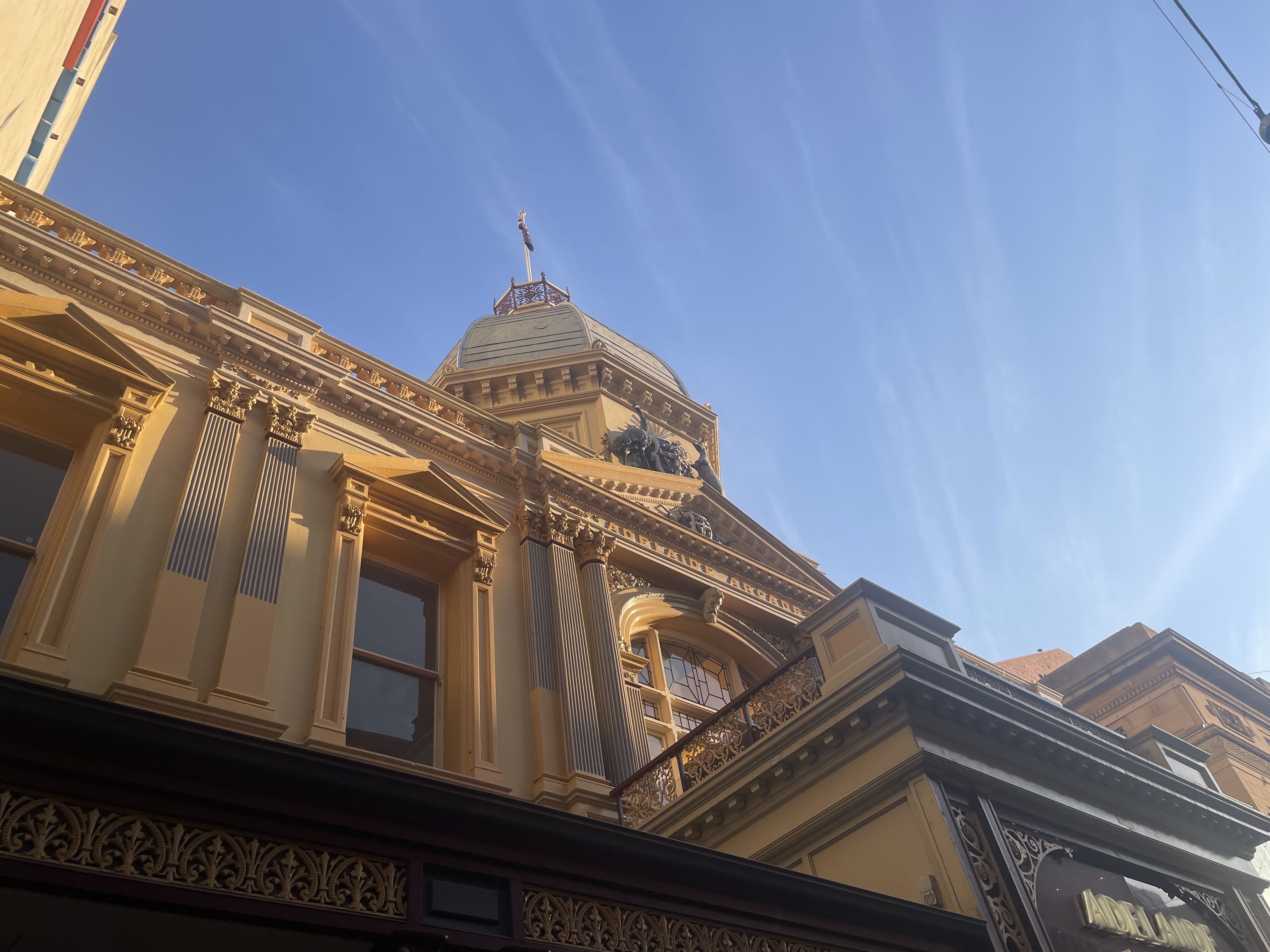
Adelaide Arcade, Rundle Street Mall, 2023. Photographer: Nicole Davis

Last October I travelled to Adelaide for research as one of the fortunate recipients of a 2023 Jack Cross Fellowship from the Friends of South Australia’s Archives (alongside Robyn Dunlop from University of Newcastle). The organisation inaugurated the fellowship in 2022 in honour of Jack Cross, their longest-serving President. This post is an edited version of the article I wrote for their December 2023 newsletter, which explained that the ‘Fellowships are awarded annually to support researchers of South Australian history to pursue research in archives, with a focus on the use of South Australian resources.’

Architectural Plan for Adelaide Arcade, 1885, Withall & Wells Architects. State Library of South Australia, PRG 1431/1/2

As part of my 2022 thesis on Australia’s nineteenth-century arcades, I did some extensive research into these buildings but in-person archival research was stymied by COVID-19. The generosity of the FSAA gave me the opportunity to begin to undertake an initial scoping visit, which will add nuance to the book I’m writing based on my thesis.

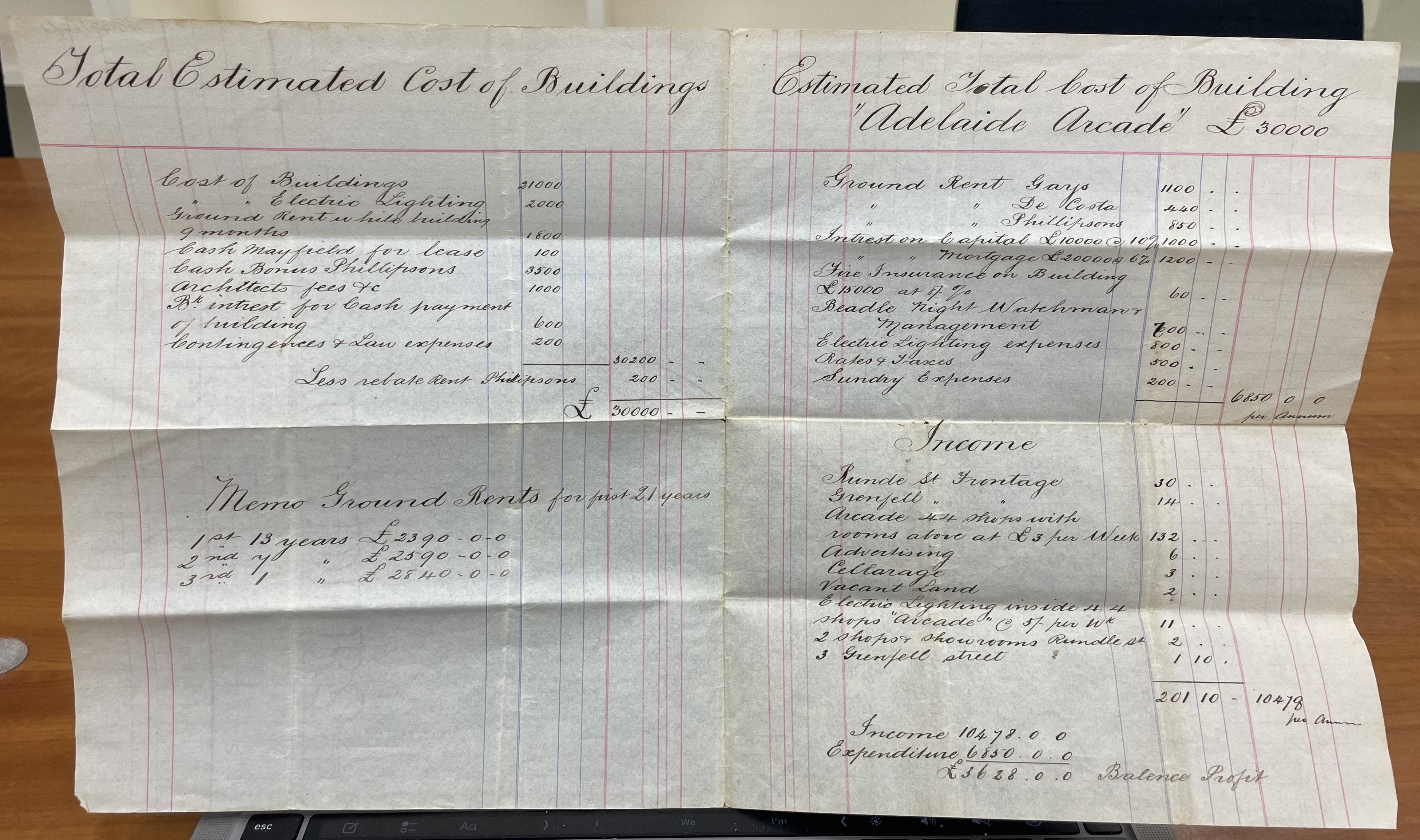
 Cost sheet for Adelaide Arcade, with estimate of total cost of buildings (30,000 pounds), with price of fixtures, architectural fees and estimates of rent, 1885. State Library South Australia, PRG 1431/2/1

During the visit I examined the resources available in some of the Adelaide archives, which will allow me to further explore the histories of this site and those who were connected with it – architects and owners, shopkeepers and workers, shoppers, and other visitors – during the nineteenth and early twentieth centuries, as well as its businesses and the goods and services traded within. 


Cash books relating to the management of Adelaide Arcade by Bullock & Wilkinson, Land Agents, 1924–1927. State Library of South Australia, BRG 64/23/1 & 2

Although this was intended as a scoping visit, it was a very fruitful and yielded a rich range of material. I spent a week in Adelaide, visiting State Library South Australia, the City Archives, the Architecture Museum at University of South Australia, and special collections at University of Adelaide. During my visit, I was able to digitise a large amount of primary manuscript and published material relating to the long history of the sites, including original plans, images, letters, and other sources not available online. I also accessed a wide range of publications from the twentieth century to today that revealed the importance of this heritage site to Adelaide, its history, and present day placemaking.

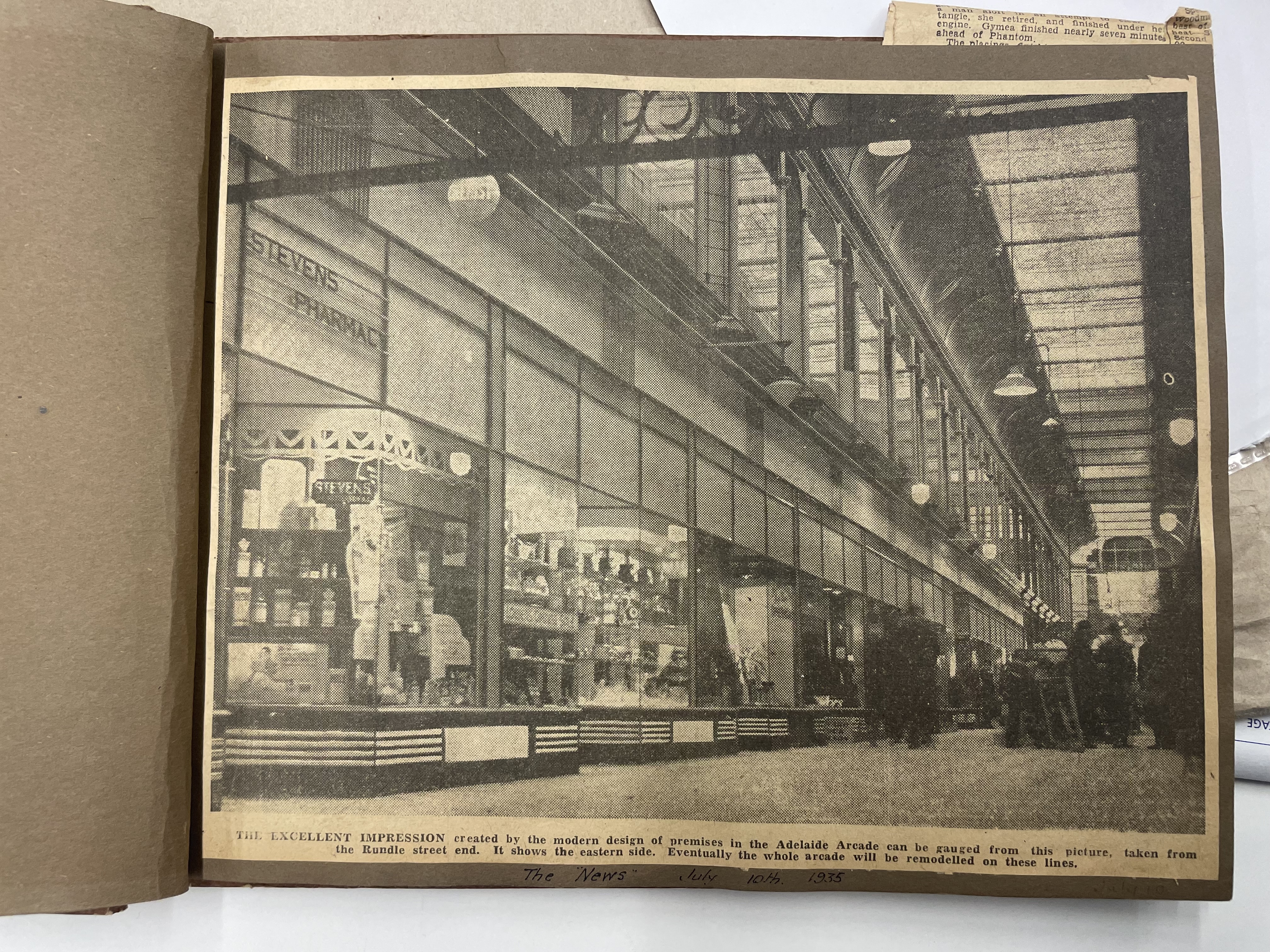
Newsclippings from The News, 10 July 1935, showing impression of the proposed remodel of the Adelaide Arcade, with new shopfronts replacing the nineteenth-century originals. Architecture Museum, University of South Australia, GRIGGS, Harold Thomas COLLECTION S167/4241

Although time did not permit me to visit State Records South Australia, I plan to return in 2024 to examine their small collection of related records, as well as to delve further into the City Archives, which has a large amount of material but requires some intensive investigation and sifting through indexes and boxes to find the relevant information. Also, the National Trust of South Australia, while they did not have any records of relevance, suggested that I visit the South Australian Heritage Council, which will also be in the plan for next visit.

Objects in the museum, Adelaide Arcade, 2023. Photographer: Nicole Davis

Two other valuable contributions arose from the work. The first was the ability to (finally!) visit the arcades in-person for the first time since the very beginning of my thesis. I closely observed the architectural details, the changes made to the site over the years, and some of the similarities with one of Melbourne’s (sadly demolished) arcades, the Eastern on Bourke Street. Experiencing the site in person provided a more complex understanding of its place in the city and also allowed me to view the museum, which has printed material and objects related to the arcade, the latter of which are often very difficult to find or identify.

Adelaide Arcade viewed from upper level at Rundle Street end, c1885 (probably opening day, 12 December 1885). The man at right is likely the Arcade’s caretaker, Francis Cluney, who died in 1887 in the arcade in an industrial accident. Photographer: Samuel White Sweet (arcade tenant). State Library South Australia, B7496
Central promenade of Adelaide Arcade, 2023. Note the gallery/balcony, added during renovations during the 1960s. Photographer: Nicole Davis

It was also great to see what shops are there today and notice the people enjoying the building. Secondly, I met library and archives staff who were wholly generous with their time, expertise, and knowledge of the city. They picked out material and publications for me to view that I hadn’t already identified and were really valuable to the research. It was also really fantastic to immerse myself for almost a week in the lovely city that is Adelaide!

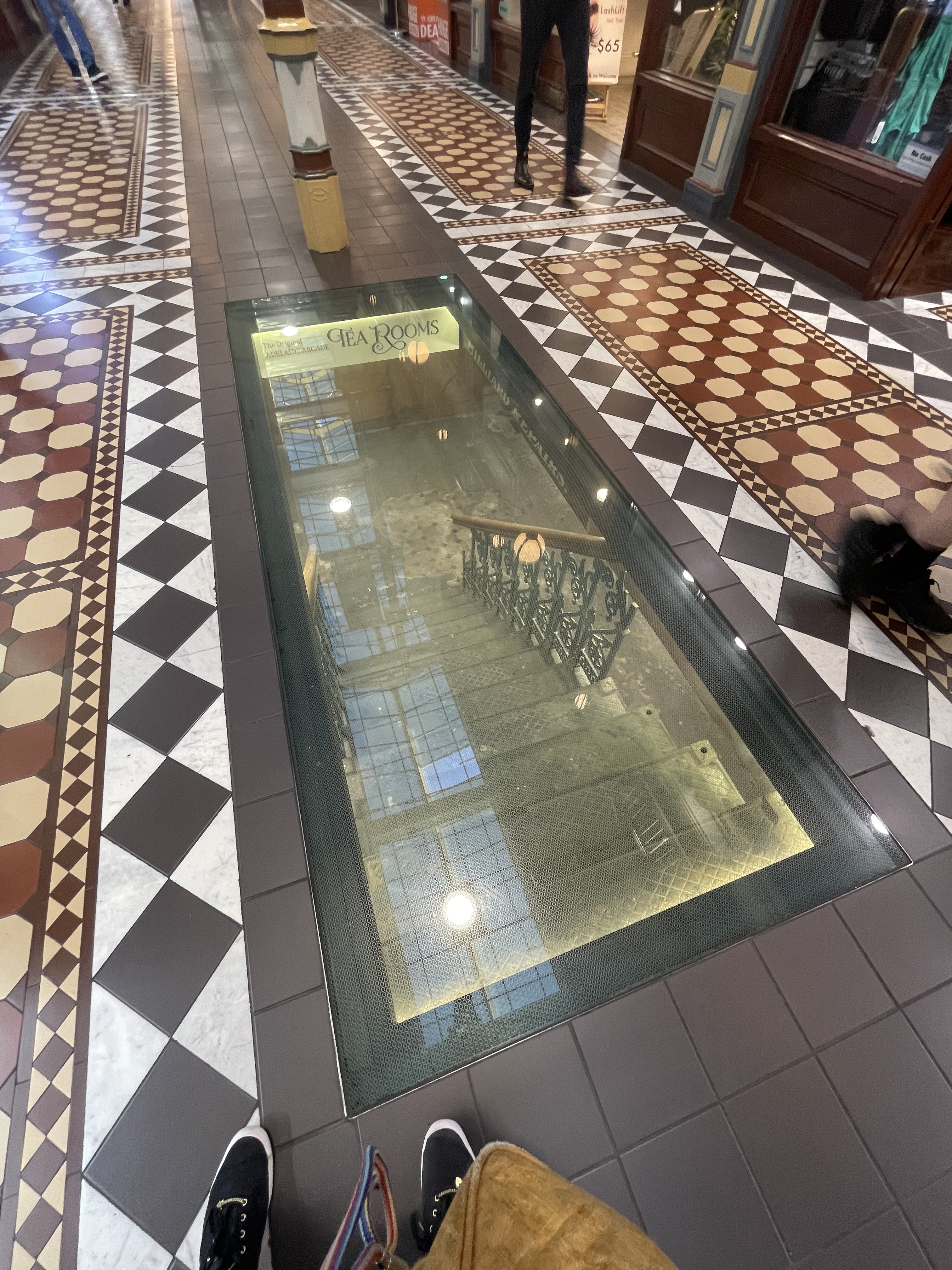
The disused basement, formerly tearooms, still visible through glass, Adelaide Arcade, 2023. Photographer: Nicole Davis

From here, I intend to further explore this topic and analyse the large amount of material that I collected while in Adelaide, which will contribute to my book on Australia’s arcades, as well as an online exhibition and website project that I hope to produce in the next year. The research conducted in Adelaide will also likely provide evidence to support a larger application for funding to delve further into the history of the arcades and the next phase of research to be conducted in 2024.

Adelaide Arcade, Rundle Street Mall, 2023. Photographer: Nicole Davis

I am greatly appreciative to the Friends of South Australia’s Archives for the Jack Cross Fellowship and will keep you up to date with further work on my research and, in the future, you’ll see an article on the arcades and their history right here.

Hi everyone. Well, it’s been a crazy busy few months. When is it not?

So much has happened that I want to quickly tell you about.

Well, I had my first holiday in about five years, when I travelled to Ireland, Scotland and England in July. I mostly did lots of hiking, did some pilgrimages to places where my family emigrated from and looked at many many many museums and built and natural heritage sites, which was really inspiring for my thoughts on, practice in and teaching for that space.

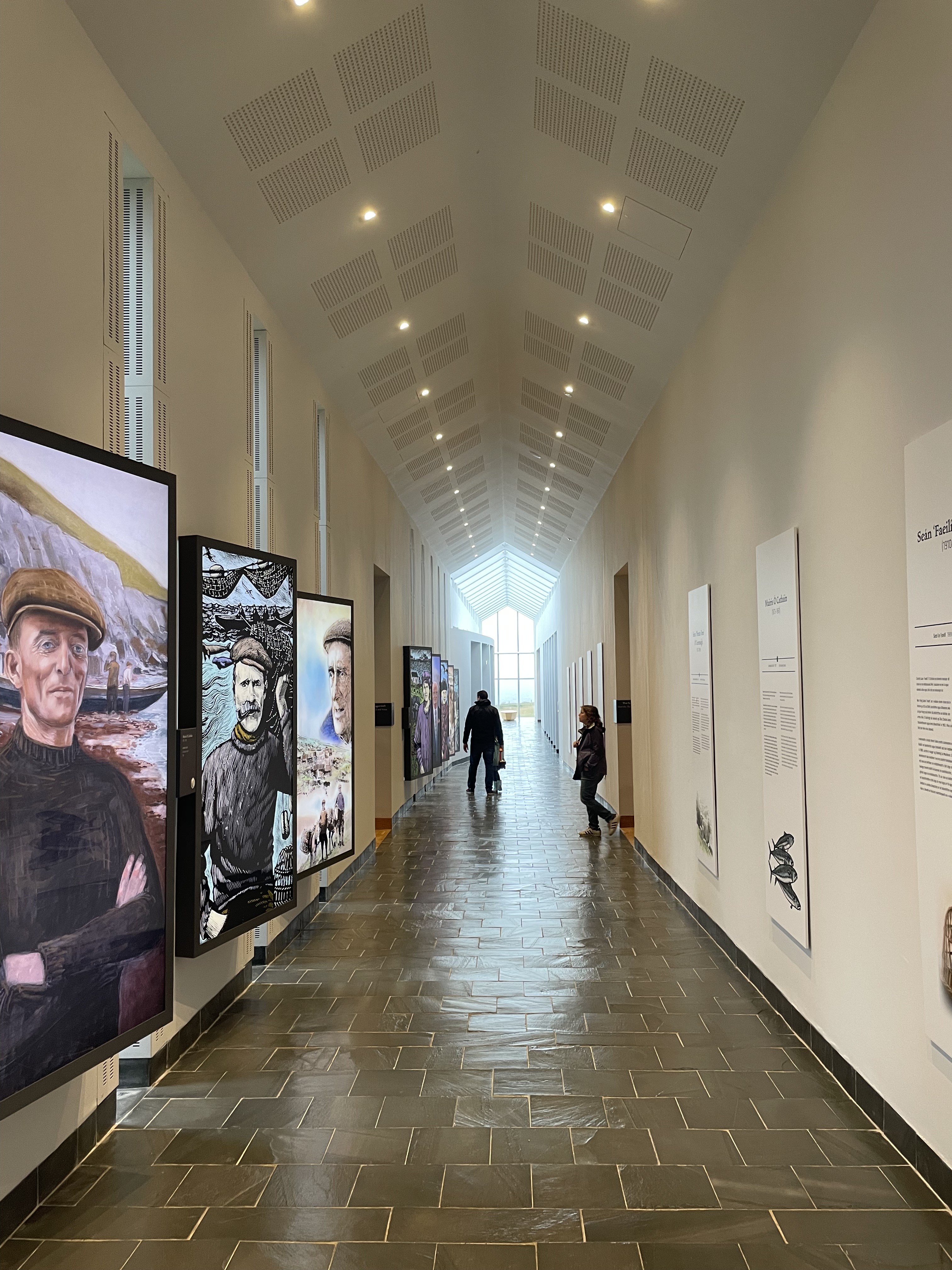
The amazing Great Blasket Centre, a museum in Dingle, Ireland, about the now largely abandoned islands just off the coast. Probably one of my favourite museums ever. So well designed and curated, with stories and objects that really get to your heart, especially if, like me, you have family connections with the region.

I also presented a paper at the fiftieth anniversary conference of the Urban History journal, The State of Urban History: Past, Present, Future, in Leicester. Invited to be part of a panel on Globalising Australian Urban History, I presented some work from my thesis research that didn’t quite make it into the thesis in much detail.

It was fantastic to speak about new work along with other historians of Australian urban landscapes: Simon Sleight, James Lesh, Anna Tenby. Most of us stayed onsite and agreed that it was one of the best conferences we’d been to in a long time. My paper, ‘Arcadian Dreams: Regionalising Australian Urban History’, examined nineteenth-century Australian urbanity through the lens of the arcades, often viewed as a symbol of urban life throughout the globe during this period.

It explored several case studies of these buildings constructed in towns and cities outside the colonial capitals in this era, including their architecture, the shops and other businesses they contained, and the language that surrounded them in print media. I ask in it if, by looking at and comparing these sites across the regional/metropolitan divide, we can gain a better and more nuanced understanding of what it meant to live and be urban in nineteenth-century Australia. 

Inside courtyard of Leicester’s wonderful fourteenth-century Guildhall

After the conference we also got to have a little tour around Leicester on the final day and see their amazing fourteenth-century Guildhall (and the carpark where Richard III’s remains were found, which is a site of pilgrimage itself). After that, I had a well-deserved six weeks off and largely spent my time hiking in the Scottish Highlands, followed by a few days in London, and one little visit to the archives in Bedford to research for a paper I’m giving in October.

The luckiest shot ever. Torridon Estate, a National Trust for Scotland natural heritage site. There is a deer park and museum there but this was in a random carpark I pulled in to so I could take a photo of the mountains. This deer was VERY comfortable with cars and people!
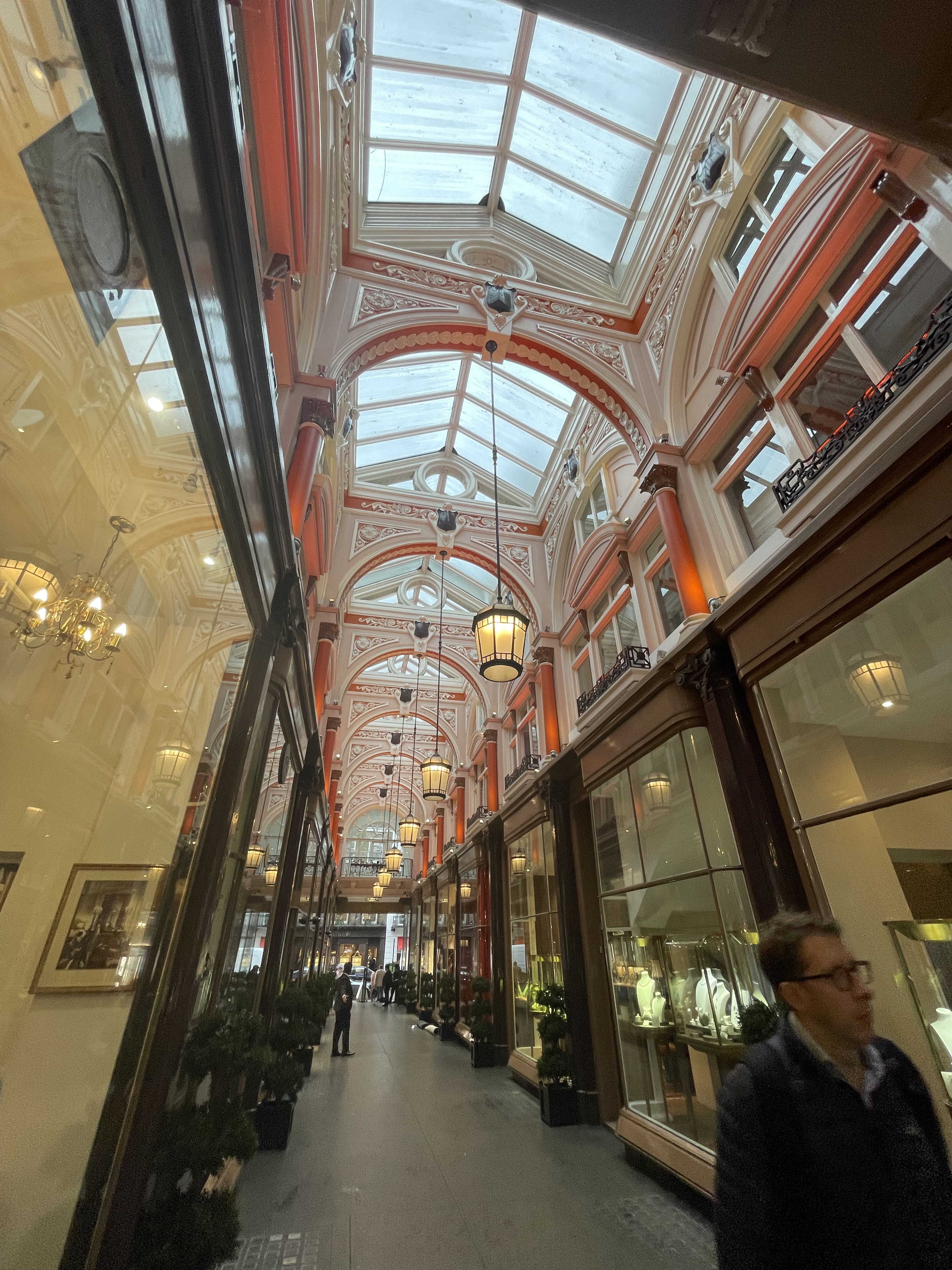
The fabulous 1879 Royal Arcade in London. Less well-known than the nearby and much older Burlington, it’s nevertheless also spectacular and really reminds me of some of the aspects of both the Block and Royal in Melbourne

In August I also presented a longer version of the Leicester paper for the University of Melbourne, School of Historical & Philosophical Studies Brown Bag Seminar Series, and am currently working on it for a journal submission. I also presented a new paper in September, ‘One of the Sights of the Colony: Australian Ninteenth-Century Arcades’, at the European Association for Urban History Online Symposium, Exchanges: European Cities and the Wider Urban World. Based on one of my thesis chapters, this is coming out soon as an article in the History of Retailing and Consumption journal special issue on Australian retail history. It looks at how the arcades were represented in the print media in the nineteenth-century as sites of progress and civilisation in settler colonial Australia.

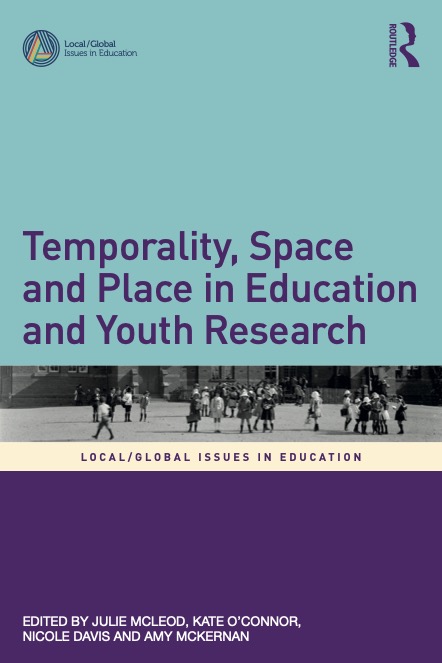
In other exciting news, at the end of June, Temporality, Space and Place in Education and Youth Research, a co-edited collection, produced with Julie McLeod, Kate O’Connor and Amy McKernan, released! A fantastic group of articles from scholars globally, ‘it explores the everyday ways in which time marks the experience of education as well as the concerns and methods of education and youth research’. We are having a launch on 26 October in Melbourne and would love to see you there. Details and bookings can be found on Eventbrite.

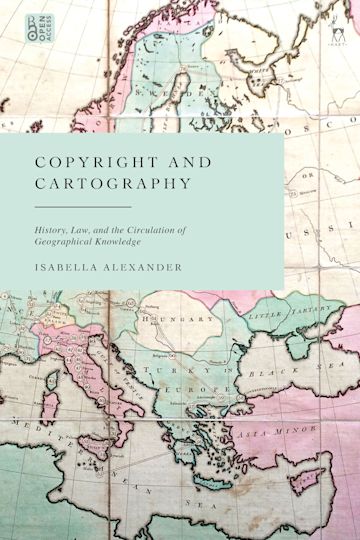
In the same month, a project that for which I was a research assistant, including deciphering the handwriting of some early nineteenth-century clerks in the Ordnance Survey Offices, culminated in a book publication. Isabella Alexander’s Copyright and Cartography: History, Law & the Circulation of Knowledge ‘explores the intertwined histories of mapmaking and copyright law in Britain from the early modern period up to World War 1, focusing chiefly on the 18th and 19th centuries’. I also did the copyedits for this publication and it was such a pleasure to see it come to fruition after being involved with it for several years.

The biggest news though, is probably, GRADUATION! That’s right. All that hard work culminated in a fantastic ceremony at the Royal Exhibition Building in Melbourne, where I got to wear the funny hat and celebrate with friends and family. It was really quite special not only graduating but in a building that is intimately related to the topic of my thesis on the arcades.

On that note, signing off for now! I’ll have some actual history writing on the arcades for you very very soon.


Feature image: Night of the referendum on Federation of Australia, Charters Towers, 1900, with Royal Arcade at far left. Marion Photos. State Library of Queensland, Negative number: 25141

Feature image: celebrating 130 years of the Block Arcade, while lining up to buy Easter treats at Haighs, April 2023

The blog is back! I’ve been on hiatus for the past couple of years with posting to the blog and working on the website. Like everyone, I’ve had a crazy ride since the last time I posted here. So what’s been happening? Here’s a quick rundown, along with some photos of life over the last few years.

In March 2020, I was living in Thailand where I’d been living since late 2019 and expecting to stay for another six months. My thesis writing was going really well and I’d expected to finish it in the time I had left in Thailand. But, in the end, I rushed back to Australia on the last day that Singapore Airport was open before COVID-19 closures.

My office view on Koh Phangan in 2019. It was tough, I’m telling you!
My 2020 office view in Melbourne during my quarantine. This doesn’t show the bed taking up most of the rest of the room 😀

Over the next two years I kept working on the thesis in lockdown in Melbourne while doing other history projects, having a part-time university job, and doing some university marking. We moved twice from a tiny one bedroom into ultimately a two bed plus study, where we both had a study to do our online teaching/meetings and work-from-home. Having an outdoor space finally after years also meant LOTS of pandemic-gardening-PhD-procrastination times!

In 2022, when everyone was slowly emerging from lockdowns, I was still hunkered down finishing the thesis. I did my completion seminar (sort of like a viver or defence but less scary I think!) in May, which went really really well (I might post the text of that sometime soon). Then in July I went to a big in-person history conference, caught up with friends, and promptly caught COVID.

A bit of a holiday from thesis writing. The Australian Historical Association Conference 22 in Geelong. Which was fabulous but ended up giving me COVID 😀
A quick whip through the Sydney Arcades on a last-minute research trip in November 2022. This is the Queen Victoria Building, ostensibly built as a ‘market’ in 1898, but always intended as a grand arcade.

Despite it really knocking me around, I spent the next six months working hard and finishing my thesis, which I handed in on 14 December! It was such an amazing feeling after all that time working on it. While I hadn’t and still haven’t lost passion for the subject itself, I was very keen to be actually finished the thesis. It was so amazing to have a Christmas break without working on (or feeling guilty about not working on) my thesis.

So, in early March, after less than three months, I got the results back as a pass with no changes! Though I did have to do some typo corrections and proofs, there were no substantive changes to the content. This is so pleasing when you know, yes, you’ve done a good job, but your examiners might feel you need to do a bit more.

Exhausted but happy after thesis submission on 14 December. I’d had about six hours sleep in 48 hours at this point. I also couldn’t stand my office anymore so moved into the loungeroom for the final couple of weeks. This image largely hides the mess!
Getting to enjoy the Brunello my parents bought in 2007 and saved for my PhD graduation. It was sublime. So amazing to actually fully enjoy Christmas with my thesis out of the way.

In early April, I got the okay to submit the final version to our university repository and the thesis should be conferred (I officially became a Doctor of Philosophy) in mid- to late May. My graduation’s likely set for early August and I can’t wait to wear the funny hat 😀 Meanwhile, I’m heading off to the UK to be on a panel at the Journal of Urban History 50th anniversary conference in July and then head to some archives for research in England and Scotland, with a quick side trip to Ireland.

Depositing the final version of the thesis in April 2023.
Urban wanderings in Sydney again after the final version submission, April 2023. QVB featuring again, together with the new Sydney trams/light rail.

This blog is going to be more regularly update from now on with topics from the thesis and things that I didn’t really get to go into much detail on or had to leave out all together due to work length, including more biographies; individual histories of arcade buildings; some reminiscences from the experience of thesis writing and research; and more discussion on what was sold in the arcade shops and the experiences of those that worked and visited. I’ll be redesigning the site and hopefully adding some sort of virtual exhibition space, as well as digital humanities/visualisation work that I’d like to do in the coming year.

Please keep posting comments and tell me more about what you’d like to learn on the site.

And don’t forget to follow me on Instagram and Facebook, as well as taking note of my business website, Epigraphein, where I offer professional history research and writing, editing and proofing..

So stay tuned and glad to be back!


Feature image: celebrating 130 years of the Block Arcade, while lining up to buy Easter treats at Haighs, April 2023

I’m doing a LOT of travelling as part of my research for my thesis. Recently, I did a trip to Queensland to look at the history of the nineteenth century arcades there. It was a fruitful journey that answered a number of questions that couldn’t be resolved through online research.

It allowed me to visit the sites & understand their location and placement within the cityscape of both the nineteenth century & today, and I also collected reams of information, images, plans, maps, directories, council records and other resources that will assist with my research.

Additionally I was able to gain valuable information through direct contact with the staff of the archives and libraries there that yielded some revelations. Some of the information was contextual and this was vital. Despite growing up in Brisbane, I knew comparatively little about its history compared to Sydney & Melbourne, as that has been  where my history and heritage work has focused up until recently.

There were four arcades constructed in Queensland prior to 1901 – while I say nineteenth-century a lot,  my study actually extends to 1901, in order for me to consider one of these specific Queensland sites, constructed in the year of Federation and on the cusp of the new century that brought great changes to the Australian urban landscape.

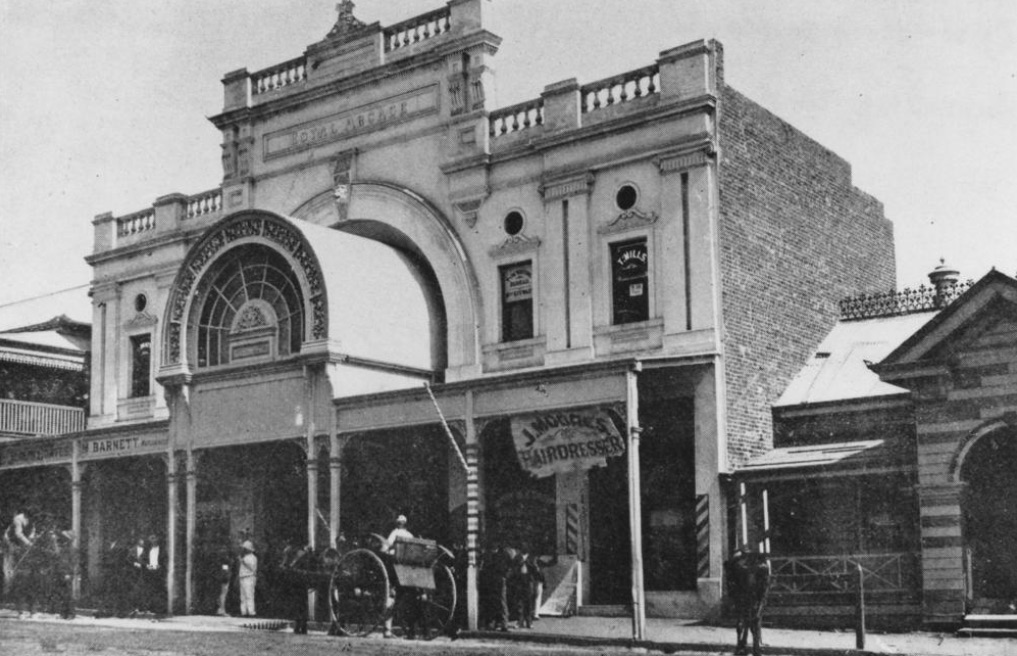
Two were constructed in Brisbane and both were the brainwave of enterprising businessman Henry Morwitch, who lived a truly international life throughout the British Empire and beyond. Born in Poland, he migrated to England, then Victoria, followed by New Zealand, back over to Brisbane (with a sojourn in Gympie), then to Sydney and, at the end of his life, returning to Britain. His two arcades were built on the busiest commercial street in Brisbane, Queen Street, in close proximity to each other.

These were the Royal Exhibition Arcade, constructed in 1877 and demolished in the years around World War I, and the Grand Arcade (fronting Queen and Edward Streets), built in 1885 and demolished in parts between the mid 1920s to late 1930s.

Picture1.png
Grand Arcade (front right) & Royal Exhibition Arcade (fourth building from rh corner), both featuring wrought iron verandahs, Queen Street, Brisbane, c1908, State Library Queensland.

Both sites are now taken up by commercial buildings featuring similar tenants, although certainly on a different scale. The Royal Exhibition Arcade was on the site of Macarthur Central, a large, recently constructed, shopping centre with diverse shops and eateries. As for the Grand, the Tattersall’s Arcade, part of the Tattersall’s Club buildings constructed between World Wars I and II, sits on the exact footprint of the Grand Arcade.

Macarthur Central, 255 Queen Street Brisbane. Site of the Royal Exhibition Arcade. Nicole Davis, 2014. Macarthur Central, site of the Royal Exhibition Arcade & several other buildings, 255 Queen Street Brisbane. Site of the Royal Exhibition Arcade. Nicole Davis, 2014.

The other two arcades that were built in Queensland were in seemingly unlikely locations, but at the time of their construction represented the progress and modernity of two regional towns that were booming, both economically and in terms of population.

The first was constructed in Charters Towers, nearly 1400 km from Brisbane, in the mining country of Far North Queensland. In 1888 the town was a city with a rapidly expanding population, drawn by rich lure of its gold discoveries and usurping the land of its traditional owners. By 1899 it had a population of 25,000 and was one of the biggest cities in the Australian colonies.

Entrepreneurs in Charters Towers used the gold wealth to create a European-style city, commissioning architects, often from the cities of Brisbane, Sydney and Melbourne, to design buildings in the manner of the high boom metropolises far to the south. One of these was the Royal Arcade, today known as the Stock Exchange Arcade, constructed in 1888 for businessman Alexander Malcolm and designed by Sydney architect Mark Cooper Day. It was never completely finished due to Malcolm becoming insolvent, and today the back remains open to the land and laneway at the rear. It’s the only remaining arcade from the nineteenth century in Queensland and both it and the town, with its mining history and several heritage sites, are fantastic spots to visit.

Screen Shot 2018-11-01 at 1.26.52 pm
Charters Towers Stock Exchange building (former Royal Arcade), c1890. Photographer unknown. State Library Queensland

The last site I visited was in Townsville, 140 km east of Charters Towers on the coast. It’s a quite expansive city of 170,000 people. In 1901, the year of Federation, the Earl of Hopetoun, first Governor-General of Australia, opened the large municipal civic buildings constructed on Flinders Street. The structure, which took up a significant section of the block, included a Town Hall, a theatre, a licensed hotel, a market and a shopping arcade.

Unfortunately, not much survives in records nor in the collective memory about this arcade and before I arrived I doubted that it even was a real arcade in the sense that I was defining them. But I found some tantalising evidence in the Townsville City Library that did confirm it was an ‘authentic’ shopping arcade. This photocopy of a cross-section came from the original plans, which certainly existed in the 1990s, but now appear to be lost.

This amazing collection of buildings, built during a period of intense change for Australia, were unfortunately destroyed by fire in 1978 and today, the current municipal buildings, a typical example of 1980s civic architecture, stand in its place.

Despite the fact that the majority of these arcades no longer exists, seeing the sites on which they stood (and still stand, in the case of the Royal Arcade), allowed me to better understand their placement within the urban environment that no amount of looking at images or maps can provide. I also feel much more illuminated as to their place within the history of the cities in which they were built and the overarching historical narrative of those places.

The experience of road tripping to Charters Towers in particularly was fascinating as the bitumen road from tropical seaside Townsville took me to the dry almost outback of western Queensland and allowed me to understand the true feat of what was constructed in this now small town in the last decades of the nineteenth century.

I’m currently collating all the material and information gathered and this will figure in a longer case study of specific arcades that will contribute to my thesis.

This trip was made possibly by a Graduate Research Arts Travel Scholarship from the University of Melbourne. Lastly, a big shout out to those who assisted so much in my research on this whirlwind two week trip:

Brisbane City Archives

State Library of Queensland

Trisha Fielding and all the staff at Townsville City Libraries (Trisha, a historian, also has a fantastic North Queensland history blog in which she discusses the Town Hall buildings)

James Cook University Special Collections

Charters Towers & Dalrymple Archives Group, especially archivist and curator, Michael Brumby, who was excessively generous with his time and resources, and was willing to have great long chats about history with me.

Charters Towers Library

National Trust Queensland volunteers at the Stock Exchange Arcade and Zara Clark Museum in Charters Towers and the Hou Wang Temple in Atherton

The Stock Exchange Arcade Gallery (which allowed me to see the upstairs of the Royal Arcade)

And to the Royal Hotel and the Stock Exchange Arcade Cafe in Charters Towers, for giving me a luxurious place to lay my head and excellent coffee to fortify me!