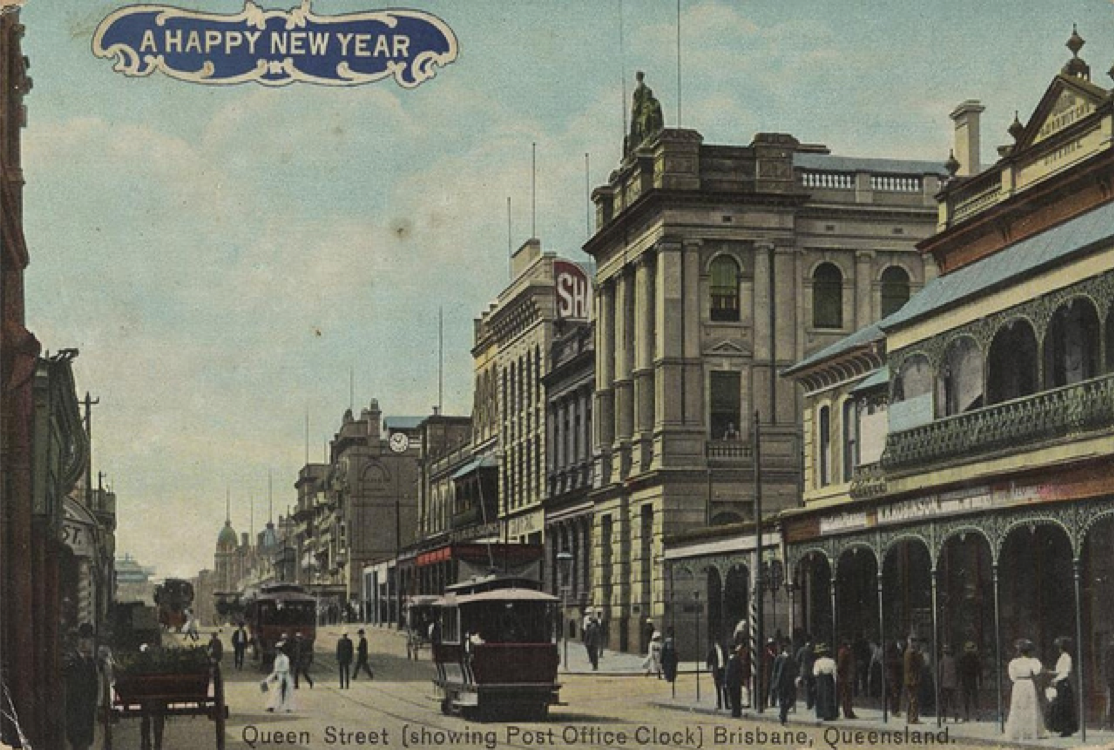
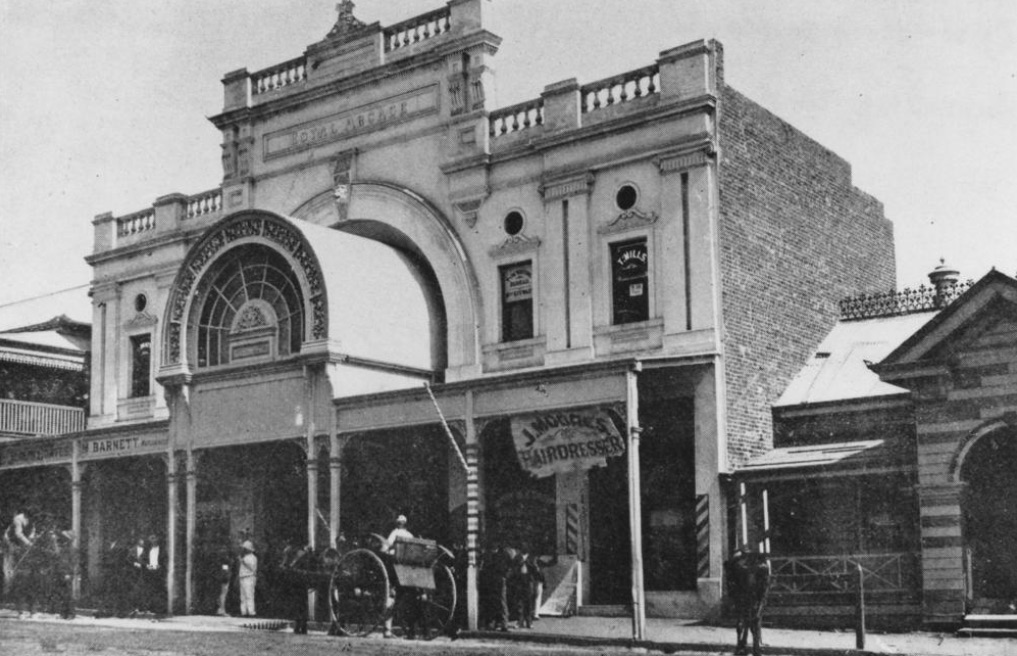
Brisbane Arcade, Queen Street Entrance, 2023. Photographer: Nicole Davis

This year the wonderful Brisbane Arcade celebrates the 100th anniversary of its opening!

In February 1924 Brisbane’s Daily Mail celebrated the progress of the city through the many new buildings constructed over the previous 12 months. Only five years after the end of World War I, the enthusiasm for improvement, demolition of the old city and construction of the new was felt throughout Australia.

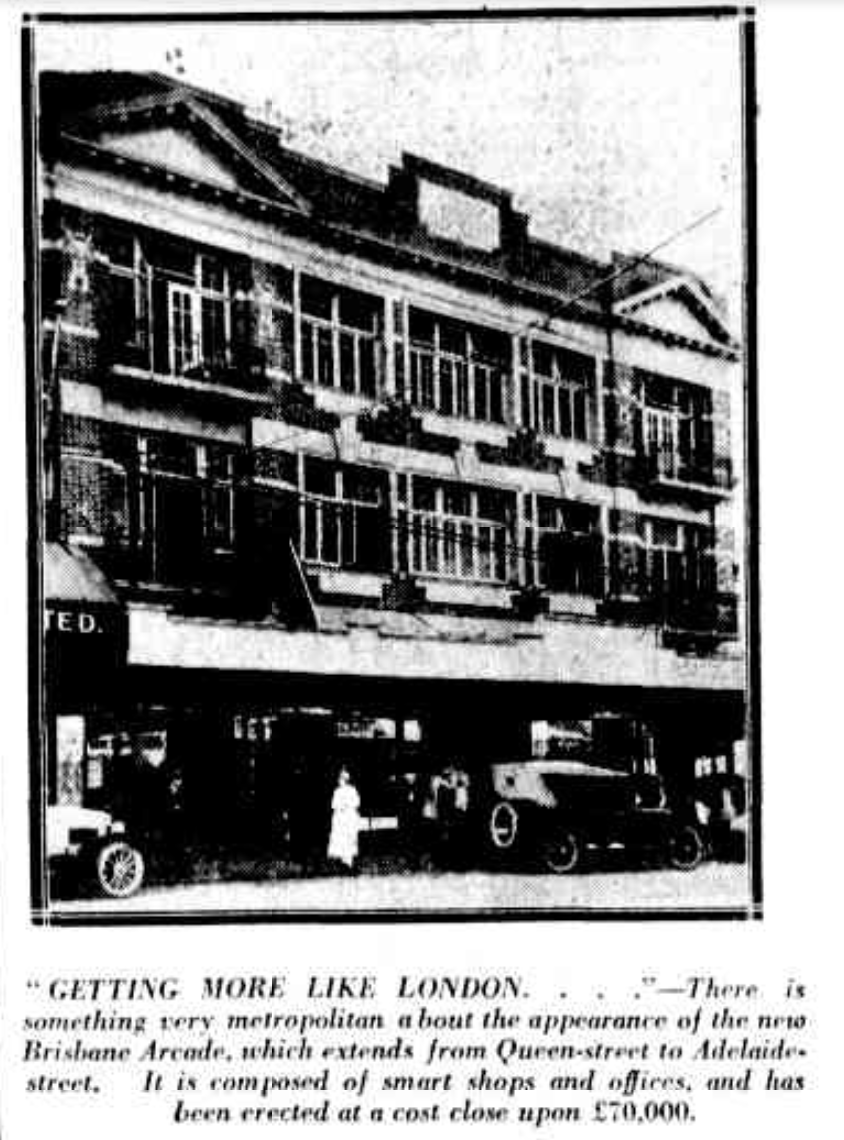
In Brisbane, this included the new Brisbane Arcade ‘of brick, with modern shops and plate-glass windows, this is considered equal to the best Sydney and Melbourne arcades, … [which] cost close upon £70,000’ (5 February 1924, 11).

A similar refrain to stories written for seventy years about arcades in Australia – comparing them to those in Britain, Europe and the United States and equating them with urban progress – is to be found in the stories surrounding this new example:

The arcade, leading from Queen to Adelaide streets, is an attractive addition to the city’s architecture. Arcades are a feature of most large American, Continental and English cities—the one now in the course of construction may one day become the Burlington of Brisbane.

Daily Standard, 3 January 1924, 7.
The Brisbane Arcade has delighted generations of Brisbane residents and visitors throughout the years. I remember walking through as a young child, thinking what a magical place it seemed to me – particularly the Darrell Lea chocolate shop!

As a teenager, it became a regular thoroughfare as I made my way to meet friends at the Hungry Jacks on the corner of Queen and Albert Streets (the regular meeting spot for generations of Brisbane kids). When I started my first job – Bookworld in the Myer Centre – at the age of 16, it again became my route to and from Central Station. It always seemed quite glam and very expensive at that time in my life but still endlessly fascinating.

Being originally an ancient historian, I sadly didn’t pay much attention to Brisbane’s heritage buildings until a few years after I moved to Sydney and morphed into a museum professional working in Australian history and heritage. It once again became a site that I visited and wandered, now taking more scholarly notice of its architecture and stories.

My PhD thesis on Australian arcades was originally planned to look at those built into the 1920s, including this wonderful arcade, the Johnston Arcade in Terang, Victoria, and the many examples built in regional towns in the early twentieth century. But the sheer proliferation of arcades built in this period meant I had to restrict my study to the five decades from 1853 (the first arcade built in Australia) to 1901 (the year of Federation).

Despite having to move away from this period, I still wanted to hear more about the stories of this building, which has always been a special place for me. This year I’m able to do that, as a Griffith University Harry Gentle Resource Centre Visiting Fellow. After a bit of a hiccupy start to the research a couple of months ago, I’m back in Brisbane beginning the project in earnest.

Group of women modelling fashions from Paul’s millinery, Brisbane Arcade, at race day fashions at Ascot races, Brisbane, 1935. Photograph: The Queenslander, 6 June 1935. State Library Queensland, Neg: 191045

The work focuses on women business owners who occupied shops in the nineteenth-century Queensland arcades, focusing on businesses present from the 1870s to 1920s. I’m hoping to uncover the histories of these women: where they came from, how they financed their businesses, what motivated them to open their own establishment, what the experience was like for them, where they got their stock from, the networks they leveraged to do all of this, what happened to them after they left the arcades and, generally, to bring their stories to a broad audience.

At the end of the research, there’ll be a public talk, a website, a journal article, and a couple of conference presentations, all talking about these women. It will also contribute to a chapter in the book I’m writing based on my PhD thesis.

Brisbane Arcade was in fact built nearly 50 years after the city’s first example, the Royal Exhibition Arcade, down the road on Queen Street, and its successor, the 1885 Grand, straddling the corner of Queen and Edward streets (Tattersalls Arcade today sits on its footprint). Also earlier in Far North Queensland were the Royal Arcade in Charters Towers, built in 1888, and the 1901 arcade built as part of the Townsville Municipal Council buildings in 1901. For more on these earlier arcades, you can see my discussion of them in some earlier blog posts.

While I’m technically not researching the 1920s arcades, I likely will research the Brisbane Arcade for the project because I’d really like to compare both the usage and representation of this arcade with its nineteenth-century predecessors. We’ve already seen above in the list of store owners, many more shops aimed at women customers than those earlier examples. I also suspect when I look at the percentages, there will be a greater number of women owners as well. Many of those discussed above were at least run by women and there is a high likelihood many were owned by them as well.

With the 100th Anniversary celebrations, this week seemed an auspicious time to start on my research, and I’ve done a little on the Brisbane Arcade over the past few days, looking at newspapers and other sources.

Like a number of earlier examples, the Brisbane Arcade had a woman owner: Mary Emilia Mayne and her brother, Dr James Mayne, commissioned architect Richard Gailey Jr to design the building, with construction beginning in 1923. The Maynes were significant benefactors in Brisbane, helping to establish the University of Queensland Medical School at Herston and, in 1926, the land at St Lucia, where the main university campus is still located today. On their deaths, in 1940 and 1939 respectively, they left the proceeds of their estates in trust for the medical school, including the income from the arcade.

Mary Emilia Mayne, 1890 [1870s?]. University of Queensland Archives, S908 p541

Nearly two months after that first article in the Daily Mail, the same newspaper informed their reader about some of the businesses about to open there (30 March 1924, 6). These included a wide variety of women’s clothes and accessories shops such as the Arcadia Shoe Salon; Myrtle Power Salon, selling frocks and table linens; Luxor Shoe Store; Miss Morrie McLoughlin, who sold frocks and gowns; Dulcie Decor’s frocks and wraps; Frank Brennan and Miss Brennan, tailoring and ready-to-wear for women; Jenny Salon, run by Esme Davis [or Davies], high-class costumier; SB Heiser, fine jewellery; Searl’s, ‘well-known Sydney florists’; The Women’s Exchange, with knickknacks and lingerie; and Britton and Williams Cutlery Co.

Unlike the arcades of the nineteenth-century, which aimed at a diversity of businesses to attract both women and men, the Brisbane Arcade seems to have focused quite closely on shops that would attract women clientele.

There is a distinct divide in the March article between the relatively feminine boutiques and the seemingly more masculine real estate agents and brokers and so forth. This may have reflected the changing idea of who a shopper was expected to be, or who the advertising and retail industries were targeting as their audiences, and the emphasis on shopping as a woman-centric pastime.

Staff behind the counter at George E Adams’s cake shop, Brisbane Arcade, c1938. Photographer unknown. State Library Queensland

Looking at the Wise’s Directory for 1924-5 demonstrates that this article gives a good overview of the tenants, but mainly those on the ground floor. There were several other businesses there also, including refreshment rooms: Mrs Edge’s White Swan Café and a restaurant run by the Misses Alford and Watts.

On the first floor this continued with more dressmakers and similar businesses aimed at women, as well as the workrooms of some of the stores on the ground floor such as those of Jenny Salon and Brennan & Co. However, there were quite a few others that would have attracted male visitors.

These included a number of agents, also listed in the newspaper article, on this level (accessed via the balcony that runs along the entire outline of the void). This included AJ Hoye, estate agent; DB McCullough, real estate; John McCormack, house, land and business agent; and Allsop and Taylor, real estate. Also to be found upstairs were Cranfield’s Sports Depot, the Committee of Direction of Fruit Marketing, the Queensland Lawn Tennis Association, the Financial Aid Co and a number of (likely men’s) tailors on the first and second floors.

It seems then that there was an apparent spatial divide along gender lines in the building, at least initially. The ground floor was largely aimed at women clientele or more ‘feminine’ pursuits and interests, while the upstairs tenancies were those more traditionally associated with males or a mixed clientele. This is not to say that men didn’t accompany their female relatives to downstairs stores or food outlets, but that the division of interests by gender was apparent.

Of relevance to my current research project, one noticeable difference between nineteenth-century arcades and the Brisbane Arcade appears to be the real shift in gender balance of those running businesses. Here we see an overwhelming majority are run by women, unusual for the arcades of the previous century, particularly those in Brisbane. We do see women-run businesses to varying degrees in those earlier arcades, but they are by no means in the majority and, in Brisbane, there are in fact far more men listed as tenants.
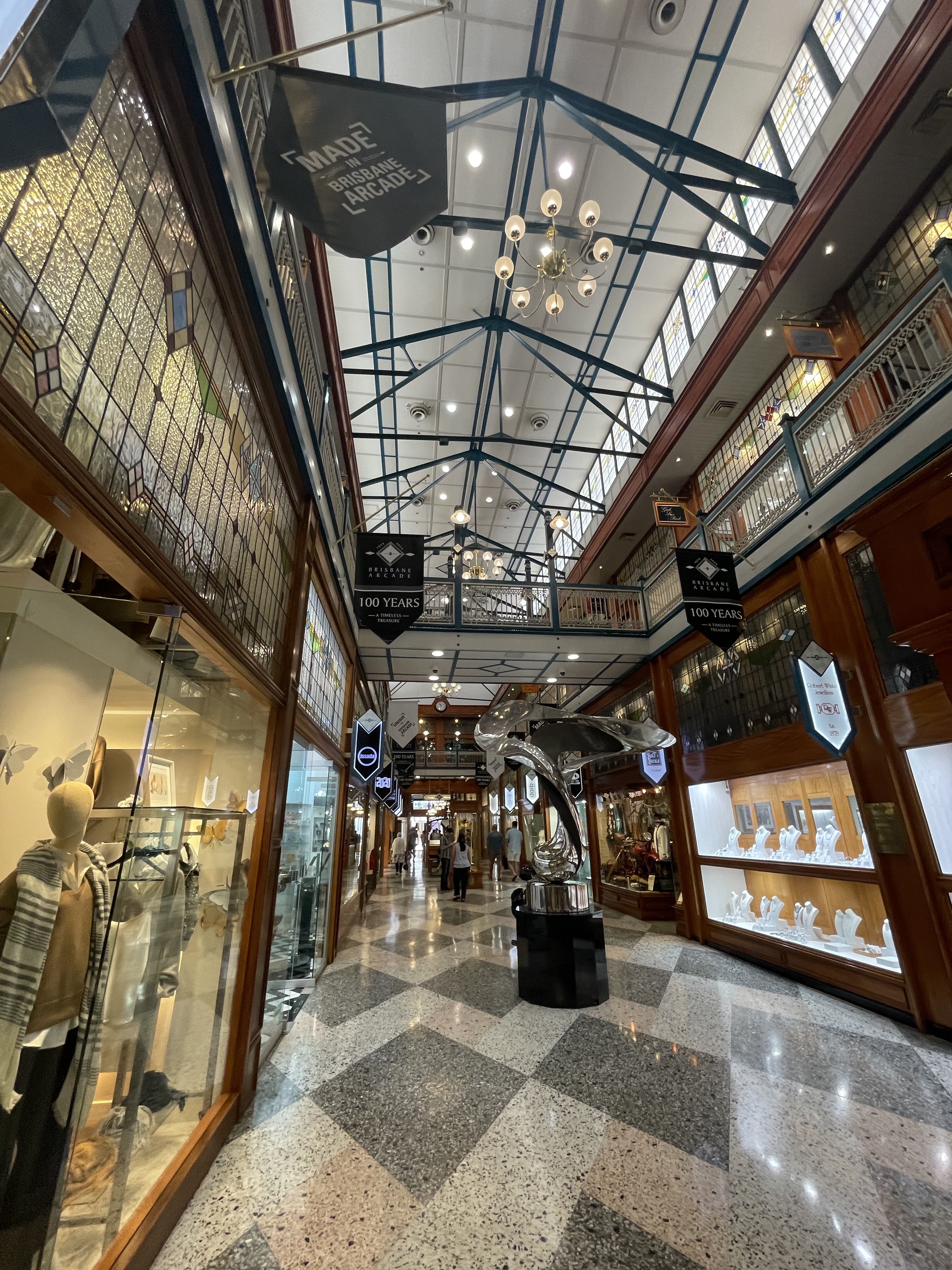
Brisbane Arcade, interior, 2024. Photographer: Nicole Davis

I’m looking forward to exploring more about these changes over time, and when, where and why differences might occur, including looking through newspapers and perhaps business records of shops or business associations, when I can find them.

For the next fortnight, I’m working in the State Library of Queensland and the Queensland State Archives to start to unpack the stories of the Queensland arcades and their businesswomen and I’m very excited to bring you along with me on this research journey. I’ll be posting on my Instagram a bit along the way, so please join me!

Meanwhile, there is loads of stuff happening to celebrate the Brisbane Arcade’s 100th birthday. They have a great range of historical stories about the building on their website, including visitors’ memories of the arcade over the years. This Friday, 19 April, will see a special celebration on the Queen Street Mall, outside the building, with a radio broadcast, special gifts, entertainment, cake (!) and more during the day to celebrate the occasion.

You’ll definitely see me there and, while Darrell Lea is sadly gone, I’ll be stopping by their successor, the Noosa Chocolate Factory. Yum!
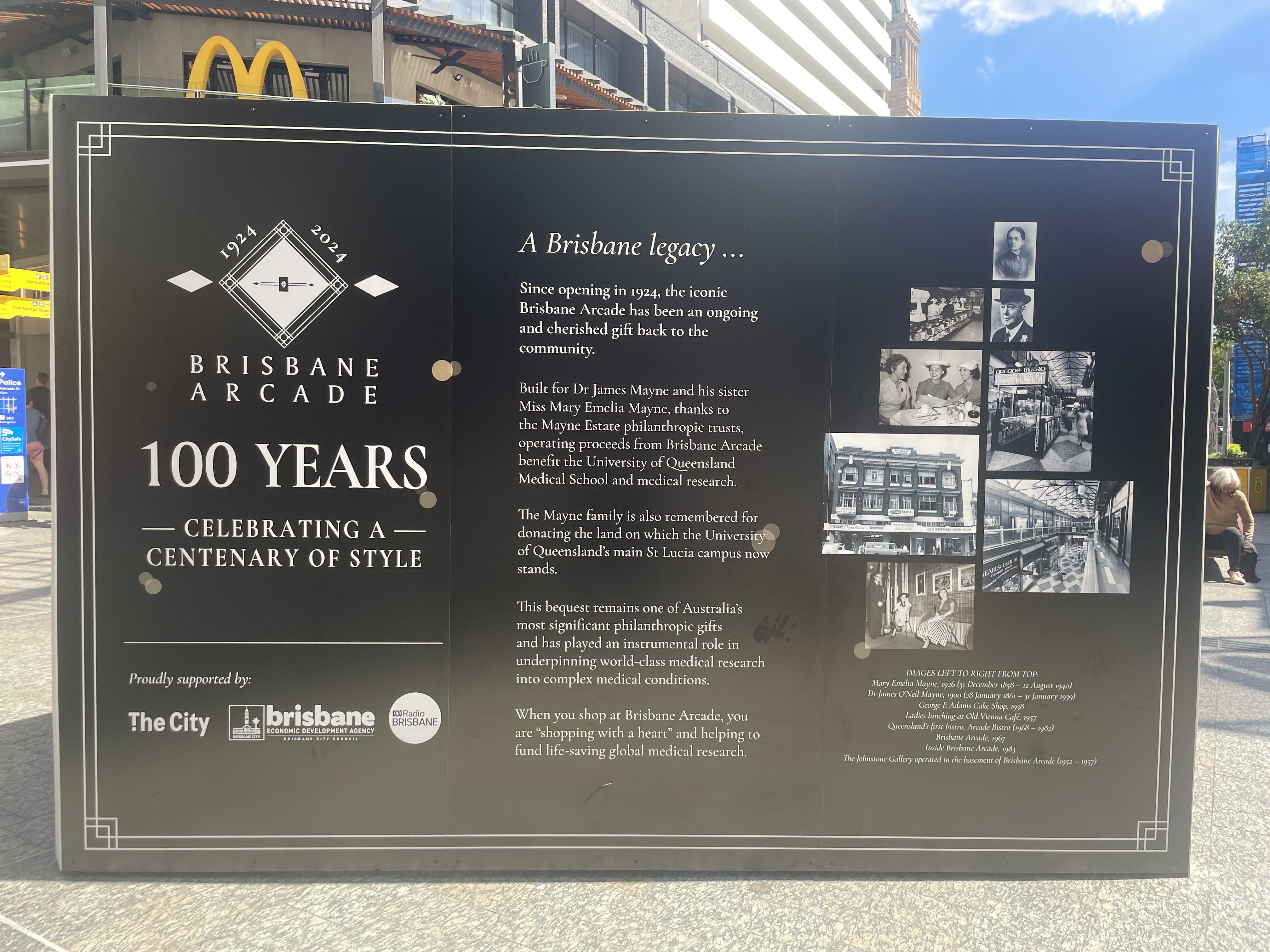
Brisbane Arcade Centenary history display, Queen Street Mall, 2024. Photographer: Nicole Davis

I still have a bunch of three-quarter drafted posts, which are actually about the history of arcades, but thought today I’d give an update on research life lately.

I’ve been working hard with my fellow authors, Richard Broome, Andrew J May and Helen Stitt on a thirtieth anniversary edition of Weston Bate’s Essential but Unplanned: The Story of Melbourne’s Lanes, which will be released later this year by Royal Historical Society of Victoria and State Library Victoria. Bate also included the city’s arcades, many of which join up with the lanes, an essential part of the way we move through and experience the city.

For me, this has involved two seemingly diametric activities. Often it has consisted of sitting at a desk staring at directories, maps, and spreadsheets to work on tracking the histories of the lanes. But it also means extensive walking around Melbourne’s CBD to see if certain lanes actually still exist in our rapidly changing cityscape or determining some other aspect of their location past or present. On those days, my 10,000 steps are easy to achieve!

Working away at Royal Historical Society of Victoria on Melbourne laneway histories with very old and very modern sources!
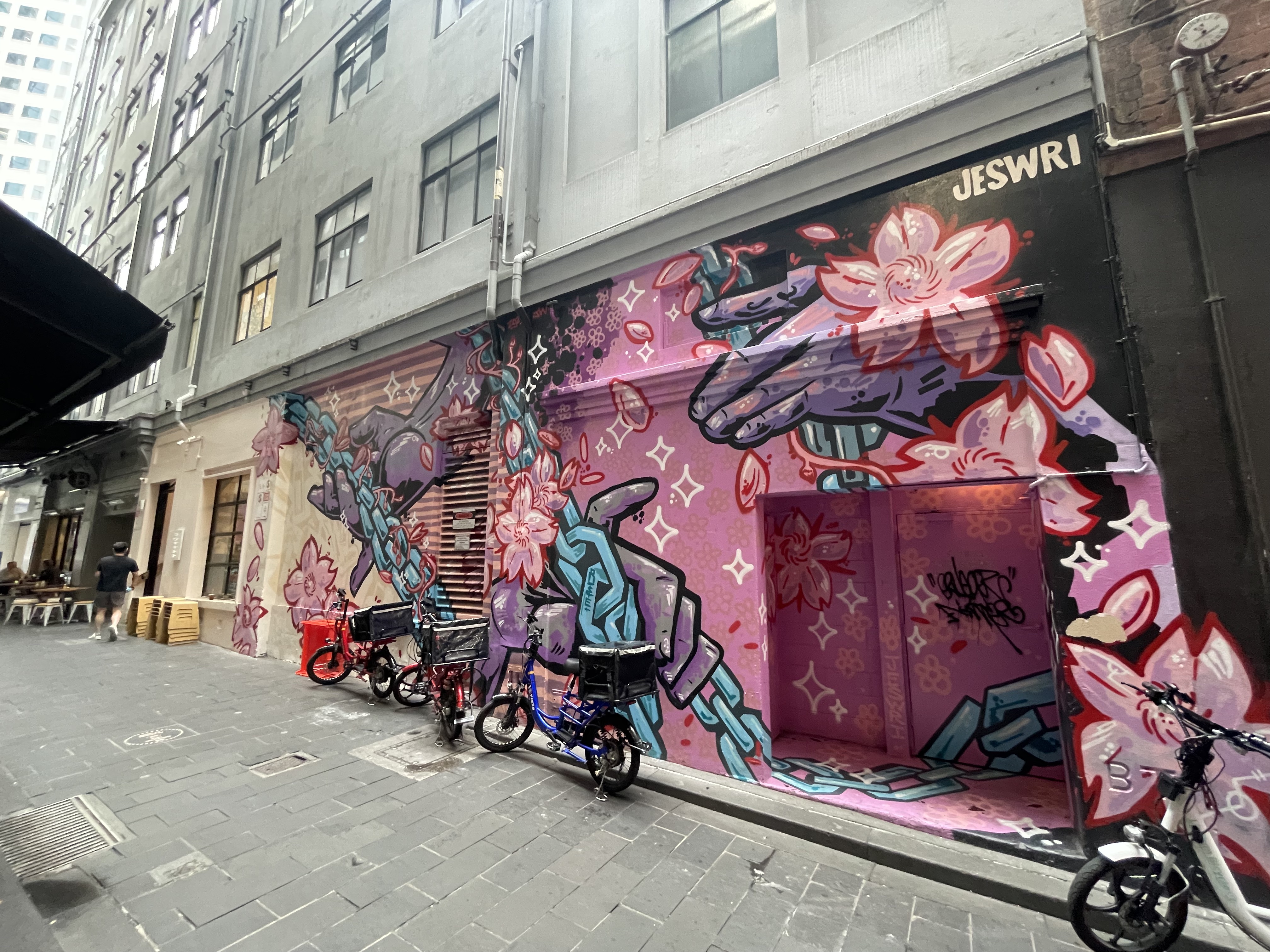
Exploring Melbourne’s lanes on foot is rewarding … but gosh my feet get sore! Amazing mural by Gadigal artist Jeswri (Jesse Wright) in Equitable Place.

It’s been really amazing discovering unknown corners of Melbourne, as well as seeing the history of its arcades: from the long-gone 1853 Queen’s Arcade to the most recent iteration, the Melbourne Walk, a combined arcade and laneway complex, which should open towards the end of 2024.

The book is accompanied by an exhibition at RHSV, Melbourne’s Storied Laneways, curated by David Thompson, which opens 11 April. Further details can be found on the RHSV website.

There’s actually an important story for me with this book, but I’ll reveal that when we launch!


In other exciting news, my latest journal article came out! It was submitted in October 2022, prior to my PhD being finalised, and is actually based on one of the thesis chapters. ‘”One of the Sights of the Colony“: Australia’s Nineteenth-Century Arcades’ appears in History of Retailing and Consumption. This is part of the new special issue on Australian retailing, edited by Matthew Bailey, one of my colleagues at Macquarie University. It is not open access but people can contact me for an author’s digital print of the article if they don’t have university or other library access. The abstract gives you an idea of the focus:

The arcade is a nineteenth-century architectural and social form long associated with industrial modernity and consumer culture. Better known in the British and European urban landscape, they were also significant in the Australian colonial context from 1853 onwards, in numbers rivalling those in the so-called ‘metropole’. Australian entrepreneurs, architects and shop owners utilized what was seen as a very European form to represent the progress and civilization of the Australian colonies and their urban spaces, both in capital cities and smaller regional centres. The arcades, including their presence in the landscape, their architecture, and the commodities and leisure activities found within, were regularly invoked by boosters in order to demonstrate the sophistication of these colonial urban spaces. This article briefly discusses the history of the nineteenth-century Australian arcades, the boosterish discourse that promoted them, and how their representation was a way to express the place of the Australian colonies within a transnational milieu.

It was wonderful participating in this special issue with Matt and other colleagues who work on shopping, retailing and business history. Matt also gave a great overview in the introduction to the special issue of all the authors’ work, which is well worth reading too.

Queen Victoria Markets Building (now, QVB), 1898. Photographer: Charles Kerry. City of Sydney Archives, SRC18023

Another publication also hit the virtual shelves in December 2023, a book chapter also written with colleagues, this time from my other life working on the history and sociology of education. Although it seems somewhat different, for me all these topics tie into aspects of my wider interest in urban history, just from slightly different perspectives. This is, wonderfully, open access and represents just one of the outputs from an ongoing transnational collaboration, Connecting History of Education, involving academics from all over the world and led by a team in Spain.

Julie McLeod, Nicole Davis, Kevin Myers and Helen Proctor, ‘Mapping connections across fields of knowledge and international networks in the history of education: Australasia, Northern Europe and the United Kingdom’ in Andrés Payà Rico, José Luis Hernández Huerta (eds.), Conectando la historia de la educación Tendencias internacionales en la investigación y difusión del conocimiento (Octaedro, 2023). Our chapter

takes up the invitation to map the development of the history of education as a disciplinary field, traced through the activities of discipline associations and journals in two contrasting regions, Australasia and Northern Europe. Defining and putting parameters around these regions is of course a problematic endeavour, replete with longer geopolitical and imperial histories, including the positioning of some regions, such as Australasia, as somewhat peripheral or marginal to developments in northern metropolitan centres. While a full consideration of these matters is beyond the scope of the chapter, we note them at the start in order to signal the larger contexts both framing and unsettling these mapping exercises. There is also considerable heterogeneity within these broadly defined regions. Even so, looking at them side by side has revealed some common concerns and also some important differences in how the journals conceived of their mission in relation to issues of national histories and international outlooks.


More exciting things have been happening too but I’ll just mention one. Last year I was awarded a 2024 Visiting Fellowship with the Harry Gentle Resource Centre at Griffith University, Brisbane.

Harry Gentle was a Griffith University alumnus who studied politics and history in the 1980s at the Griffith School of Humanities. He left a generous bequest upon his death to support the study of Australian colonial history. The Harry Gentle Resource Centre (HGRC) at Griffith University was established to promote the study of the peoples and lands of Australia, with an initial focus on the area that became Queensland and its borderlands in the nineteenth century.

Harry Gentle Resource Centre: Visiting Fellowships

My fellowship is taking my thesis work a bit further, in preparation for writing a monograph on Australia’s arcades.

The project will explore the experiences and networks of nineteenth-century Queensland businesswomen. It examines establishments owned or run by women, and commodities or services they provided, in four arcades built during this period – in Brisbane, Charters Towers and Townsville. Sometimes disguised behind male relatives acting as faces of the businesses or historiography overlooking their participation, these women played a vital role in the Australian colonial economy and represented significant networks in global exchanges of goods, ideas and people.


Earl of Hopetoun, Governor-General of Australia, unfurls the Flag at the opening of the Townsville Municipal Buildings, 16 September 1901. The building’s arcade is under the dome at right of image. Photographer: WJ Laurie. Citylibraries, Townsville. 

I’m excited to be heading up there next week to begin my first couple of weeks of research. It will be great to meet the team at the centre and also catch up with friends and family in Brisbane.

I’ll likely be reporting on the fellowships a bit on my Instagram and Facebook page, so follow me and see what I discover!

Eastern Arcade, Bourke Street, Melbourne, 1875, with banner for US Minstrels and images depicting the players. Photographer: NJ Caire/Anglo-Australasian Photo Co. State Library Victoria, H84.3/11

The Queen’s Arcade on Lonsdale Street in Melbourne, after renovations, reopened to great fanfare in March 1856, with a military band and a fountain of eau de cologne supplied by arcade fancy goods’ dealer Levy Bros, as well as

musical entertainments … varied by the performance of a powerfully toned apollonicon [a large barrel organ], which is intended in future to play at stated periods during the day, and thus prove a continual attraction to the passer-by to make use of this elegant avenue as a lounge


Age, 17 March 1856, 4

Arcades are often thought of purely as places of commodity exchange or places to eat and drink, with retail shops and tearooms often the focus of discussions both popular and academic. As I argue in my thesis, the arcades in fact reflected broader social and cultural aspects of urban life, with a wide variety of entertainments, including theatres, dance halls, hotels, balls and music in the promenades, and amusement parlours. As I note in Chapter Five, following James Lesh, arcades ‘catered for colonial Australian thirst for “amusements, performances and hospitality: novel forms of leisure and entertainment”[1] that were part of the global experience of modernity, many of which they might find within’ [2].

The entertainments in the arcades ranged in type. While there were more refined shows, such as art shows and elegant balls, displays at the ‘cheap amusement’ end of the spectrum were also found in these buildings, demonstrating the appetite for ‘new and innovative entertainments, many of which utilised new technologies in their presentation’ [3] but might also utilise the fantastical or seemingly strange to amuse patrons. While spectacle was a key component, these amusements might also be considered educative, about current or historic people and events, or new ideas and technologies.

The Queen’s Arcade was a regular site of such amusements, which also might play at other locations around Melbourne and Australia. These included models and panoramas of current events, such as important moments and sites in the war in the Crimea in the mid-1850s, including a model of the Sevastopol and Kronstadt naval bases, as well as St Petersburg. In 1855 and 1858, there featured an ‘exhibition of dissolving views‘ using a calcium light to project photographs, in the first case, including ‘places such as the Arctic regions, Turkey, Italy, Netley Abbey, and Walmer Castle‘, with the commonly applied entry fee of a shilling for adults and children at sixpence.

In the Eastern Arcade in Bourke Street Melbourne, there were a variety of such cheap amusements, as well as businesses that straddled the line between entertainment and health and wellbeing, such as phrenologists and fortune tellers. As these latter characters are the focus of the work of other scholars [4], I’ll focus here on the other amusements present in this building, but in another post, I might talk about these people in other arcades!

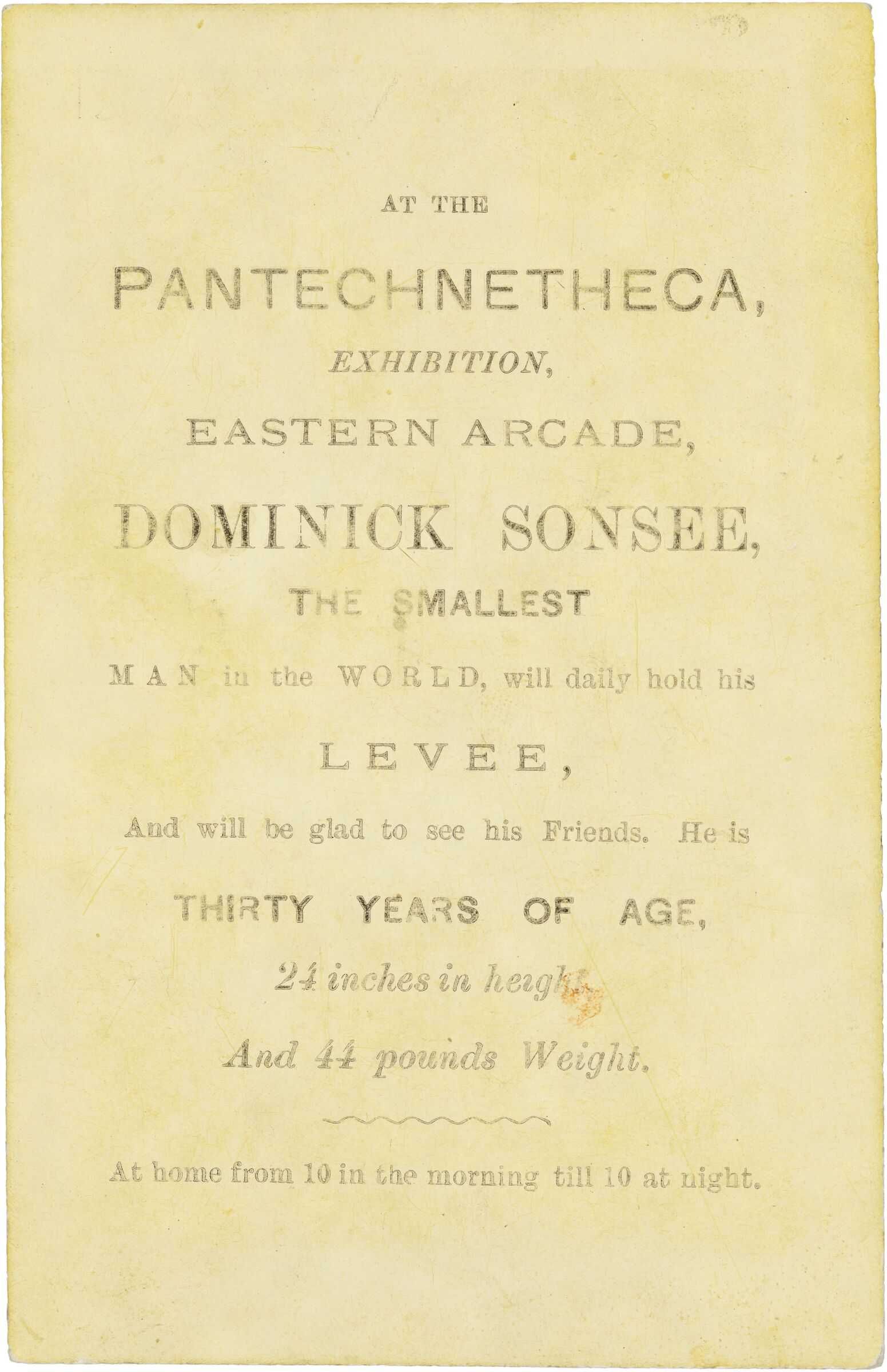
One of the other business-owners in the building also thought of innovative ways to attract people to the building. In 1879 fancy goods dealer Isaac Solomons hosted the Great American Pantechnetha in conjunction with a fancy bazaar, which featured panoramas of ‘the Prussian & Russian wars and views of the principal cities in Europe – surpassing anything ever seen in the Australian colonies’. He also later paid Dominick Sonsee, ‘the smallest man in the world’, to appear and hold an ‘at home’, where he chatted with visitors about politics and current events. Sonsee later, however, took publican Thomas Bentley to court over non-payment of the fee from Solomons, which Bentley had allegedly accepted on Sonsee’s behalf but not passed on, with newspapers rueing that Sonsee had been taken advantage of and portraying him in a pitying light.


Carte de visite advertisement for appearance of Dominick Sonsee at the Eastern Arcade, c1880.
Photographer: William Burman. National Portrait Gallery, 2014.5

The Eastern Arcade also had two dedicated entertainment spaces which featured entertainments such as the US Minstrels and Lady Court Minstrels (the latter also played at the Victoria Arcade & Academy of Music in 1884), and Kate and James Kelly, siblings of bushranger Ned, who held a rather grim entertainment where patrons could see and talk to them for one shilling prior to their brother’s execution in November 1880. In the same arcade in 1914, Seattle-born George and Leo Whitney, who had been leaseholders of Luna Park, Melbourne, opened the Joy Parlour amusement arcade in nine of the arcade shops, ‘entertaining hundreds of people both day and night with all kinds of amusement and picture shows. … Beautifully lit with electric light, and music always‘. According to the oral testimony of George K Whitney, his father (also George) ran the shooting and amusement section of the arcade, while his uncle ran the photography studio, before moving back to the US in the 1920s.

Bourke Street in the area of the arcade was well-established as the heart of Melbourne’s popular entertainment during the late 1800s. The atmosphere was beautifully described around 1912 by future journalist, Hugh Buggy: ‘a non-stop vaudeville show … [with] its music halls or “academies” of music, its billiard parlours, its shooting galleries, and a waxwork chamber of horrors … it was the heart of Theatreland and the stomping ground of sports.'[5] Both the Eastern and the Victoria Arcade and Academy of music on the next block contributed much to this atmosphere. These entertainments and others at the Eastern Arcade show that the life of the surrounding streets entered the once-imagined refined confines of the building and may have contributed (along with larrikins, phrenologists, fortune tellers, theatre connections, and murders) to its poor reputation from the 1890s to 1920s.

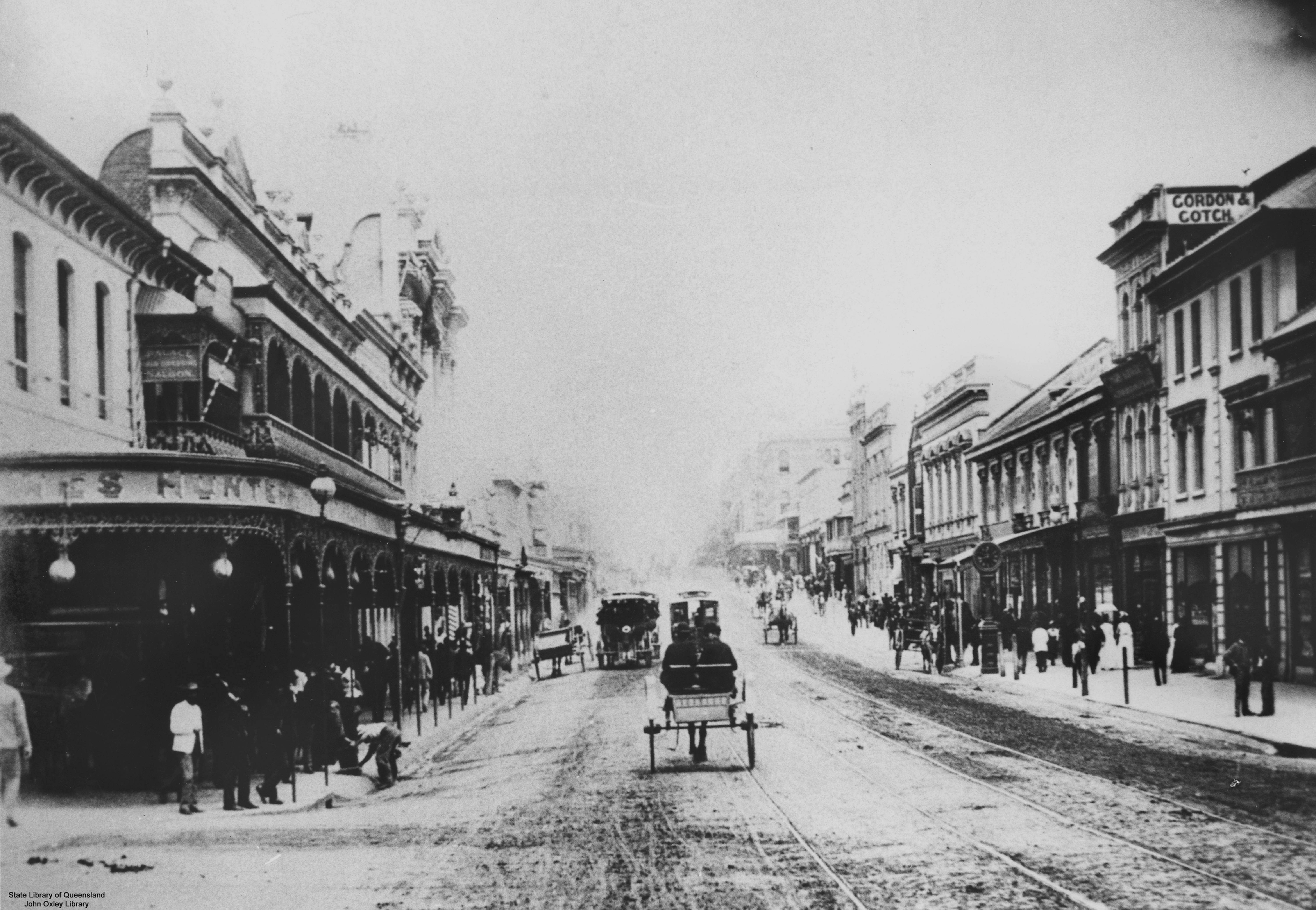
Grand Arcade (second from corner at left), c1889. Photographer unknown. State Library Queensland, Negative: 100723

Heading north to Brisbane, Henry Morwitch’s Grand Arcade, which seemed to have a regular program of public events, hosting ‘a variety of entertainments and amusements on offer ranging from carnivalesque to the refined’. [6] In 1889, it featured a sideshow-type performer, Fedor Jeftichew, who experienced hypertrichosis, leading to excess body hair, billed as ‘Jo-Jo the Russian dog-faced boy‘. Demonstrating the transnational movements of so many of these entertainers across the globe, Russia-born Jeftichew toured England, Europe and Australia, originally with US showman and circus owner, PT Barnum, who satisfied the public appetite for shows featuring those advertised as ‘monsters’.

Shows that incorporated or featured new technologies also took place in the Grand, including Woodroffe’s glass-blowing exhibition in 1889. Born in the US, Charles Woodroffe exhibited in the States before coming to Australian in the 1860s under the patronage of entertainment entrepreneur George Coppin. Woodroffe’s shows featured glass-blowing combined with technologies such as steam engines made from glass. These shows were popular travelling entertainments and we see Woodroffe exhibiting throughout Australia, as well as presenting his more scientific glass aparatus at international exhibitions. The glassblowing shows were part informative and part show and, as Rebecca C Hopman tells us, ‘delight[ed] spectators with lampworking displays, fabulous models, and tables crowded with glass trinkets’. [7] In 1897 and 1898, new technology again featured, when Lumiére’s cinematograph of moving pictures was exhibited, producing images of the Queen Victoria’s Diamond Jubilee and the Melbourne Cup, as well as ‘other exciting events’.

Description of Charles Woodroffe’s show in Maryborough, Queensland. Maryborough Chronicle, 30 August 1887, 2.
Poster for Woodroffe’s brother’s show in Utica New York, 1881. Rakow Research Library Special Collections, Corning Museum of Glass, Flat Files (Unit 31, Drawer 6)

Like those in Melbourne and Brisbane, Sydney’s arcades also hosted a variety of similar amusements. From October 1893 to around December 1894, the basement of the Strand Arcade played host to the Crystal Maze Palace of Amusement, in the Strand Arcade basement. The newspapers tell us that it included entertainments such as ‘Madame Paula, the scientific palmist’, a mirror maze, and mechanical novelties, gaining ‘a large measure of popularity as a holiday resort‘. The next year the arcade had a model of the Tower of London made entirely of cork (one million pieces!), and from 1896 to 1897, Sawyer’s Australian Waxworks, featuring celebrities of the day such as Sarah Bernhardt. These exhibits attained popularity in the nineteenth-century with contemporary and historical personalities rendered in wax, arguably the most famous today being Madame Tussauds, with branches all over the world (including Sydney). Waxworks seems to have tried to attract broad audiences, being advertised in numerous newspapers, including the Guang yi hua bao/The Chinese Australian Herald.

While these are just a snippet of the types of ‘cheap amusements’ that could be found in the Australian arcades in the nineteenth and early twentieth centuries, they demonstrate the diversity of the types of entertainments that were available. Their presence indicates that arcades were not just sites that would attract the town elites but had a wider class of visitor. While the Eastern Arcade spatially was embedded in Melbourne’s entertainment district, the Strand was in a more apparently refined location on Pitt Street, in the shopping heart of Sydney, although relatively close to the theatre district on King Street. The presence of such amusements widen our understanding not only of the types of businesses found within arcades but also their visitors, breaking down the idea that these buildings were only the preserve of middle-class or elite shoppers and tea-drinkers.

At the same time, these examples also give insight into the global exchanges that took place in the arcades beyond those of commodities. These travelling entertainers often hailed from North America, Europe or Britain, and elsewhere across the the globe, and travelled independently or as part of troupes, sometimes managed by entertainment entrepreneurs such as Coppin or Barnum. They utilised a variety of genres and techniques, including music and dance, as well as technologies driven by steam and electricity [8], wax modelling, and glassblowing in order to amuse and delight their audiences within the arcades.

Learn more

On 31 October 2023, Dr Alexandra Roginski, a fellow Professional Historians Association (Vic & Tas) member, and Professor Andrew Singleton from Deakin University are presenting ‘An Evening of Mystery in the Eastern Arcade: Phrenologists & Spiritualists’ at the Victorian Archives Centre and online. It should be a great talk, so book via Eventbrite! I’m so looking forward to it!

Footnotes

  1. James Lesh, ‘Cremorne Gardens, Gold-rush Melbourne, and the Victorian-era Pleasure Garden, 1853-63’, Victorian Historical Journal 90.2 (2019): 219–252. https://search.informit.org/doi/10.3316/INFORMIT.893493942124131.  
  2. Nicole Davis, Nineteenth-century Arcades in Australia: History, Heritage & Representation (PhD Thesis, University of Melbourne, 2023), 165.
  3. Ibid. 186.
  4. Alexandra Roginski, Science and Power in the Nineteenth-Century Tasman World: Popular Phrenology in Australia and Aotearoa New Zealand (Cambridge, 2022), in which she talks about the Eastern Arcade.
  5. Hugh Buggy, The Real John Wren (Widescope International, 1977), quoted in Otto, Capital, 47–48.
  6. Davis, ‘Nineteenth-century Arcades in Australia’, 192.
  7. Rebecca C Hopman, ‘Demonstrations Gain Steam’, Journal of Glass Studies 62 (2020): 281.
  8. See for example: Henry Reese, ‘”The World Wanderings of a Voice”: Exhibiting the Cylinder Phonograph in Australasia’, in A Cultural History of Sound, Memory, and the Senses, edited by Joy Damousi & Paula Hamilton (Routledge, 2017)

Other Sources & Further Reading

Mimi Colligan, Canvas Documentaries: Panoramic Entertainments. inNineteenth-Century Australia and New Zealand (Melbourne University Press, 2002).

Corning Museum of Glass, ‘The Grand Bohemian Troupe of Fancy Glass Workers|Behind the Glass Lecture’, 19 January 2019. YouTube.

Clay Djubal, ‘What Oh Tonight: The Methodology Factor and Pre-1930s’ Australian Variety Theatre (with Special Focus on the One Act Musical Comedy, 1914–1920)’ (PhD Thesis, University of Queensland, 2005).

Harry Gordon, ‘Buggy, Edward Hugh (1896–1974)’, Australian Dictionary of Biography.  

Andrew May, ‘Bourke Street’, eMelbourne: The City Past and Present.

Official Record Containing Introduction, History of Exhibition, Description of Exhibition and Exhibits, Official Awards of Commissioners and Catalogue of Exhibits. (Melbourne: Mason, Firth & McCutcheon, 1882), 434, 648.

Kristin Otto, Capital: Melbourne When it Was the Capital City of Australia, 1901–27 (Text Publishing, 2009), 47–75.

Henry Reese, ‘Spectacular Entertainments at Edison Lane’ (parts one and two), State Library of Queensland Blog, 20 December 2022.

Henry Reese, ‘Settler Colonial Soundscapes: Phonograph Demonstrations in 1890s Australia’, in Phonographic Encounters: Mapping Transnational Cultures of Sound, 1890–1945, edited by Elodie A Roy and Eva Moreda Rodriguez (Routledge, 2022), 60–77.

‘The Great Exhibition, 1851: Philosophical instruments by Deleuil 1851’ [photograph], Claude-Marie Ferrier, RCIN 2800038, Royal Collection Trust.  

Richard Waterhouse, ‘The Internationalisation of American Popular Culture in the Nineteenth Century: The Case of the Minstrel Show’ Australasian Journal of American Studies 4.1 (1985): 1–11.

Richard Waterhouse, From Minstrel Shows to Vaudeville: the Australian Popular Stage 1788–1914 (NSW University Press, 1990)

Richard Waterhouse, Private Pleasures, Public Leisure: A History of Australian Popular Culture Since 1788 (Longman, 2005).

Alexa Wright, Monstrosity: The Human Monster in Visual Culture (Bloomsbury, 2013), 84–85.

Grand Arcade (front right) & Royal Exhibition Arcade (fourth building from rh corner), both featuring wrought iron verandahs, Queen Street, Brisbane, c1908, State Library Queensland.

Previously I’ve given an outline of the nineteenth-century shopping arcades built in both Victoria and Sydney. By the mid-1870s,  five shopping arcades had been built in Victoria, the most recent being the Victoria Arcade & Academy of Music on Bourke Street (1876). Although Sydney had been promised an arcade as early as 1859 (Illawarra Mercury, 24 March 1859, 2), one was not actually built until 1880.

While it is probably not a surprise to many that the first arcades in the Australian colonies were built in the booming goldrush metropolis of Melbourne, the second city where they were constructed is probably more of a revelation. Today we move further north to Queensland, to briefly touch on the three arcades built there in the nineteenth-century, and another that just sneaks into my research end date of 1901.

It was in the small colonial capital of Brisbane that one entrepreneurial man built both of the first arcades in Queensland – the Royal Exhibition Arcade (1877) and the Grand Arcade (1885) both within a few doors of each other on Queen Street, the city’s main shopping thoroughfare. The story of these arcades is inseparable from the life of their owners, Henry and Louisa Morwitch, about whose lives I’ve recently written a book chapter, and about whom I will write more in another post.

An advertisement for Professor G.W. Gibson, Botanic Physician, from the Queensland Figaro newspaper, 20 April 1889, 601. He was based in the Royal Exhibition Arcade, seen at left.

The other two arcades that were built in Queensland were in seemingly unlikely locations but, at the time of their construction, represented the progress and modernity of two regional towns that were booming, both economically and in terms of population.

Firstly, the Royal Arcade was constructed in Charters Towers, nearly 1400 km from Brisbane, in the mining country of Far North Queensland, by businessman Alexander Malcolm and designed by Sydney architect Mark Cooper Day.  In 1888 the town was rapidly expanding, with a population drawn by lure of new gold discoveries (and displacing the traditional owners, the Gudjal people).

Although it was never finished (it still is missing it’s back half!) it is in fact, the only of the four Queensland arcades that I’m studying that still exists. Because it housed the Charters Towers Stock Exchange for a number of years, it’s now known as the Stock Exchange Arcade and is again operating as an arcade, run by the National Trust of Queensland.

Charters Towers Stock Exchange building (former Royal Arcade), c1890. Photographer unknown. State Library of Queensland

The Stock Exchange Arcade, Charters Towers, 2014. © Nicole Davis. Note the missing back half!

The final arcade in Queensland that I will look at is the Town Hall Arcade in Townsville, which was built by Townsville’s city council as part of a large development known as the Market Reserve Buildings, which included a Town Hall, Arcade, Theatre Royal and Central Hotel. The theatre was completed in 1900 and the complex was opened by Lord Hopetoun in September the next year (who raised the new flag of the federated Australia above it).

It was a magnificent example of very early Federation architecture and must have been quite a site to behold. This amazing collection of buildings (see an image here) was partly demolished in 1973 and tragically destroyed by fire in 1978. Today, the current municipal buildings, a typical example of 1980s civic architecture, stand in its place (Townsville Bulletin, 15 February 2015).

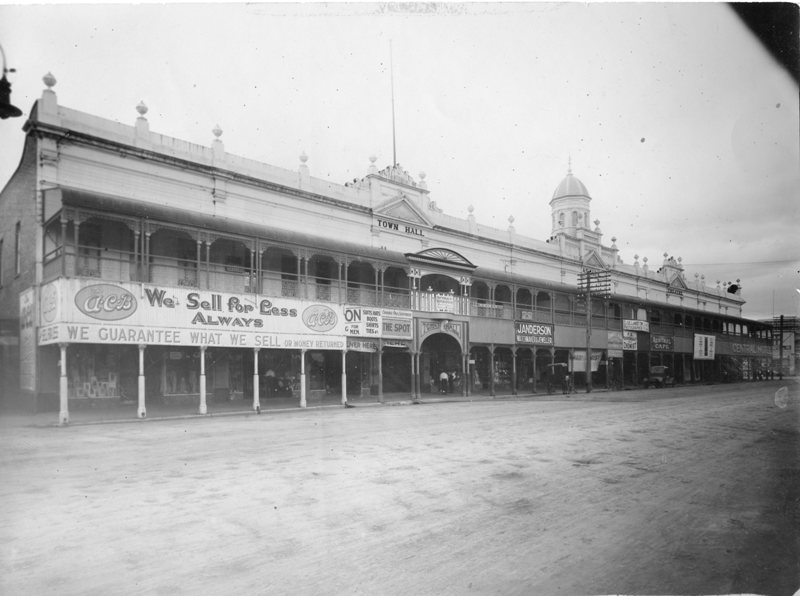
Town Hall, Flinders Street, Townsville, 1914. Photographer: W.J. Laurie. City Libraries Townsville, 315258. The Arcade entrance is below the tower.

Arcade building and premises of Brownhill, Kirk and Company, Market Reserve Building, Flinders Street, 1913. Photographer unknown. City Libraries Townsville, 323846.

If you want to read a little bit more about these Queensland arcades, head to my post detailing the big road trip I took to do site visits and archival research on all four in 2014. In the future, I’ll be doing profiles of each of the arcades as well – in that previous post, the Townsville arcade was a particular mystery, but I’ve found out a lot more since then!

I’m doing a LOT of travelling as part of my research for my thesis. Recently, I did a trip to Queensland to look at the history of the nineteenth century arcades there. It was a fruitful journey that answered a number of questions that couldn’t be resolved through online research.

It allowed me to visit the sites & understand their location and placement within the cityscape of both the nineteenth century & today, and I also collected reams of information, images, plans, maps, directories, council records and other resources that will assist with my research.

Additionally I was able to gain valuable information through direct contact with the staff of the archives and libraries there that yielded some revelations. Some of the information was contextual and this was vital. Despite growing up in Brisbane, I knew comparatively little about its history compared to Sydney & Melbourne, as that has been  where my history and heritage work has focused up until recently.

There were four arcades constructed in Queensland prior to 1901 – while I say nineteenth-century a lot,  my study actually extends to 1901, in order for me to consider one of these specific Queensland sites, constructed in the year of Federation and on the cusp of the new century that brought great changes to the Australian urban landscape.

Two were constructed in Brisbane and both were the brainwave of enterprising businessman Henry Morwitch, who lived a truly international life throughout the British Empire and beyond. Born in Poland, he migrated to England, then Victoria, followed by New Zealand, back over to Brisbane (with a sojourn in Gympie), then to Sydney and, at the end of his life, returning to Britain. His two arcades were built on the busiest commercial street in Brisbane, Queen Street, in close proximity to each other.

These were the Royal Exhibition Arcade, constructed in 1877 and demolished in the years around World War I, and the Grand Arcade (fronting Queen and Edward Streets), built in 1885 and demolished in parts between the mid 1920s to late 1930s.

Picture1.png
Grand Arcade (front right) & Royal Exhibition Arcade (fourth building from rh corner), both featuring wrought iron verandahs, Queen Street, Brisbane, c1908, State Library Queensland.

Both sites are now taken up by commercial buildings featuring similar tenants, although certainly on a different scale. The Royal Exhibition Arcade was on the site of Macarthur Central, a large, recently constructed, shopping centre with diverse shops and eateries. As for the Grand, the Tattersall’s Arcade, part of the Tattersall’s Club buildings constructed between World Wars I and II, sits on the exact footprint of the Grand Arcade.

Macarthur Central, 255 Queen Street Brisbane. Site of the Royal Exhibition Arcade. Nicole Davis, 2014. Macarthur Central, site of the Royal Exhibition Arcade & several other buildings, 255 Queen Street Brisbane. Site of the Royal Exhibition Arcade. Nicole Davis, 2014.

The other two arcades that were built in Queensland were in seemingly unlikely locations, but at the time of their construction represented the progress and modernity of two regional towns that were booming, both economically and in terms of population.

The first was constructed in Charters Towers, nearly 1400 km from Brisbane, in the mining country of Far North Queensland. In 1888 the town was a city with a rapidly expanding population, drawn by rich lure of its gold discoveries and usurping the land of its traditional owners. By 1899 it had a population of 25,000 and was one of the biggest cities in the Australian colonies.

Entrepreneurs in Charters Towers used the gold wealth to create a European-style city, commissioning architects, often from the cities of Brisbane, Sydney and Melbourne, to design buildings in the manner of the high boom metropolises far to the south. One of these was the Royal Arcade, today known as the Stock Exchange Arcade, constructed in 1888 for businessman Alexander Malcolm and designed by Sydney architect Mark Cooper Day. It was never completely finished due to Malcolm becoming insolvent, and today the back remains open to the land and laneway at the rear. It’s the only remaining arcade from the nineteenth century in Queensland and both it and the town, with its mining history and several heritage sites, are fantastic spots to visit.

Screen Shot 2018-11-01 at 1.26.52 pm
Charters Towers Stock Exchange building (former Royal Arcade), c1890. Photographer unknown. State Library Queensland

The last site I visited was in Townsville, 140 km east of Charters Towers on the coast. It’s a quite expansive city of 170,000 people. In 1901, the year of Federation, the Earl of Hopetoun, first Governor-General of Australia, opened the large municipal civic buildings constructed on Flinders Street. The structure, which took up a significant section of the block, included a Town Hall, a theatre, a licensed hotel, a market and a shopping arcade.

Unfortunately, not much survives in records nor in the collective memory about this arcade and before I arrived I doubted that it even was a real arcade in the sense that I was defining them. But I found some tantalising evidence in the Townsville City Library that did confirm it was an ‘authentic’ shopping arcade. This photocopy of a cross-section came from the original plans, which certainly existed in the 1990s, but now appear to be lost.

This amazing collection of buildings, built during a period of intense change for Australia, were unfortunately destroyed by fire in 1978 and today, the current municipal buildings, a typical example of 1980s civic architecture, stand in its place.

Despite the fact that the majority of these arcades no longer exists, seeing the sites on which they stood (and still stand, in the case of the Royal Arcade), allowed me to better understand their placement within the urban environment that no amount of looking at images or maps can provide. I also feel much more illuminated as to their place within the history of the cities in which they were built and the overarching historical narrative of those places.

The experience of road tripping to Charters Towers in particularly was fascinating as the bitumen road from tropical seaside Townsville took me to the dry almost outback of western Queensland and allowed me to understand the true feat of what was constructed in this now small town in the last decades of the nineteenth century.

I’m currently collating all the material and information gathered and this will figure in a longer case study of specific arcades that will contribute to my thesis.

This trip was made possibly by a Graduate Research Arts Travel Scholarship from the University of Melbourne. Lastly, a big shout out to those who assisted so much in my research on this whirlwind two week trip:

Brisbane City Archives

State Library of Queensland

Trisha Fielding and all the staff at Townsville City Libraries (Trisha, a historian, also has a fantastic North Queensland history blog in which she discusses the Town Hall buildings)

James Cook University Special Collections

Charters Towers & Dalrymple Archives Group, especially archivist and curator, Michael Brumby, who was excessively generous with his time and resources, and was willing to have great long chats about history with me.

Charters Towers Library

National Trust Queensland volunteers at the Stock Exchange Arcade and Zara Clark Museum in Charters Towers and the Hou Wang Temple in Atherton

The Stock Exchange Arcade Gallery (which allowed me to see the upstairs of the Royal Arcade)

And to the Royal Hotel and the Stock Exchange Arcade Cafe in Charters Towers, for giving me a luxurious place to lay my head and excellent coffee to fortify me!