Almost 30 years after the first shopping arcade was built in Melbourne, the first was constructed in Sydney. The 1881 Royal Arcade, which ran between George & Pitt Streets, was considered ‘one of the most tasteful features of [the] city’ by the Illustrated Sydney News (25 Nov 1882, 8)
This was followed quickly by the Sydney Arcade and later in the decade by the Victoria Arcade on Castlereagh Street. Despite the depression of the early 1890s, several more arcades were built in Sydney at this time, including one that has been completely forgotten. In discussions of these social spaces in Sydney most authors/historians discuss only five or six arcades, depending if they include the QVB or not (which I do, but more on that later). In fact there was a seventh.
Located on George Street, the Central Arcade was a rather small arcade with only a handful of shops, that first appears in city directories in 1890. It certainly received little fanfare, with almost nothing written about it in the newspapers of the time, apart from a few advertisements. Perhaps this is not surprising given that it lacked the grandeur and luxury shops of the other arcades located closer to the heart of the CBD. Rather it housed more practical shops such as a herbalist and a variety of tradesmen. The only reason I even identified it is because I caught site of it in the directory listings.
The seventh and final arcade constructed in Sydney was the large Queen Victoria Markets building, which took up an entire city block adjacent to the Town Hall. While some don’t count it in lists of Sydney Arcades, it certainly was one for all intents and purposes, despite its name. The Sydney City Council, shamed by the supposedly run down George Street markets in the vicinity of their new, grand Town Hall, desired a more fitting structure for their aspirations as a city. The brief for City Architect, Scottish-born George McRae, was to design a building in arcade form that would occupy this block, containing shops in it’s main spaces with a market hall in the basement. It is possible that McRae was inspired by the monolithic arcades of Europe that took up single blocks, such as Milan’s Galleria Vittorio Emanuele II and the new Upper Trading Rows building in Moscow, which was built in 1893 and which bears a striking resemblance to McRae’s original design for the Sydney Markets.
This is just a brief introduction to the nineteenth-century shopping arcades of Sydney, much more about which will be written at a later date!
Sydney’s nineteenth-century shopping arcades:
1881 Royal Arcade, George & Pitt Streets – demolished
1882 Sydney Arcade, George & King Streets – demolished
1887 Victoria Arcade, Castlereagh & Elizabeth Streets – demolished
c1890 Central Arcade, George Street – demolished
1891 Imperial Arcade, George & Castlereagh Streets – demolished
1892 Strand Arcade, George Street & Pitt Streets – extant & operating continuously
Adelaide Arcade, between Rundle & Grenfell Streets, 1886. State Library of South Australia (click image to view in Flickr, for further information & a link to the catalogue record).
It’s been a while between posts I know! But I have been busily writing. Here’s the introduction to Chapter One, which is being handed in soon for my confirmation! Gives a bit of an idea of what I’ve been researching for the last year (FT equivalent – really 2 1/2 years!). Please feel free to skip the footnotes. A couple of things need fixing up but here goes!
[the] arcades … in their physiognomy, remind you, now of the Burlington … and now of the Passage des Panoramas … in Paris, but which, nevertheless, possess a distinctive stamp and character of their own.[1]
English journalist George Augustus Sala, visiting Australia in 1885 as a correspondent for the Daily Telegraph, wrote a series of syndicated articles, The Land of the Golden Fleece, describing the land, peoples and cities of the continent.[2] In Part Eight, ‘Arcadia in Australia’, he explored its shopping arcades, along with other public spaces, and their inhabitants, with a specific focus on Melbourne. In this passage Sala compares these arcades to several of the oldest and most elegant of their European counterparts and likewise sung the praises of some of the city’s other public spaces, where ‘you might, without any very violent stretch of the imagination, fancy on a fine night that Bourke-street was one of the Paris boulevards instead of being a road hewed not 50 years ago out of the trackless bush’.[3] Sala’s narrative suggests that these were one of a number of sites through which nineteenth-century urban developers utilised public spaces and architecture to express a colonial identity that partly relied on emulation of European forms. Arriving in the midst of rapid population and urban growth, he paints a picture of booming and elegant antipodean cities, tinged with slight incredulity at how far these cities had come in such a short time period.[4]
This relatively brief characterisation highlights the inextricable connection of the history of the Australian shopping arcades (and other urban forms) with their European origins. The comparison of Australian cities to those in Europe, America and other continents has long been part of the way that Australians and visitors have conceived of the country’s place within the global context.[5] Nineteenth-century Australia was part of ‘a vast transcontinental movement of people and information at intensely parochial and inherently cosmopolitan’[6] that looked to other cities for inspiration and emulation. One such idea embraced by Australian entrepreneurs was the shopping arcade, a structure considered representative of urban modernity, with their innovative organisation of semi-public retail and leisure space and use of new technologies in their construction.[7]
From 1786 to the late 1930s, a period Bertrand Lemoine defined as l’Ère des passages (the Arcade Era), thousands of glass-roofed shopping arcades were built throughout the world. A direct derivative of an architectural form that had first been invented in Paris almost a century before, by Sala’s time they were a common feature of many urban centres. While they were, in their origins and in public perception, a very European form of architecture and social space, the arcades were in fact a global phenomenon, adopted as a popular architectural solution in European-influenced cities throughout North and South America, Russia, Turkey, South Africa, Asia, Australia, New Zealand during the nineteenth and early twentieth centuries.
German theorist Walter Benjamin, writing in the 1930s, described the shopping arcade as ‘a city, a world in miniature’,[8] and used them as a lens through which to explore the story of nineteenth-century Paris, the ‘Capital of the Nineteenth Century’. Within his essays on the city and in his major work, The arcades project, Benjamin explored facets of urban modernity – technological advances, commodity consumption, the transience of the modern city, changes in urban space – that were to be found represented within these buildings.[9] As Dana Arnold has suggested, they are not merely a way to view the history of Paris, but it is also ‘possible to narrate the history of other cities, including provincial ones, through the lens of the arcades’.[10] While Arnold considered the arcade as a pan-European phenomenon, observing that it could be used as an analogy for any of the cities of that continent, they should, as I have argued, be more correctly viewed as a pan-global one. With their widespread adoption in cities and towns on six continents, the arcade might arguably be utilised to explore the history of any urban space in which one was located, including Australian cities and towns.
These architectural forms incorporated and were inspired by technological and industrial advances that characterised modern urban spaces in the nineteenth-century, such as the introduction of gas lighting and electricity and developments in iron, steel and glass construction. They were an economic and social centre, both a product and a representation of diverse strands of social, cultural and political changes, which occurred in different cities and nations at different times throughout the world.[11] The retail aspect of the arcades was incontestably a crucial one. Lining the pedestrian ways that were the heart of these buildings were individual stores that provided specialised goods and services intended to attract the custom of the rising middle classes to whose identity the conspicuous consumption of luxury goods sold in such establishments was central.[12] While they are primarily associated today with their retail function – as a place to shop – they contained a wide assortment of spaces and tenants that made them a social, cultural and business hub, an extension of the street outside.[13] The arcade was much more than just a place to buy goods – it was also a site for business, leisure and pleasure. Most were truly intended to be cities in miniature, housing an enormous diversity of spaces including refreshment rooms, offices, studios, theatres, galleries and more. With opulent decorations, bountiful products on display, diverse entertainments, and refreshment rooms, they were intended as enclosed and rarified spaces removed from the outside world in which to indulge the senses.
Patricia Morton wrote that ‘the arcades both represent the development of the nineteenth-century economy and are transformed as it changes’, capturing the inextricable link between the history of the arcade form and the history of modernity in that century.[14] Arguably the arcade can also be used as a lens through which to view the history of the twentieth and twenty-first centuries. As Lynda Nead has discussed with her work on mid-Victorian London, the history of modernity is multi-layered, with ‘varied and uneven strands and … multiple levels of representation and experience’ and, following Benjamin, that ‘the city was an accumulation of historical traces …’[15] The glass-roofed arcade influenced and gradually gave way to new forms of similar pedestrian passageways as the twentieth century advanced. Other forms of retail space with which the arcade form had synergies – the department store, the shopping mall – developed and arose.[16] So too the arcades constructed during the nineteenth century underwent changes that reflected the ever-changing nature of urban life. Some arcades lost popularity relatively rapidly, while others, never quite achieved it. Stores and goods found in them changed with the changes in consumption and fashion. Changes were made to the physical fabric of the buildings in order to attempt to make them viable or in step with architectural fashion. Some continued to be well-frequented shopping locations, meeting place or thoroughfares, while others became down at heel and empty. Numerous examples ceased to function as arcades at all and were gutted to become carparks or liquor stores,[17] while over time many were gradually demolished altogether to make way for more modern buildings high rise buildings that were able greater income for the owners. The architectural form of the arcade is part of the story of modernity and the city but, like the historical process of modernity itself, the history of the arcade is not one of linear progression and development.[18]
The global shopping arcade phenomenon transcended time and space and ‘needs to be situated in the wider context of intellectual and architectural discourses which extend beyond local and national boundaries … part of a wider economic, geopolitical and cultural system’.[19] But particular arcades were also products of their own time and place, with specificity unique to a particular moment and affected by local events and personalities. The urban dweller of different epochs had their own unique experience of their particular period with its own ‘set of historical discourses and processes’.[20]
From the first example, the Queen’s Arcade, constructed in Melbourne in 1853, arcades in Australia provided an obvious point of comparison between the colonial cities and others in which they were located worldwide, particularly those of London and Paris. As with other forms of Australian urban life, contemporary nineteenth-century writers often equated the arcades with their European and other international counterparts, contextualising them within a wider global context of economic, social and cultural exchange.[21] The history of these spaces is multilayered, with development and influences that followed diverse vectors. A comparison of the use of the arcade in the contemporary discourses of other cities and nations in order to construct their identities and explore their global relationships may also reveal commonalities with the Australian experience.[22] Thus these Australian arcades must necessarily be viewed through a transnational lens, not only in order to examine exchanges of international ideas and influences but also to illuminate their own particularities influenced by their specific location and period and what gave them ‘a distinctive stamp and character of their own’.[23]
To this end this chapter will explore the broader history of the arcade phenomenon in a twofold manner. First, it will briefly explore the chronological development of the shopping arcades from their origins in pre-Revolutionary eighteenth-century Paris to the spread and development of this architectural form throughout Europe and the rest of the world during the course of the nineteenth century and into the twentieth. In order to gain an overview of their origins and diffusion, such chronological signposts are necessary to understanding the various events and strands that impacted on the arcades in different times and places. The chapter goes on to discuss specific aspects of the history of the arcade, including origins and influences, architectural forms and uses. It will explore the importance of arcade as an architectural, social, celebratory, business, political, economic space and its multiplicity of meanings and uses within the city and introduce themes that are more will be more fully explored in later individual chapters on the Australian arcades.
[2] These articles also appeared at the time in numerous Australian newspapers, including Melbourne’s Argus.
[3] Sala, The Argus, 22 August 1885.
[4] Each of the colonial capitals had generally experienced rapid growth in population since their founding and saw massive urban growth in the 1880s boom period. Melbourne had grown rapidly since its founding in 1832. Spurred by the 1852 Victorian Gold Rush, the population jumped from 29,000 to 125,000 in 1851-1861 (McCann, 2004, 15) [Miles Lewis says 126,000 – five times what it was in 1851 (Melbourne – the city’s history and development), the fastest growing city in the world at the time. When Sala arrived the city was in the midst of another boom driven by immigration, investment, development and trade. In the decade from 1881-1891 the population almost doubled from 268,000 to 473,000 and by the end of it, Melbourne was the largest city in the Southern Hemisphere. It’s growth and population outstripped Sydney during the decades 1850-1880, with the latter growing from c 54,000 to c 96,000 in 1851-61 and c 225,000 to c 383,000 in 1881-1891. While far smaller, Brisbane had similarly rapid relative growth, from 2,097 to 6,051 (1851-1861) and 37,000 to 100,000 from 1881-1891. Earlier visitors had expressed surprise at how urbanised the population of the Australian colonies was.
[5] Newspaper articles, travelogues and other forms of literature often compared the Australian cities to those of both Britain and mainland Europe. Marcus Clarke frequently used such comparisons in his work, viewing the urban landscape of Melbourne and its architectural forms, including arcades, as representative of European metropolitan life. See Andrew McCann, Marcus Clarke’s Bohemia:Literature and Modernity in Colonial Melbourne (Melbourne, 2004): Melbourne University Press) 52-53. For other nineteenth-century contemporary accounts cf. Tim Flannery, The Birth of Melbourne, 2002 where a large number of the excerpts written by immigrants, visitors and native-born Australians compare Melbourne to the cities of Europe and, to a lesser extent, the United States. Graeme Davison, ‘The European City in Australia’, Journal of Urban History, 27.6 (2001), 779-793; Ben Schrader, ‘Paris or New York? Contesting Melbourne’s Skyline, 1880-1958’, Journal of Urban History, 36.6 (2010), 814-831 discusses the long debate over which ideal urban landscape – Paris with its height limits or New York with its skyscrapers – that of Melbourne should be modelled on.
[6] Kirsten Mackenzie, Scandal in the Colonies: Sydney and Cape Town, 1820-1850 (Melbourne: Melbourne University Press, 2004), 9.
[7] Other European urban forms of architecture, leisure and entertainment were emulated in the cities of colonial Australia, including cafes, theatres, panoramas, waxworks, museums, art galleries, International Exhibitions, Turkish baths, libraries and more, marking them as modern metropolitan cities.
[8] Walter Benjamin, ‘Paris, the Capital of the Nineteenth Century’ (Exposé of 1935) in The Arcades Project (Cambridge and London: Harvard University Press, 1999), 3. He saw them as ‘the most important architecture of the nineteenth century’ in Das Passagen Werk, 1002, (translated by Patricia A. Morton in ‘The Afterlife of Buildings: Architecture and Walter Benjamin’s theory of history’, in Dana Arnold, Elvan Altan Ergut and Belgin Turan Özkaya, eds, Rethinking Architectural Historiography, (London and New York: Routledge, 2006)).
[9] Key works on Benjamin’s Arcades Project include Susan Buck-Morss, The Dialectics of Seeing: Walter Benjamin and the Arcades Project Cambridge, Massachusetts and London: MIT Press, 1989) and Peter Buse, Ken Hirschkop, Scott McCracken, Bertrand Taithe, Benjamin’s Arcades: An unGuided Tour (Manchester and New York: Manchester University Press, 2005).
[10] Dana Arnold, ‘Panoptic visions of London: possessing the metropolis’, Art History, Vol 32 No 2. April, 2009, 332-350, 349 note 2.
[11] Morton, ‘The Afterlife of Buildings’, 361, quotes Benjamin: ‘I pursue the origins of the forms and changes in the Paris arcades from their beginning to their decline, and grasp them through economic facts. These facts, seen from the point of view of causation … wouldn’t be primal events; they only become that insofar as, in their own progress – unfolding would be a better word – they allow the whole series of the arcades’ concrete historical forms to emerge, like a leaf unfolding all the wealth of the empirical world of plants (N2a, 4) and M says ‘Economic facts do not directly determine the life history of the arcades … Rather, Benjamin posits a more complex relationship between economy and the history of Ur-phenomena such as the arcades, in which their forms develop out of changes to their economic foundation’.
[12] Davison, Rise and Fall of Marvellous Melbourne, 200-202; Linda Young, Middle class culture in the nineteenth-century America, Australia, and Britain (New York: Palgrave Macmillan, 2002), 88-94.
[13] Hannah Forsyth‘‘‘Making night hideous with their noise”: New Year’s Eve in 1897’, History Australia, Volume 8, Number 2, 66-86, 78; Benjamin,
[14] Morton, 361.
[15] Lynda Nead, Victorian Babylon: People, streets and images in nineteenth-century London (New Haven: Yale University Press, 2000) p6. James Winter, London’s Teeming Streets (London and New York: Routledge, 1993) 12.
[16] As will be explored in the literature review, histories of the department store and the shopping mall recognise the arcade as the antecedent of the department store and the shopping mall. See Henderson-Smith ‘From Booth to Shopping Mall’, 40, 52, 55-58; Bill Lancaster, Thedepartment store: a social history, 8, who calls the arcade a ‘proto shopping mall’; Geoffrey Crossick and Serge Jaumain, ‘The world of the department store: distribution, culture and social change’, in Geoffrey Crossick and Serge Jaumain (eds) Cathedrals of consumption: The European department store 1850 – 1939 (Aldershot: Ashgate Publishing Company, 1999) 1-45, 10; Matt Bailey, ‘Bringing “the city to the suburbs”: Regional shopping centre development in Sydney, 1957-1994’, PhD thesis, Macquarie University, 2010, 22-23.
[17] The Galerie Vivienne in Paris was turned into a carpark, while a garage operated out of the Eastern Arcade, Melbourne in the late 1920s; the 1889 Prahran arcade on High Street, Prahran in inner suburban Melbourne became a giant liquor store in the 1960s; the 1899 Queen Victoria Markets in Sydney were reused numerous times, including to house a council library and electricity office; and the 1889 Royal Arcade in Charters Towers, Queensland became the towns stock exchange after a year.
[18] Morton.
[19] Felix Driver and David Gilbert ‘Imperial cities: overlapping territories, intertwined histories’, in Felix Driver and David Gilbert, Imperial Cities: landscape, display and identity, (Manchester: Manchester University Press, 1999) 8
[20] Nead, 7.
[21]Driver and Gilbert, ‘Imperial Cities: overlapping territories, intertwined histories’, 4: ‘urban economies were integrally related to a wider global economic system’.
[22]For example, the form of the arcade was used in contemporary discourse in Russia & Turkey to explore these countries complicated relationship to Europe and the adoption of European culture and ideas. They might be very different to those of these countries but also might utilise both European and local ideas to produce an architecture and process of thought that melded the two. [Ref here].
[23] Most authors writing on individual arcades or those of specific cities and countries prefaces their work with a brief or long discussion of the general history of the arcade form. Hollington ‘Dickens, Sala & the London Arcades’, Dickens Quarterly, 273 stresses the relationship of the London arcades to their predecessors in Paris and the indivisibility of the British from the Parisian history of the arcades. Driver and Gilbert ‘Imperial Cities: overlapping territories, intertwined histories’, 4: ‘identity of places … is constituted as much by their relation with other places as by anything intrinsic to their location’.
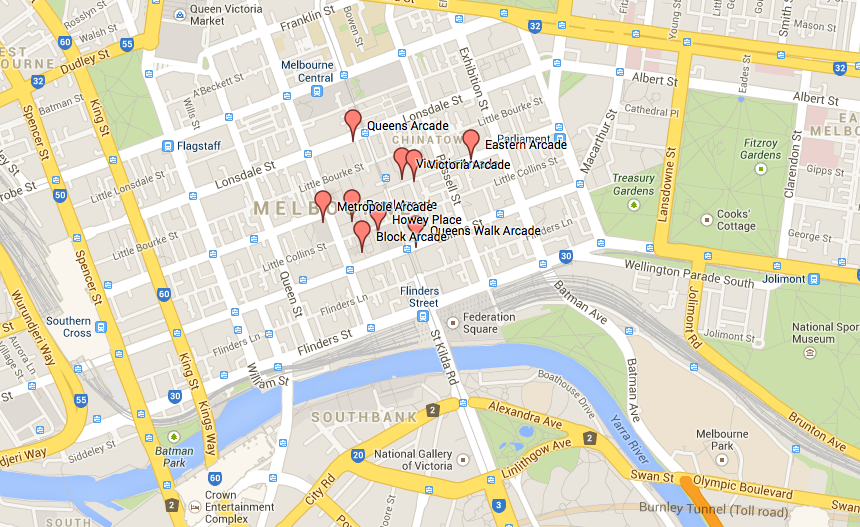
So I always knew you could create a custom map on Google. But didn’t think to do one basic one for the nineteenth-century arcades in Australia until I did my post the other day about creating maps in TileMill.
I am not sure yet how much you can customise these custom Google Maps but for the moment it is a good little reference point. And it means other people can see it and imagine these buildings in relation to the street layout of today.
So here is the link to the map for those who want to check it out. Please let me know if you can’t see it!!
Between 1853 and 1893 approximately 12 glass-roofed shopping arcades were built in the the colony of Victoria. Influenced by the numerous examples built in Europe from the late eighteenth century onwards, these buildings were hailed as symbols of the colony’s modernity and progress.
The majority were built in the central business district of Melbourne, but some also appeared in suburban Melbourne and regional cities. For many years Victoria was the only state to boast these forms of architecture, followed by Brisbane in the 1870s, then Sydney, Perth, Adelaide and various regional cities in the 1880s. The building of arcades in Victoria ceased after 1893, possibly due to the economic depression that affected Australia so greatly in this decade.
In the first half of the twentieth century, arcades were built all over Australia, from capital cities to small country towns; arguably they were an influence on the suburban shopping arcade and the large shopping centres of the second half of the century.
I say there were approximately 12 arcades, but I have glimpsed hints of some through newspaper reports and such for which I have little further information – and there may even have been more. If you have any further examples or know any information about the arcades listed I would love to hear from you!
Today I will just leave you with a short list of the nineteenth-century arcades of Victoria and will return to discuss them in further detail at a later stage.
1889 Queens Walk Arcade, Collins & Swanston Streets, Melbourne
1890 Howey Place, Little Collins Street, Melbourne
1891 Metropole Arcade, Bourke Street, Melbourne
1892 Block Arcade, Collins Street, Melbourne
c1892 Bendigo Arcade, Hargreaves Street, Bendigo (on the site of an earlier arcade?)
1893 Kings Arcade, High Street, Armadale, Melbourne
EDIT: Sadly I’ve had to strike the Kings Arcade off the list! I’ve discovered that it was actually a single block of shops until the 1920s, when it was turned into an arcade. I was doubtful that it was all nineteenth century from visiting it but this was confirmed when I visited the National Trust (Victoria) and looked at some of their files. Such a shame that now I can only say that there was one nineteenth century suburban shopping arcade in Australia – the Prahran Arcade!
ANOTHER EDIT: Or was their only one … tantalising hints are surfacing!
I have finally decided that I really have to do something with this blog! Let’s start with baby steps!
#ArtsHack 2013 was a great series of workshops organised for arts students by the University of Melbourne last year. ITS Research at Uni does the great job of ’empower[ing] researchers to do great things with IT.’
TileMill/Mapbox are in fact the mapping platform for websites and apps like foursquare, pinterest & two of my faves Direct Me NYC 1940 & 1940s New York. The possibilities really are endless & you can see more on the Mapbox Showcase
You can do numerous extremely complex maps in TileMill and my group did a more simple one that pinpointed institutions that displayed antiquities in the city of Melbourne. My own test version was even simpler and, for the purposes of my thesis, I wanted to do a map of locations of nineteenth-century shopping arcades in Australia.
It was very fun to tinker with it but I am not sure for my purpose that I wouldn’t simply be just as happy creating something in Photoshop, with which I am far more familiar. But if you are doing extremely complex mapping projects, I think TileMill – just one of the many mapping programs around – could be great.
Anyway – here is my humble little map which will give you a great idea of where the Fashionable Promenades were built in 1800s Australia! Never fear … in the next few days I will start giving you some lists of what and where they were!




 A fashionable promenade