Welcome back! This week’s post started off as a very quick musing on something I became interested in during my thesis but had ended up as a dead end. So, I very quickly wrote a ‘short’ post on it, thinking I might just think through some of the issues. Of course, this short post is now a bit of a long read, as I keep thinking of further avenues to investigate and it’s turned out much longer and more intricate than expected. It is now something of a thinkpiece on my own history practices as well as a specific site. But I hope it’s enjoyable for its dive into mid-1800s Melbourne during the goldrush years, layers of urban history, and some of the sources that we look at when doing this type of research.

During the research and writing of my thesis, there were a few arcades that bothered me. With some I couldn’t figure out if they’d been arcades in the nineteenth-century or had been modified in the twentieth. Still others bore the name ‘arcade’ and were mentioned in the newspapers but I was uncertain, if there were no descriptions, that they were the type of arcade on which I was focusing: with shops running along a central promenade (and usually a glass roof). In colonial Australia, the word ‘arcade’ was used for these types of buildings but also others, including large furniture or mixed business shops and, famously, for the Coles Book Arcade in Melbourne.

And then there was the Victoria Arcade in Melbourne. Early on in the research I came across this beautiful image (above) in the State Library of Victoria, depicting a beautifully ornate arcade, with some inscriptions.

Victoria Arcade, now erecting in Bourke Street East

Wharton & Burns Architects & Surveyors
30. Collins Street Melbourne

John Black, Proprietor
J.S. Campbell & Co., Lithographers

It also has a small ‘handwritten’ signature identifying the artist: STG – for Samuel Thomas Gill – and the date [18]53.

ST Gill, Victoria Arcade, Bourke Street East, Melbourne, 1853. SLV, H2087

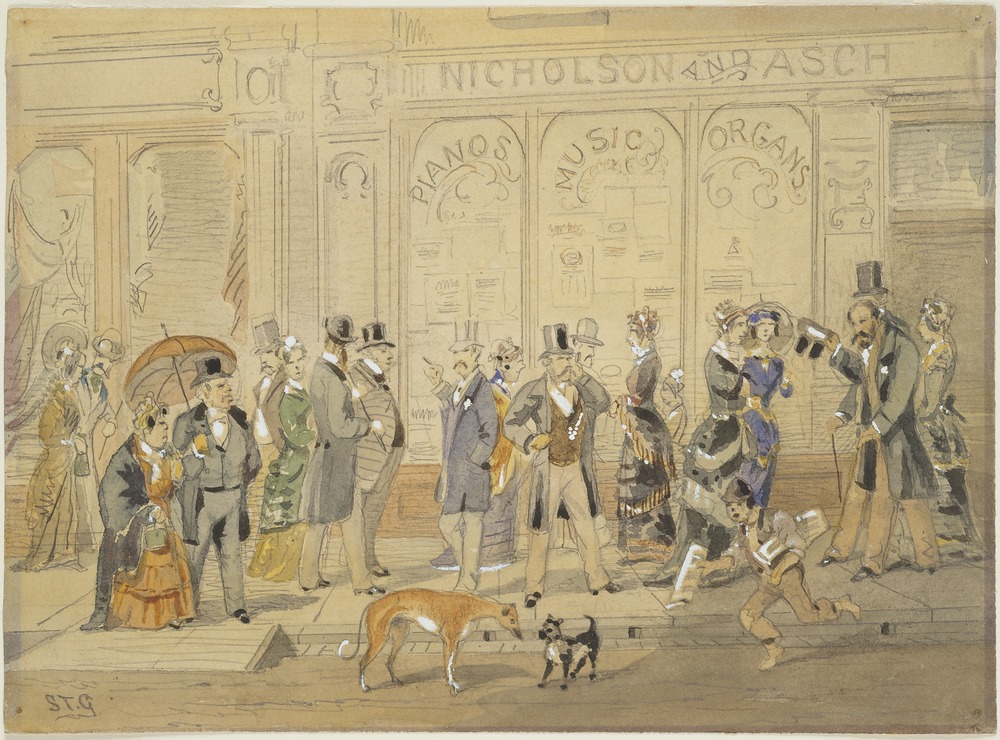
Three years later, ST Gill, would go on to do a small sketch of the Queens Arcade and was to become a well-known and prolific chronicler of goldrush Victoria, including its urban environments. Even later, he would do another lively street scene in front of the Royal Arcade, completed in 1870, also on Bourke Street.

Possibly a companion or slightly earlier piece to that of the Victoria Arcade is another lithograph by Gill (below), also dated 1853, of Black’s Tattersalls Horse Bazaar on Lonsdale Street.

ST Gill, Tattersalls Horse Bazaar, Lonsdale Street, Melbourne, 1853. SLV, H2156

These two artworks demonstrate a grandeur and elegance that Melbourne entrepreneurs and officials were at pains to emphasise during this period, as they tried to ‘improve’ and ‘civilise’ the fledgling city. In reality, Melbourne at the time was far from this, with a rapidly expanding population due to the goldrush. Many still lived in the tent encampment south of the Yarra and other temporary structures, as well as portable (kit) iron and wood buildings imported from England, were erected to provide residential premises; the city was a building site, as the construction tried to catch up with the needs of the population.

Seeking to take advantage of this was entrepreneur John Black, born in Lancashire of Scottish ancestry. He arrived in Australia around 1852, likely drawn by the lure of the goldrush. Having worked for a London merchant prior to emigration, he promptly set up carrying goods between the goldfields, Geelong and Melbourne (Gibson-Wilde, 25). An advertisement in Pierce’s Commercial Directory from 1853 shows that he also had ‘stores’ on the goldfields, likely supplying a wide mix of needs for miners including food and equipment.

Goldrush immigrants often made more from businesses such as this than they ever would from gold and it appears that Black made a solid fortune in a short time. On 1 November 1853 John Black (as well as a man named Edward Gilbert) obtained an auctioneer’s license in Melbourne, likely in preparation for his two new ventures: the horse bazaar and the arcade.
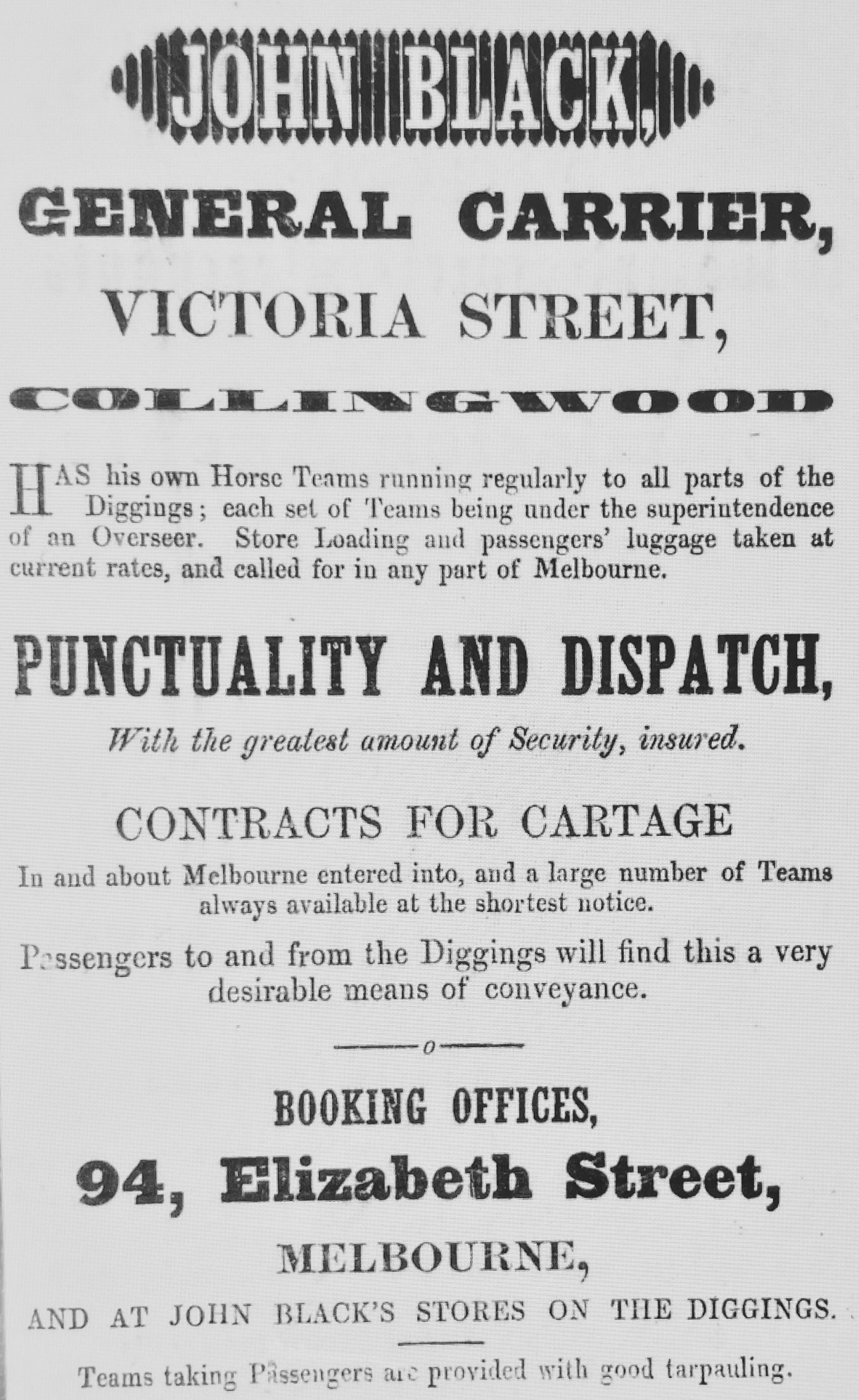
Pierce’s Commercial Directory, 1853. State Library Victoria
John Melton Black, c1866–1867? Townsville City Libraries via Flickr

Black probably commissioned Gill to make the images of Tattersalls and the proposed Victoria Arcade when one or both buildings were in the planning stages. The Argus reported on the completed horse and cattle bazaar on 14 November 1853, noting it was an arcade-like structure “used for an hotel, livery stables, auction mart, cattle-yards, coach-house, warehouse for vehicles &c” (14 November 1853).

An advertisement from the Argus on 4 November 1853 tells us that plans for the arcade were publicly displayed in the finished bazaar for prospective tenants to view.

VICTORIA Arcade.—Parties requiring Shops in the new Arcade, Bourke street, are requested to apply early. The plans are to be seen at Tattersall’s Bazaar. Lonsdale street east. (4 November 1853, 8)

The Illustrated Sydney News told readers in greater detail about this planned urban enterprise:

COLONIAL ENTERPRISE.—Spacious as Mr. Black’s new Tattersalls, in Lonsdale and Bourke-streets, undoubtedly is, and creditable alike to the proprietor and the colony, it will be thrown completely into the shade by a new arcade which the same spirited speculator is about to erect as a continuation of the new Tattersall’s.

Immediately opposite, and running in a straight line, is the full acre allotment, the property of Mr. [O’]Sullivan, the timber merchant, and this gentleman has leased it to Mr. Black for eighteen years, at a rental of £3000 per annum. On this acre Mr. Black has bound himself down, in a heavy penalty, to erect an immense arcade, to consist of two-storied shops, forty feet high.

The two end buildings leading into Great and Little Bourke-streets, respectively are to be each four story houses; the whole is to be roofed with corrugated iron, and entirely finished by the 1st of April next. Every house is leased already at £250 a year (serving for both residence and business premises,) the tenants each paying down a bonus of £1000 on taking possession. This will probably be the most gigantic undertaking entered into by one individual south of the line. (26 November 1853, 4)

Until I found the Gill Victoria Arcade lithograph, my research suggested that no other building of this type was built in Melbourne between the Queen’s Arcade in 1853 and the Royal Arcade in 1869–1870 (one newspapers made a point of this lack when discussing the latter!).

An arcade named the Victoria – more properly the Victoria Arcade & Academy of Music – was later built on Bourke Street East in 1877, almost opposite the site slated for the 1854 Victoria Arcade. In addition to an arcade with shops, it included a theatre. This later became known as the famous Bijou, which ultimately had greater longevity than the arcade itself. While that is a story for another time, it confused me quite a lot when I found the 1853 Gill image. It was very common in nineteenth-century newspapers to not give a street address, so I wondered, was this an earlier iteration of that arcade? But it could not be as it was clearly identified as being on the opposite site of the street.

I then found a couple of newspaper reports in the 1850s that mention a Victoria Arcade as though it was completed: one year after it was first announced, we see a classified for a ‘Cook-shop to Let, with Fixtures Complete’ is identified as ‘next the Victoria Arcade’ (Argus, 10 November 1854, 3), while Chapman’s Music Warehouse is mentioned at Victoria Arcade a week earlier. Unfortunately, these seem to be simply mistakes of naming: Chapman’s, which was still in existence in the mid-1890s, was definitely located in the Queens Arcade, as many advertisements attest. It seems it would be an easy confusion, the Queen of the eponymous arcade of course being Victoria.

So what was happening here? Was the arcade built or not?

One fabulous source for identifying early buildings and their construction dates in Melbourne are the wonderful leather-bound volumes of building notices from the Melbourne municipal council, now held at Public Record Office of Victoria (PROV). They’re a little tricky to use and it doesn’t help that usually there often only a street name and not an address for these proposals, in the first two volumes at least.

When I delved into them (and it was wonderful!), I found some hints. In the first volume (1850–1853) I located a notice – 1118 for the year – ‘To build a Horse Bazaar’ on July 8 1853, with John Cotter named as builder for owner, John Black. On the next page, we are informed that works had commenced and the fee charged was £4.

John Black’s notice to build a horse bazaar, 8 July 1853. Public Record Office Victoria, Building Notices Register and Index (VPRS9289), VPRS 9289/P0001/1, 10/01/1850 – 18/08

But nowhere in late 1853 or early 1854 did I find a mention of a Victoria Arcade (although the Queens Arcade did appear in 1853). In the second volume, though, on 1 June 1854, Black’s name appears in the book at the head of another venture, with the notice of intent ‘to build a theatre’ on Bourke Street. This was the famous Theatre Royal, which opened very late in 1854, renowned in Melbourne until its last performance in the 1930s, but likely partly the causes of Black’s insolvency in 1855.

John Black’s notice to build a theatre, 1 June 1854. PROV, Building Notices Register and Index (VPRS9289), VPRS 9289/P0001/2, 18/08/1853 – 31/07,

Looking at other evidence, it becomes clear that the theatre was in fact built on the site slated for the proposed the Victoria Arcade in the Gill image, only 12 months after initially announcing the construction of the arcade.

An amazing c1860 map (known as the ‘Bibbs Map’) has been digitised recently in super high res and added to the City of Melbourne’s wonderful mapping site, with plans and aerial shots of the city layered over time. In it we can see that the Horse Bazaar and Theatre Royal ran in a straight line from Lonsdale to Bourke streets, just to the east of Swanston Street. We also know from the Illustrated Sydney News article above that the Royal was located on the the block of land where the arcade was to be constructed.

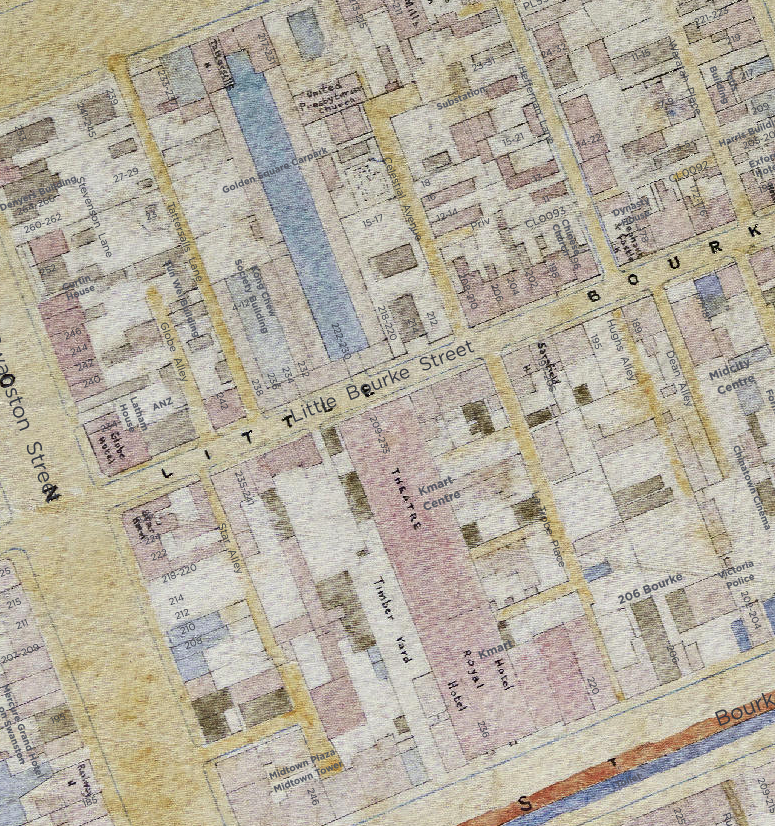
‘Bibbs’ map of Melbourne, c1860 (detail) showing Tattersalls Horse Bazaar at c222–230 (in blue) and Theatre Royal at c209–233 (in pink) Little Bourke Street. City of Melbourne Art and Heritage Collection, 1646167. This version is from City of Melbourne’s site maps.melbourne.vic.gov.au
‘Bibbs’ Map, c1856, showing Tattersalls and Theatre Royal. PROV, VPRS 8168/P3 Historic Plan Collection, Unit 46, MELBRL 12 Melbourne: [Melbourne. n.d.]

An earlier version from c1856 above, is also available in high resolution at Public Records Victoria, showing both buildings in greater detail, and its history is discussed in my colleague Barbara Minchinton’s article in PROV’s journal, Provenance.

I’ve not yet located any article that indicates that any decision was made to abandon the arcade nor construct the theatre. Perhaps these will turn up one day – I’ve not given up searching but it’s highly likely Black did not want to make a pronouncement about the change in his plans.

One advertisement for the sale of a partially completed ‘New Theatre’ in October 1854 is likely the Theatre Royal, as is the call for tenders for the completion of a theatre in early December. But the first mention of it definitely as Theatre Royal that I’ve found so far in the papers is the announcement on 22 December for its opening the following day.

On 23 December the theatre opened but in an incomplete form, with just the entrance buildings and promenade entry completed. That day the Argus advertised the ‘GRAND OPENING of the Lower Saloons and Superb Entrance Hall to the New Theatre Royal, Bourke-street east’, featuring performers such as Mrs Hancock, Miss Octavia Hamilton and infant pianist Miss Minnie Clifford, and performances continued in the promenade – Black perhaps needing to recoup some of the money already outlaid on his building ventures.
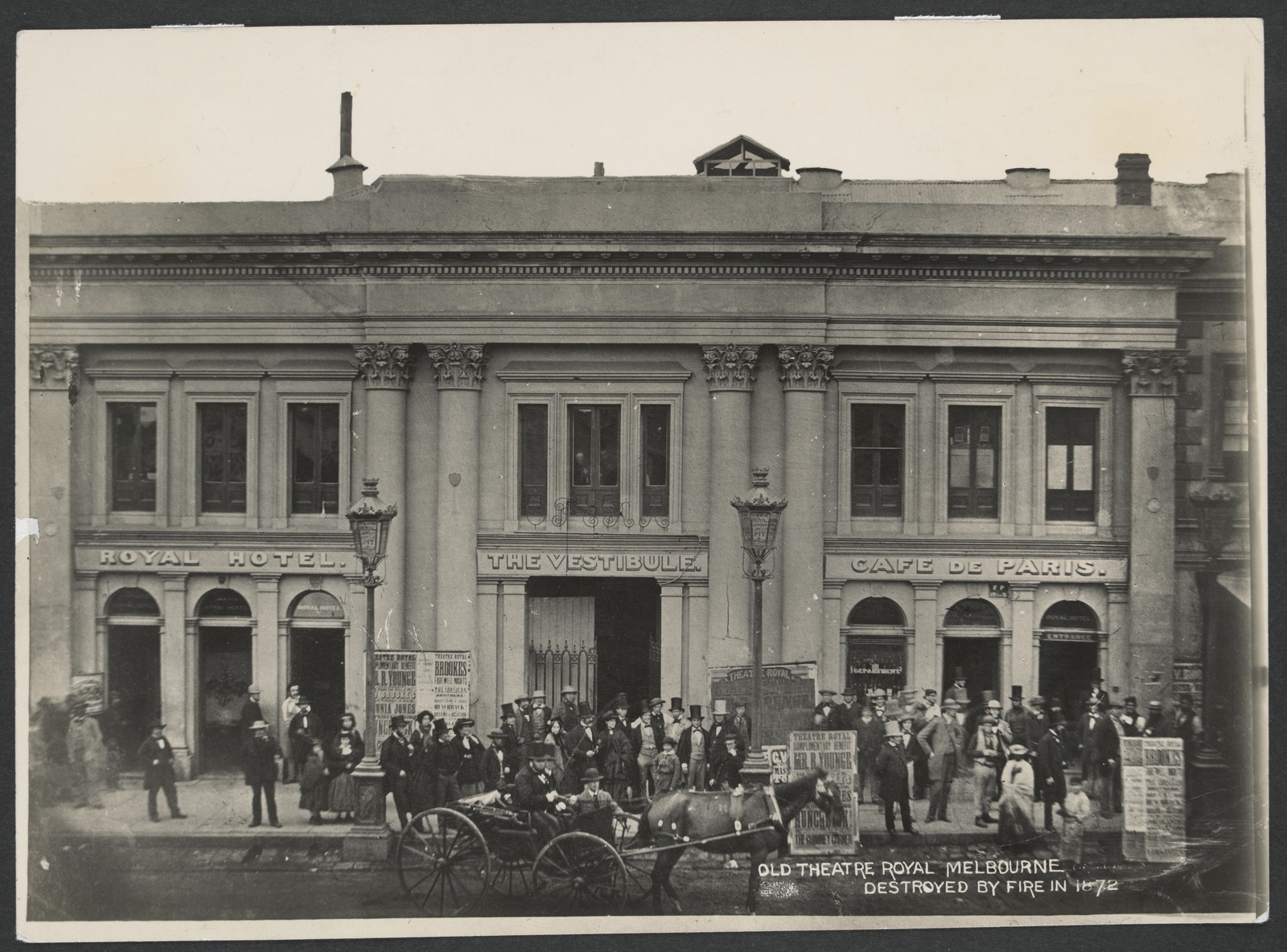
Theatre Royal, Melbourne, c1859? Photographer unknown. Copied? by Sears’ Studios, 1933. State Library Victoria, H20742

Looking at commercial directories is also a way to trace the development of buildings in the city. State Library of Victoria (SLV) and University of Melbourne have the well-known Sands & McDougall directories online for a selected number of years from 1857 to 1974 but all are too early for this conundrum.

So, I visited SLV and the helpful staff in the Newspapers & Family History Reading Rooms to investigate the earlier directories – held on microfiche. In Joseph Butterfield’s directory for 1854 (which would have been prepared in late 1853 or early 1854), there was no evidence of Tattersalls or an arcade. But the former appears in the same directory for 1855, named Tattersal’s (sic) Repository and Tattersalls Hotel, as does the Theatre Royal at 73 Little Bourke Street East as ‘New Theatre and Hotel Building’.

It was in fact not until mid-1855 that the theatre was fully completed and finally opened on 16 July. A large article singing its praises appeared in the Argus the week before:

As this magnificent Temple of the Drama is announced to be opened for the first time on Monday evening next, a narrative embodying the history of the edifice, and a description in detail of what has already been effected, may be interesting. … Mr John Black … notwithstanding many impediments which have periodically opposed themselves to the work he took in hand, has now the satisfaction of seeing his design practically carried out. (10 July 1855)

The article praises Black’s vision for the theatre – completely omitting that the site had once been slated for an arcade only 18 months previously. It tells in detail of the architecture and fittings and compares the building to London’s Covent Garden and Drury Lane theatres and the expenditure of £60,000 in its construction (an amount equating to perhaps 9-10 million Australian dollars today).

So, why abandon the arcade idea? Did the cost of the building proposed in the first Gill image prove prohibitive? Did a theatre seem like a more secure return for Black’s outlay? Perhaps with the opening of the Queens Arcade in December 1853, there was insufficient interest in another similar edifice? Ultimately, it was probably a sound decision; the Queens was not a huge success and was converted to a hotel and dining rooms by around 1860, while the theatre lasted in some form for another almost 80 years.

Much of documentation related to the parcel of land since 1851, several years before Black built the theatre, are preserved in the Coppin Collection at State Library Victoria (SLV). Possibly one of the most famous nineteenth-century Australian actors and theatre entrepreneurs, George Coppin, took over the Theatre Royal from Black in 1856. The collection include leases and mortgages, not just for the theatre but also for the lots on which Tattersalls stood.

Prior to March 1854, fellow auctioneer Edward Gilbert took over Tattersalls from Black, possibly to free up funds for Black to build the theatre, and documents related to a mortgage between the two for that land and the Tattersalls business is also contained in this collection. They also show a number of varied interests in the theatre by a number of other Melbourne businessmen. These documents show and intricate and complex shuffling of money to try and finance new buildings in the rapidly growing city.

While the theatre itself was long-lasting, the financial woes of the colony likely caused issues for a number of those invested in both it and Tattersalls, including Black. The same article that praises the new building goes on to indicate that the financial troubles over the past year had made the work difficult. Following the exuberance of the first years of the Victorian goldrush, in 1854 a recession hit, causing significant unemployment (Broome 1984, 87), and this downturn seems to have been blamed for the slow construction of the theatre. As Dorothy Gibson-Wilde notes, several days later, Black was accused by letter writers in the Argus of underpaying workers and owing money to contractors (Gibson-Wilde, 2009, 108). But this was the least of Black’s troubles.

A humorous cartoon from Melbourne Punch, 2 August 1855 depicts the Theatre Royal box office, as ‘Mr Fastemanne’ invites two ladies to the theatre. Drawn at the same time many associated with the Theatre were in financial trouble, this perhaps was also a subtle hint at those problems. Artist: Nicholas Chevalier. Engraver: Frederick Grosse. SLV, MP00/00/56/73

We can see from the documents at SLV that huge sums of money were involved in developing both Tattersalls and the Theatre Royal, and that they inevitably bankrupted several people involved with them. The original mortgage above, was in the amount of almost £35,000 that Gilbert would owe to Black, who had spent considerable money on the Tattersalls buildings, and the theatre purportedly cost £60,000.

Gilbert almost immediately tried to lease and then sell the Horse Bazaar and, by June 1855, its abject failure resulted in his insolvency. Losses on the Bazaar totalled over £13,000. In one insolvency hearing in November that year, the Commissioner noted:

the insolvent had placed the whole of his capital in the speculation of Tattersalls, which speculation had unfortunately turned out an entire failure. (Argus, 12 November)

At the same time, Black was also declaring insolvency. While this has been blamed on the expense of the building the theatre and the fact that Black probably wasn’t the best theatre manager, it certainly should also be attributed to the economic downturn. Gilbert’s insolvency report in fact made specific mention of

the period when the insolvent took possession of Tattersall’s Horse Bazaar. The colony at that time was in the very height of prosperity. Speculation and enterprise were driving men on to undertakings of inconceivable magnitude; and there is no doubt that the insolvent was inoculated with the spirit of the times, and with his capital at hand aspired to become the master of a building which presented at that moment a princely fortune. (Argus, 23 August 1855)

But it also seems that those with vested interests in the business blocked him from selling it to Coppin earlier, when he might have broke even. For several years, the shadow of the failure of Tattersalls and Theatre Royal, followed others – also resulting in the insolvencies of Gilbert and Black’s solicitor, Frederic Bayne, who had taken on Black’s interests following the latter’s insolvency, and of John O’Sullivan, to whom Gilbert’s mortgage from Black had been transferred in 1854 (and who is listed as Tattersall’s proprietor, together with E Gregory, in the directory mentioned above).

Black himself got back on his feet, becoming manager of the new Princess Theatre on Spring Street for several years. Later, he moved to Queensland, where he became the founder and first mayor of Townsville, before returning to England in the late 1860s and dying wealthy man in London in 1919 (Gibson-Wilde 1982, 2009).
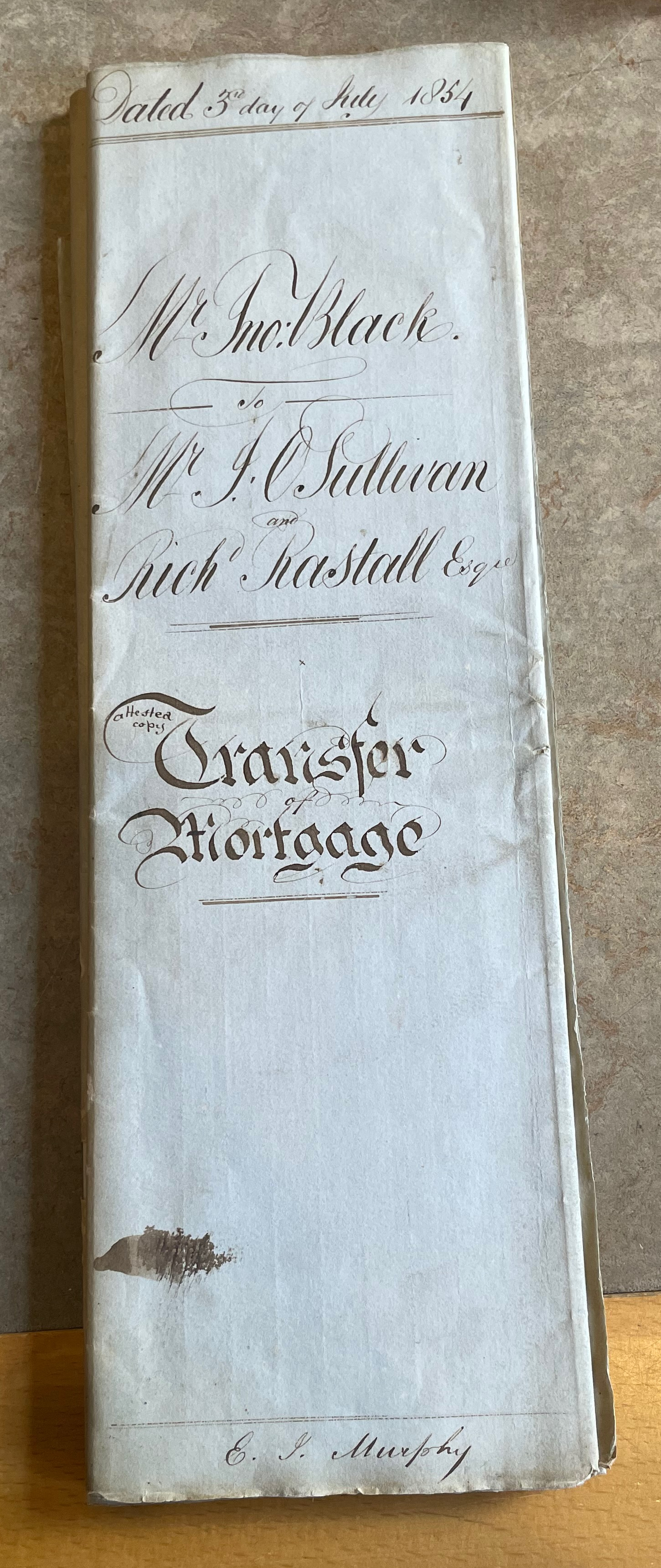
One of the documents related to the mortgages for the Theatre Royal. Between John Black, John O’Sullivan and Richard Rastall, 3 July 1854. State Library Victoria, Coppin Collection, MS SEQ 8827 BOX 13/3

Despite these beginnings, George Coppin was to make a great success of the Theatre Royal. He put on successful entertainments there for the rest of the nineteenth-century. Although the 1854/5 version was destroyed by fire in 1872, Coppin rebuilt a newer and even more impressive edifice immediately after and the theatre remained a popular Melbourne entertainment spot until its demolition in 1933.

Reading between the lines of these articles, and their silences, does make me wonder if the façade buildings of the theatre were, in fact, originally intended as the front of the arcade, although with modifications to the design. If we look at the images of the original theatre, we see that similar arched windows/entries planned for the arcade are also seen in the theatre entrance building. The centre entrance to the vestibule also mirrors that of the arcade, but with a square rather than curved arch. It also has not only wooden doors on the vestibule entrance but iron gates similar to those planned for the Victoria Arcade and which were common to buildings of this type.

I’ve been pondering this possibility for a long time and have really not come to any concrete conclusions. There were always more and better documented arcades to discuss in my thesis. But this is another rabbithole that I’ve jumped into the last couple of weeks and has led me down an archival adventure to be sure!

Perhaps other sources will also give an idea, such as diaries or letters from the period. I’ll also potentially do a systematic read through the newspapers for this year, rather than simply doing keyword searches in Trove. A few issues arise with searching online newspapers that mean you’ll never be quite certain to capture everything. One is that you inevitably come up with thousands of many options when searching, especially for the word ‘arcade’ or ‘Victoria Arcade’ or even ‘Victoria Arcade’, ‘John Black’, ‘Bourke Street’. Another issue is that often the quality of the printing of some original papers means that the OCR (Optical Character Recognition) doesn’t recognise everything accurately (hence Trove has an army of volunteer editors to correct the final results).

So, that’s where I’m at with it right now with this work-in-progress. When I do a bit more digging, I may have an update.

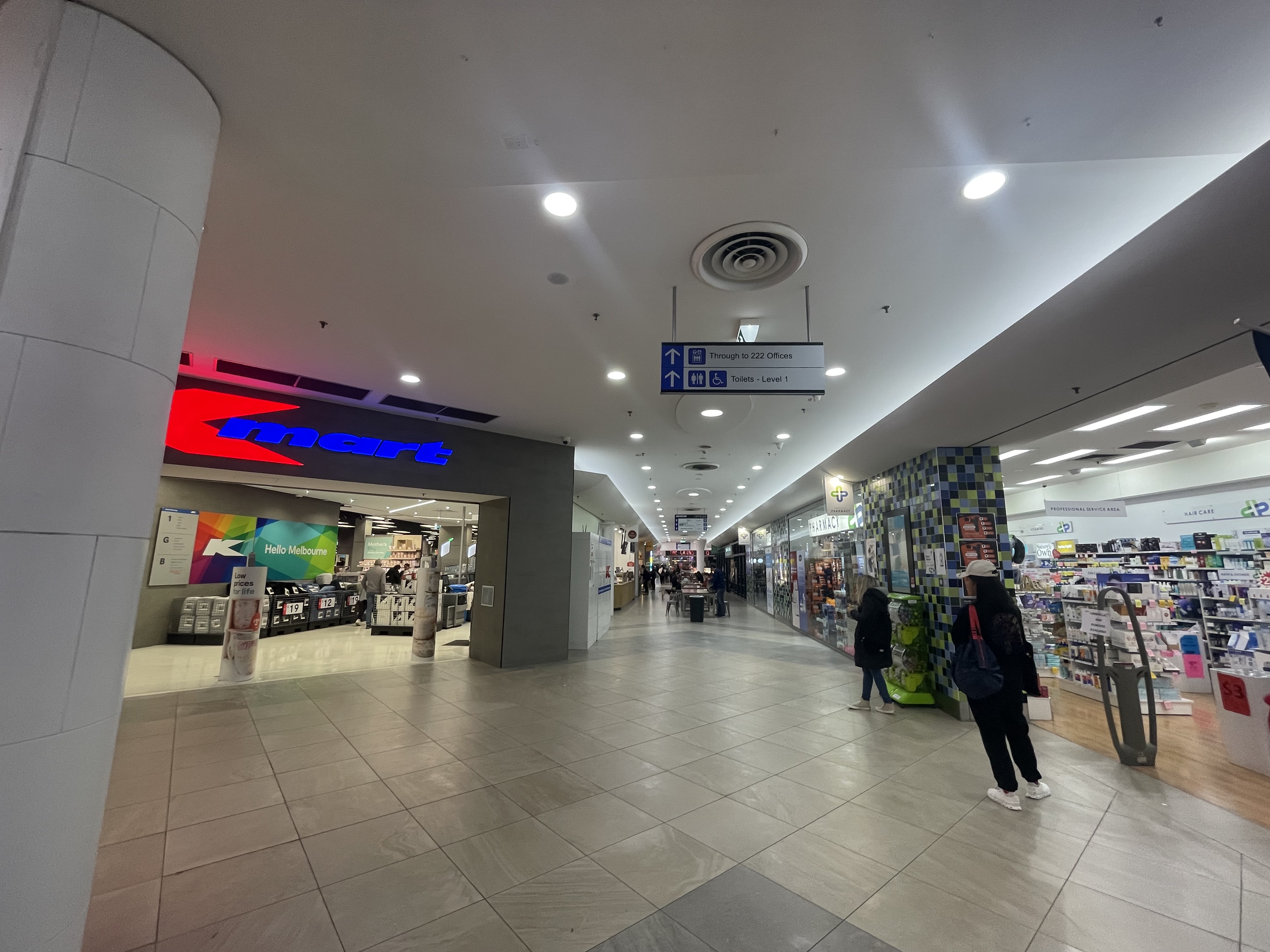
A postscript though: there is a twist in the fate of the site itself that might have had Black wryly shaking his head. After the Theatre Royal was demolished in 1933, the valuable site saw the construction of the large Mantons department store in modern Art Deco style. This business was eventually taken over by GJ Coles in the 1950s. The facade of Mantons was covered over and it was occupied by a succession of variety stores owned by the parent company of Coles-Myer : Coles Variety, then Target and, in 2021, KMart.

At some point during these changes, probably around 1994, renovations to the building included the formation of an arcade running through from Bourke to Little Bourke and, although modern and utilitarian, it runs just slightly to the left of where the promenade of Black’s planned arcade would have.

Exterior, Manton’s drapers, 226-236 Bourke Street, Melbourne, Lyle Fowler, c1952 H92.20/4125
Kmart Centre arcade looking from Little Bourke Street end, 2024. The Royal Theatre (and site of the Victoria Arcade) would have been where the main Kmart store is now. Photographer: Nicole Davis
Sign on KMart’s entrance about the site, 2024. The image is actually incorrect. This is not the Theatre Royal but the adjacent Hoyts Esquire/Deluxe movie theatre, later Mantons department store. Mantons later bought the Theatre Royal site to extend their store and built the the new Deco facaded building next to this Federation edifice. (Cooper 2020)

In October last year, along with other members of the Melbourne History Workshop (MHW), I presented at a public seminar, ‘Untimely Ends: Using Inquests for Family and Local History‘, at Public Record Office Victoria (PROV), which focused on a specific collection of documents at PROV. We looked at the broader details of information you can find in these Inquests (Series VPRS 24) and how to use them in historical research. You can find more information on the MHW website, including the PowerPoint of the talk, which is full of useful material.

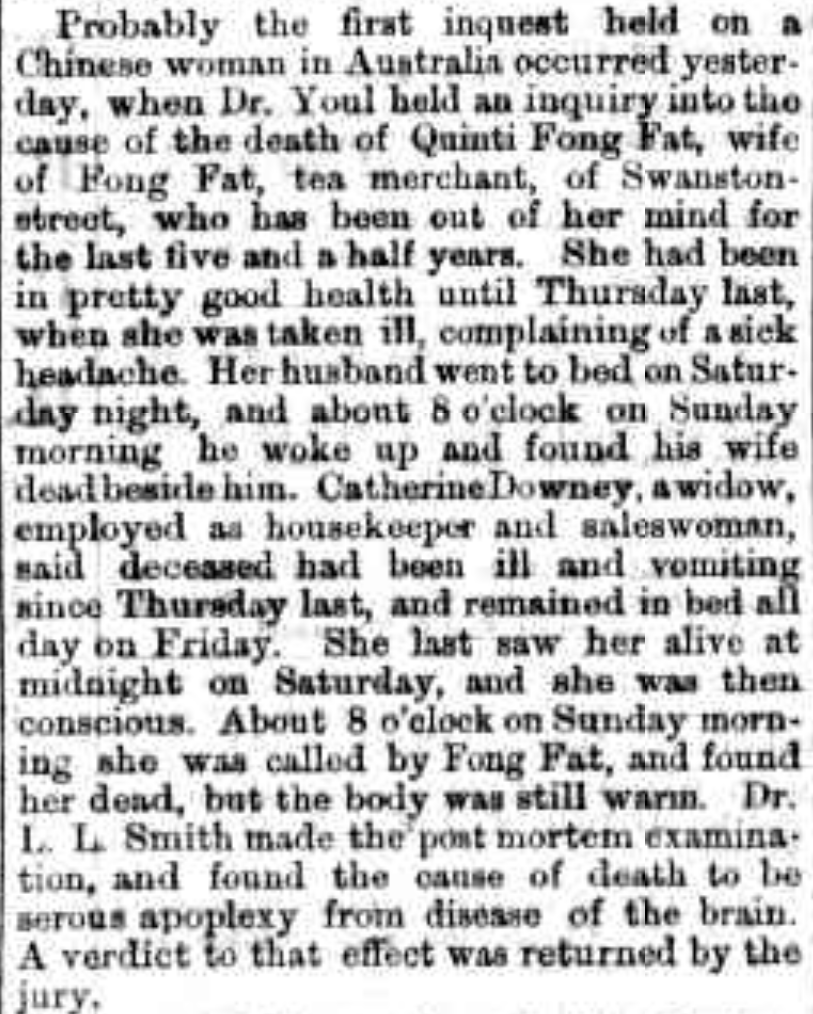
For my specific section, I talked about some research that I have been doing on Fong Fat, the Chinese owner of several Fancy Goods stores: two on Swanston Street and one in the Eastern Arcade in the 1860s and 1870s (although not all at the same time). The inquests research revealed more about his story but, more significantly, gave some greater detail about the women in his family: his daughter, Ah Chow; his first wife, Chinese-born Quinti; and his second wife, English immigrant Catherine Downey, formerly the family’s housekeeper and shop assistant.

In the last post on Fong Fat, I wrote about English-born New Zealander Charles Rooking Carter‘s comment on the shopping opportunities in the city of Melbourne in 1869:

he could find only one handsome Chinese shop in all Melbourne, and that was kept by ‘celestial’ individual rejoicing in the name of Fong Fat. He indeed, had an excellent display of Chinese fancy goods, in the way of carved ivory work, ebony work, porcelain baskets — besides tea and tobacco.

Carter, Victoria: The British ‘El Dorado‘ (1870)

Fong Fat’s shop, at 96 Swanston Street, near Little Bourke, was joined by another at 48 Bourke Street, in 1871 and then by another, in 1872, in the new and prestigious Eastern Arcade on Bourke Street. It was this shop that led me to Fong Fat and his story. In my research work on nineteenth-century Australian shopping arcades I came across advertisements for the wares that Fong Fat sold in the arcade, including imported Chinese homewares, bric-a-brac, fireworks, tea, and tobacco.

Advertisement for Fong Fat’s Eastern Arcade store, Herald, 20 December 1872, 4

While we imagine arcades in this period, and indeed Melbourne itself, as rather heterogenous and white, Chinese, Indian, Afghani and other non-European shops appeared in them to satisfy the taste for, to European eyes, exotic products from these regions. These shops and the stories of their proprietors demonstrate that Australia and its urban centres were more cosmopolitan that we often imagine.

The image we often have of the Chinese in Australia is of goldfields immigrants, sojourners that return or intend to return to China after making their money, who send their profits home, and whose Chinese wives that are left behind with the extended family. But, as scholars of the Chinese-Australian experience such as Sophie Loy-Wilson and Kate Bagnall, have explored, the story is far more complex. Many also decided to remain in Australia, becoming an integral part of Australian urban and regional life.

Fong Fat’s life is a one of those that little different to the Chinese sojourner trope, as is that of his family. Born in Canton around 1820, he came to Australia about 1857, presumably for gold, and established himself as a shopkeeper. He died in Stawell in 1884 after having married English-born widow Catherine Downey in 1872. This aspect of his story is really interesting, although not so highly unusual for Chinese-Australian men of the period; quite high numbers began relationships and had children with non-Chinese women. What intrigued me even more though was the story of his first family.

As I searched through Trove, as you do, for newspaper reports on him, I found some intriguing articles about two inquests in which he gave evidence. The first was that of four-month-old Ah Chow, the child of Fong Fat, who died in 1865 of inflammation of the lungs. The second, was that of his Chinese wife Quinti whose death, five years later, was caused by a stroke, and the newspapers claimed was probably the first inquest on a Chinese woman in the Australian colonies. These stories really intrigued me because our general story is that almost no Chinese women were present in Australia during this period. The Victorian census records indicate that there were eight Chinese women in 1861 (although 7% of the total population was China born), which grew to 31 in 1871. But there were a very very small number, of which Quinti was one .

Report on the inquest of Ah Chow, The Age, 10 July 1865, 4
Report on the inquest of Quinti, The Age, 17 May 1870, 3. The report mentions Catherine Downey, who was soon to become Fong Fat’s second wife

Interested in finding more, I obtained the inquest records (now almost all digitised!) from PROV, which told us a little more about the findings of the coroner, although the majority of the information was really quite well reported in the newspapers. But the inquests help to personalise this much more as we read the words of Fong Fat’s testimony for both his little daughter’s and wife’s deaths (the second was given through a translator). Like many testimonies, they seem dry, but we can imagine the probable distress of the father and husband at these events. Of Ah Chow’s death he stated:

The deceased female infant Ah Chow was my child. She was 28 days old. She was healthy up to the day before yesterday. She was in bed with her mother when I went home at 12 o’clock at night. My wife was crying. I saw blood coming from the child’s mouth. I went for a doctor but he was not at home. The child was alive then but lived only two hours.

Inquest deposition of Fong Fat in the death of his daughter Ah Chow. Public Records Office Victoria, VPRS 24 P0000 Unit 167, 4

The inquests are also interesting as they not only have testimonies from Fong Fat but also non-Chinese associates. This includes, in the inquest of Quinti, their housekeeper and shop assistant in Fong Fat’s store, Catherine Downey. Name sound familiar? Yes, this is the English-born widow that he married in 1871 and was his wife until her death fifteen years later!

I approach the history of urban Australia often in through the avenues of family history such as this. Using the personal stories of individual personalities to tell bigger histories and revealing larger events, such as the goldrush and its aftermath, Chinese migration to Australia, and the history of the city. Someone like Fong Fat, making his way in a city we often envisage as European and the presence of his Chinese wife and child, gives a different complexion to our imagination of Australia during the period.

Once I had found the inquests, I sourced as many other documents as I could to build a picture of these people and their lives – more newspaper reports, including advertising for the shops, stories about a court case Fong Fat’s second wife brought against someone, records of Catherine’s burial in the Melbourne General Cemetery and the gold that is the death certificates of Ah Chow and Quinti, which told us a little about them. Quinti, we find was born in Canton in around 1846 and had come to Victoria in around 1864 or 5, presumably to be a wife to Fong Fat. She quickly bore her only child, Ah Chow, in the colony, only to lose her, and then to die herself five years later.

The inquests themselves are only suggestive of what life would be like for Chinese women in Australia. Unfortunately, there is not a lot of detail in these particular ones but … in many other inquests we would receive a wealth of other detail about individuals. The death certificates reveal a little more, but they add to the story we are building. Importantly to me they also disrupt the idea that Chinese women were not present in Australia at all and the trope of the single sojourner Chinese man.

I think they also put a human slant on the often racialised and sensationalised newspaper reports about the Chinese community in the colonial city.  Together with all these other documents, the inquests provide another window into the lives of Fong Fat, Quinti and their baby daughter, as well as his second wife, and show how these types of records can provide more detailed information and illuminate the stories of Australian families.

I could find only one handsome Chinese shop in all Melbourne, and that was kept by a ‘celestial’ individual rejoicing in the name of Fong Fat. He indeed, had an excellent display of Chinese fancy goods, in the way of carved ivory work, ebony work, porcelain baskets — besides tea and tobacco. (Carter 1870, 54).

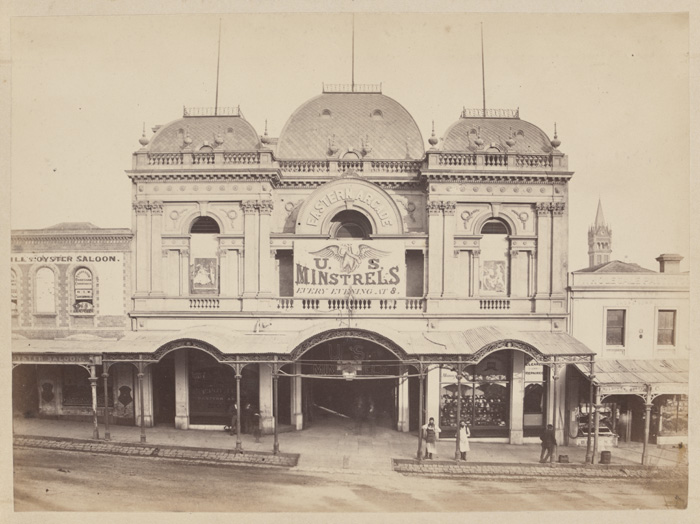
Eastern Arcade
View of the Eastern Arcade, Bourke Street, Melbourne, 1877. Photographer: NJ Caire. State Library Victoria, H84.3/11.

In 1873, four businesses in the Eastern Arcade, Bourke Street, Melbourne, were listed as fancy goods dealers. Popular in arcades and in locations on the city streets, fancy goods stores had a wide variety of products for the home and personal use.

One of these was occupied by Chinese merchant and importer, Fong Fat, whose store occupied two shopfronts – numbers 11 and 13 – but his fancy goods were a little different to many of the products to be found in similar stores in colonial Melbourne and, indeed, in the Eastern Arcade.

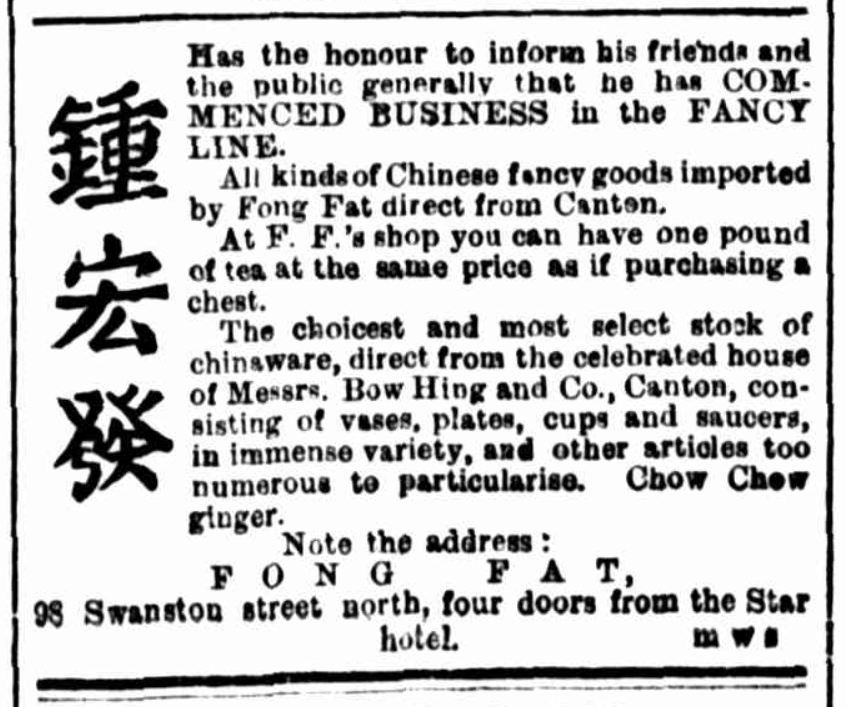
Fong Fat was already well-established in the city as a fancy goods dealer, having run such a business at 98 Swanston Street since July 1868 (Herald, 18 July 1868, 1), before opening this second branch in the ostensibly prestigious location of the Eastern Arcade, in December 1872 (Argus, 18 December 1872, 2).

Screen Shot 2018-11-01 at 7.56.22 pm
Advertisement for Fong Fat’s Fancy Goods at 98 Swanston Street, Herald, 18 July 1868, 1.

In his stores, he carried Chinese (and some Japanese) products, including manufactured goods, such as carved ivory and ebony ware, porcelain crockery, silk and cotton, dress trimmings, fans, workboxes, tea caddies firecrackers, baskets, slippers, bamboo blinds and fishing rods, Japanese toothpowder, and Chinese crackers, but also consumables such as tea, tobacco, coffee, sugar, and spices.

Advertising indicates that he utilised connections in mainland China to import these treasures himself, for ‘All kinds of Chinese fancy goods [were] imported by Fong Fat direct from Canton … [including] chinaware, direct from the celebrated house of Messrs. Bow Hing and Co.’ for his Swanston Street store (Herald, 18 July 1868, 1). Later ‘he obtained all the newest novelties in China goods expressly for’ his new store in the arcade in 1872 (Argus, 18 December 1872, 2).

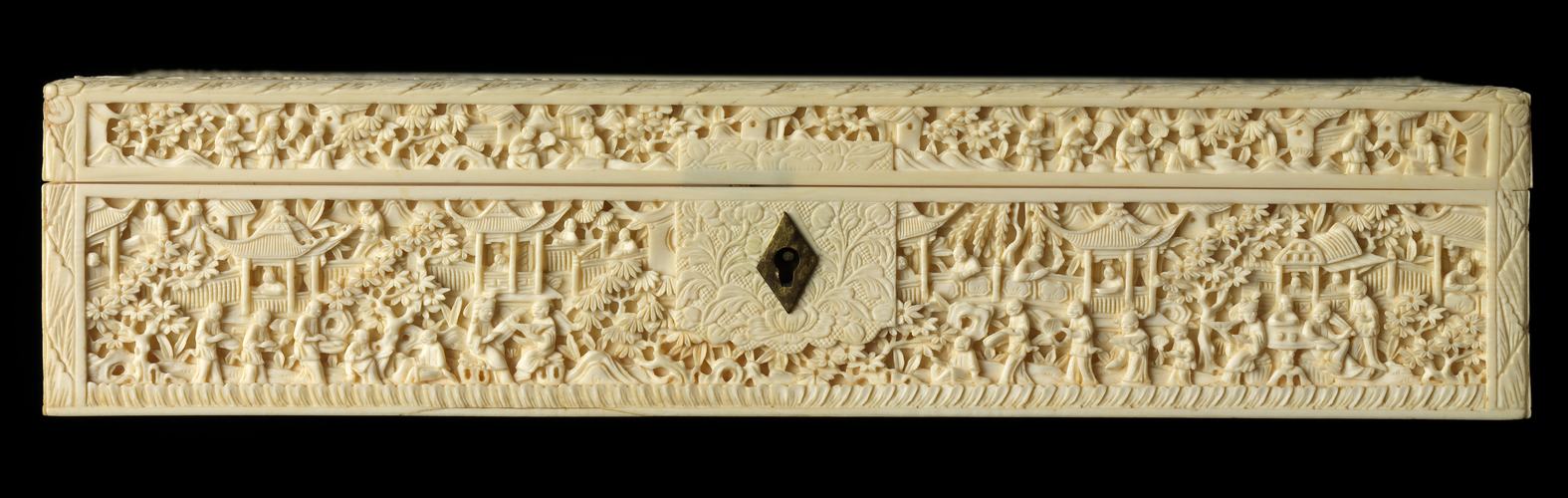
We gain an idea of what some of these goods may have looked like by taking a glance some of the imported Chinese items in the collection of Museums Victoria, including an ivory fan box, a silk and ivory fan, and a carved bone fan. Although these objects are of a slightly later date (1880), they perhaps represent some of what customers might be able to buy in Fong Fat’s shops.


563289-small
Fan Box – Ivory, Carved Village Scenes, China, late Qing Dynasty, c1880. Museums Victoria, HT 22577.

The presence of a Chinese shopkeeper in a shopping arcade, a space that is perhaps imagined as a white, elite zone of occupation and leisure, may seem unusual, but such goods fed the desire for ‘Oriental’ and exotic goods in demand in Britain and Europe. But they were also desired, and available, in regional and metropolitan Australia during the latter half of the nineteenth century into the twentieth (e.g., Loy-Wilson 2014, 2017).

We can see from newspaper advertising that a surprising number of shops and businesses in the Australian arcades captured the Orientalist desires of the consumer in the settler colonial landscape. These included importers of Japanese and Chinese silks, furniture and other wares, Indian and Chinese tea shops, Oriental Bazaars, Turkish baths, and more. Many, but not all, were owned and run by non-British or European Australians like Fong Fat.

Fong Fat only lasted a year in the Eastern Arcade, vacating when his lease ran out at the end of 1873. The last we hear of him, as a fancy goods seller at least, is at his Swanston Street store in December 1874.

download
Swanston Street, 1872. Photographer unknown. State Library Victoria, H96.160/1721. Fong Fat’s store was four doors down from the Star Hotel, and is possibly that indicated with the arrow.

Who was Fong Fat and what happened to him after this last mention? Is he the man of the same name running a Chinese lottery and gambling den in Little Collins Street in 1875 (Weekly Times, 10 July 1875, 11)? Is he the Fong Fat who was fined for creating noxious gas in 1876 from his opium refinery? (PROV, VPRS 3181/PO/660/473)? Is he the Fong Fatee that appears with his wife on the Melbourne stage in the 1880s? Do we see him donating fruit and tea to the hospital fete committee in Hay, New South Wales, in 1893?

I’m asking these and other questions during the next few weeks, as I try to piece his story together. I have found some interesting information about his personal life already, gleaned from court records, newspapers, inquests, and other documents that I’ve been scouring. In Part Two of this post I’ll talk more about Font Fat’s Chinese wife, Quinti, and their daughter, Ah Chow, as well as his shop assistant, who was later his wife, Catherine Downey.

Select Bibliography

Public Record Office Victoria, VPRS 3181 [Melbourne City Council] Town Clerk’s Files, Series I

Charles Rooking Carter, Victoria, the British ‘El Dorado’: Or: Melbourne in 1869 (London: Edward Stanford, 1870)

Sophie Loy-Wilson, ‘Rural Geographies and Chinese Empires: Chinese Shopkeepers and Shop-Life in Australia’, Australian Historical Studies 45.3 (2014): 407–424.

Sophie Loy-Wilson, Australians in Shanghai: Race, Rights and Nation in Treaty Port China (London & New York: Routledge, 2017)

Allom Lovell & Associates, The Royal Arcade: Conservation Management Plan (Melbourne: Allom Lovell &​ Associates, 1995)

Barbara Salisbury, The Strand Arcade: A History (Marrickville: Southwood Press, 1990)

Maps! So many of us love them. They take us places that we want to go or imagine that we would love to visit. But they also serve practical purposes for city planning. Recently I’ve been working on a project with a group of colleagues at the University of Melbourne’s Melbourne History Workshop. This project has taken one block of the city and is investigating the history of the site from pre-colonial days to the present. The site is the block (actually two blocks!) bounded by Swanston, Collins, Russell and Bourke streets, bisected by Little Collins. We are working with maps, newspapers, images, historical texts, museum collections and other sources that can give us an idea of the multiple historical layers of the site. As well as ‘traditional’ historical archival materials, we utilise digital humanities platforms (becoming increasingly important for the work we do as historians) and the mapping of the site and its histories through GIS and geospatial technology.

There are some fantastic sites out there at the moment using these types of technologies, such as Cleveland Historical, Collage: The London Picture Archive; and Digital Harlem. Sites like these are both digital treasure troves and digital rabbit holes. The first day I looked at Collage I ended up doing about four hours of research for my thesis and found numerous important sources that I would not have found through traditional means – mainly due to my physical distance from them.

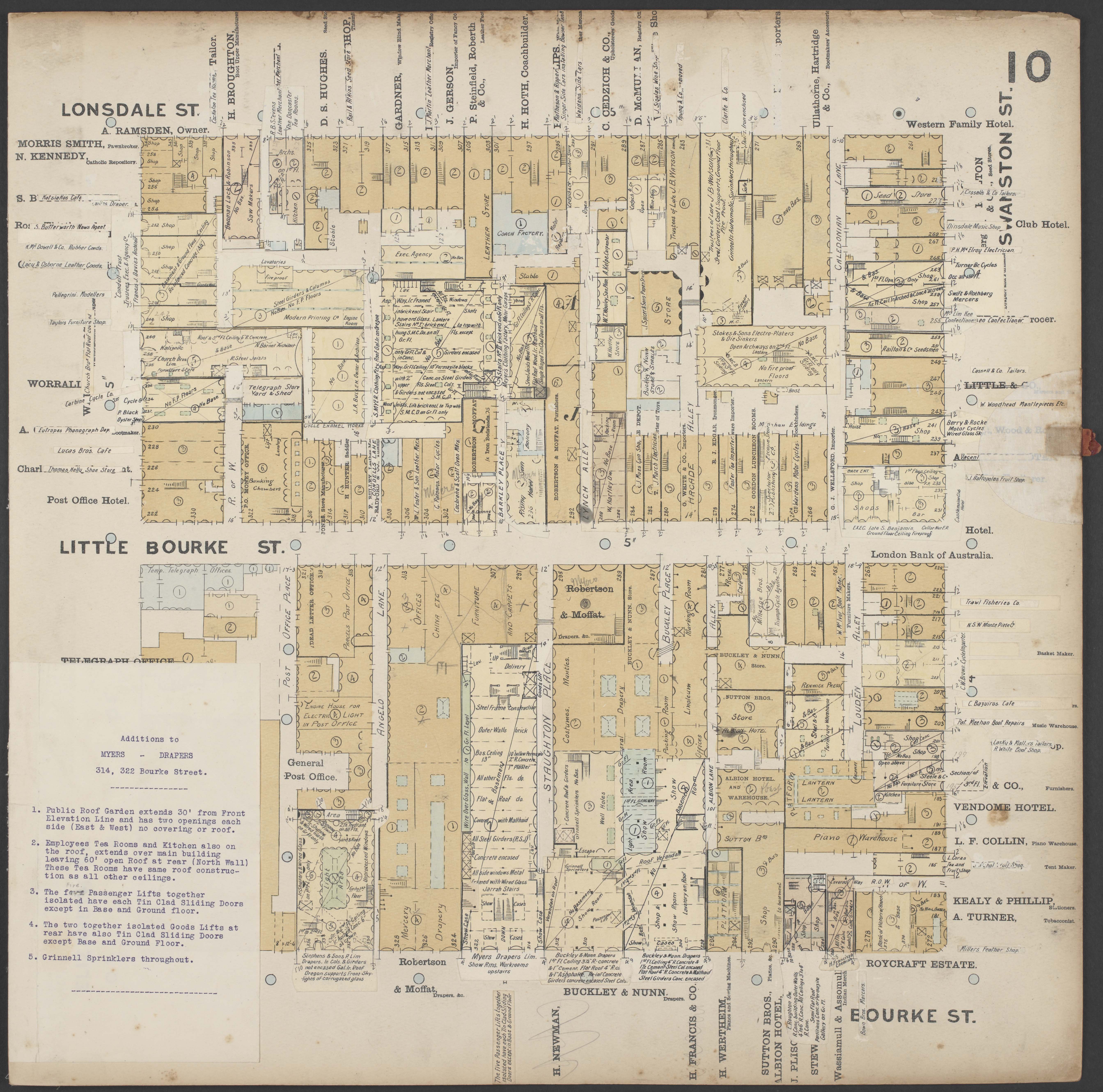
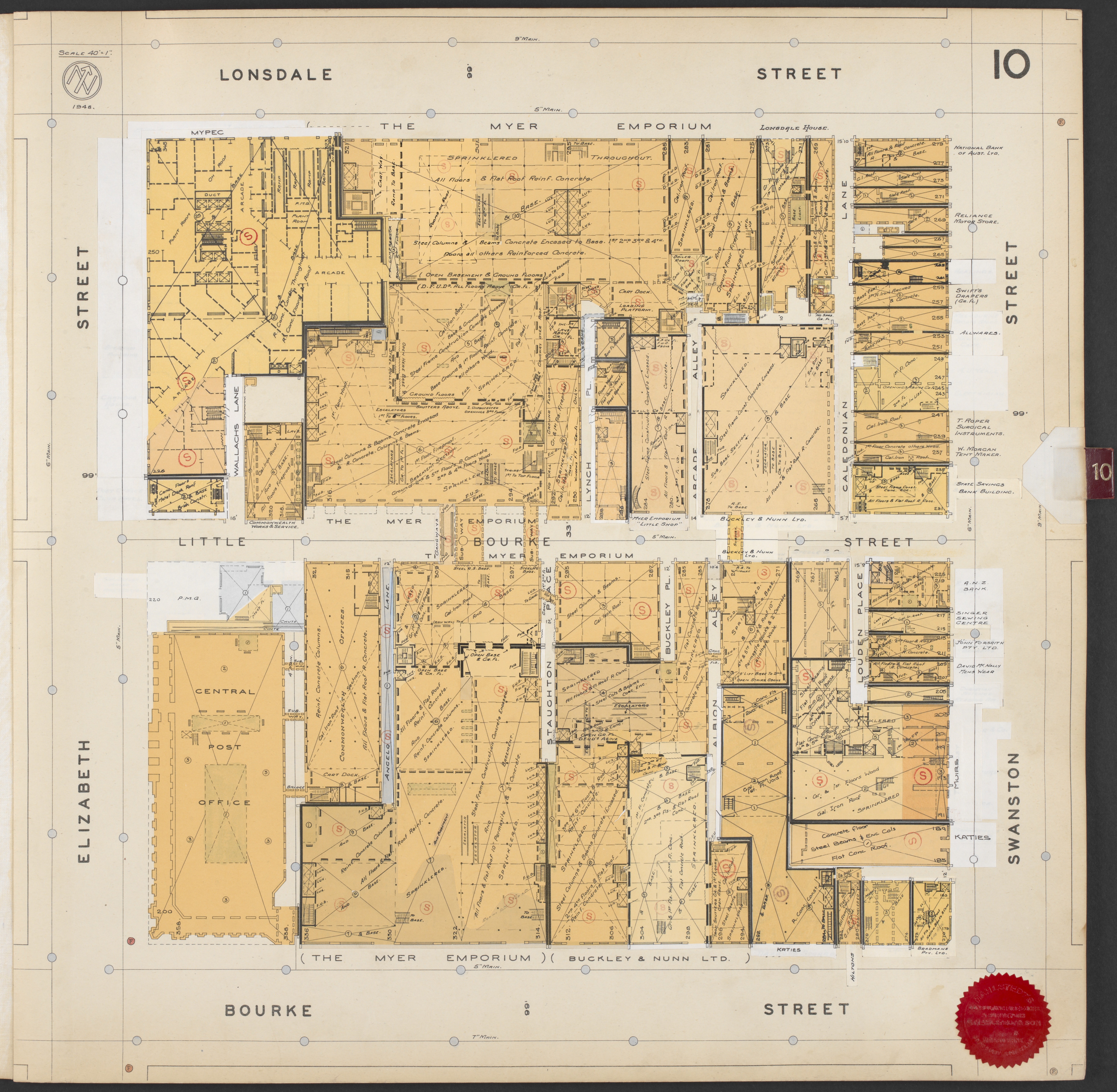
I have discussed before the importance of the idea of ‘layers of history’ to my project and the work on the project with the MHW team is part of my broader interest in researching the history of the city using this layered approach. Our inspiration for the project and the selection of the site came from a fire survey map that is in the collection of the State Library Victoria produced by surveyors Mahlstedt & Gee, which detail the buildings and even the occupants of those buildings in the city of Melbourne. They produced these maps over an approximately eighty-year period, once ever couple of decades, and by looking through them we can see the physical changes and growth that the city underwent. It’s quite amazing to see the increasing density and size of the built environment of the city through this period, as well as to explore what types of businesses were present.

After working on these maps for the block on which our project is focussed, I went back to the State Library’s website and collected them for the city blocks that each of the arcades were or are on. Below are a series of maps from Mahlstedt & Gee from the State Library Victoria, that show the evolution of the site on which the Queens Arcade in Lonsdale Street stood (they have even bigger zoomable versions on there, so I highly recommend having a look!). The first map is slightly earlier and is the land sale on which the properties owned by Rev James Clow, including the site of the Queens Arcade. Have a look at the changes that this city block underwent and let me know if you see anything that captures your attention!

City property plan of subdivision of Crown allotments 101112 13 section 21 City of Melbourne
City property plan of subdivision of Crown allotments 10, 11, 12, 13, section 21, City of Melbourne, 1873. Lithographer: H. G. DeGruchy. State Library Victoria.

download
Standard plans of the city of Melbourne, 1888. Malhstedt & Gee. State Library Victoria

Index to City of Melbourne detail fire survey
Index to City of Melbourne detail fire survey, 1910. G. Mahlstedt. State Library Victoria

City of Melbourne detail fire survey, Section 1. Compiled by the Insurance Planning Association; G. Mahlstedt & Son. State Library Victoria
City of Melbourne detail fire survey, Section 1, 1925. Compiled by the Insurance Planning Association; G. Mahlstedt & Son. State Library Victoria

Melbourne plans. Section 1, Version 1, 1948. Mahlstedt's (Vic.) Pty Ltd. State Library Victoria
Melbourne plans. Section 1, Version 1, 1948. State Library Victoria


Save

Queens Arcade Melbourne
Queen’s Arcade, Melbourne, Interior. St Gill, 1856. State Library Victoria

I know I’ve been very very quiet lately! I actually have lots of prepped posts but have been super busy over the last six months madly writing my thesis plus conference papers plus journal articles (this is good!). Today I’m writing Chapter Two and came across just the best advertisement for the Queen’s Arcade, placed in the newspaper in its opening days in October 1853.

Nineteenth-century newspaper advertisements were often entertaining and appealed to the reader through a variety of methods, including in this case … rhyme. It shows that the arcade’s owners, a consortium of well-off middle-class Melbourne businessmen, aimed provide a the wide variety and mix of tenants and produce for the consumer who visited.

Much like today’s modern shopping mall, everything shoppers desired could be found at the arcade – clothing and accessories, fabrics jewellery, musical wares, art materials, luxury consumables and onsite refreshment rooms. This gave them (ideally) no cause to go elsewhere, and the diversity and variety available seemed to place the new novelty of the arcade in an ideal position to become the centre of shopping and social life in Melbourne.

THE QUEEN’S ARCADE.

THE Belles and Beaux of Melbourne’s Town to aid,
What can be better than the Queen’s Arcade for
A pleasant lounge in summer’s sultry days,
Well shelter’d from old Sol’s o’powering rays;
And when the hot winds drive dust helter skelter
What place than this more cool and fit for shelter?
When the wet season makes our town a swamp.
The Queen’s Arcade is dry and free from damp;
And here the Melbourne belles may walk at ease,
And choose what rare commodities they please.
I’ll run them over with your kind permission
First, we’ve G. Goldsmith’s Bonnet Exhibition,
To suit complexions whether dark or fair;
Jewels and ornaments, both rich and rare;
Scents of all kinds, exquisite and recherche,
With papier mache, too, and gutta percha;
Drapery, hosiery, splendid silks, and satin,
With books in English, French, German, and Latin.
“Music hath charms to soothe the savage breast,”
And fewer bosoms. Here you’ll find the best
Quadrilles by Jullien, D’Albert’s waltzes fast,
The Arcade Polka, Winterbottoms’s last,
Bijouterie and articles of dress
On your attention, ladies, let me press,
That everything for widow, wife, or maid,
Is to be met with in the Queen’s Arcade;
And if the ladies’ smiles we only win,
Of course the gentlemen will soon drop In,
And they will find that them we’ve not forgot,
Havannahs and cheroots, a splendid lot,
With meerschaums, cutties, snuffs of every kind,
In short, all tastes will here be pleased; you’ll find
Rings, watches, pins, and studs in rich array.
Coats, trousers, vests of patterns neat or gay,
Canes, riding whips, and boots of patent leather,
With Mackintoshes to resist the weather.
To sum up all, an Universal Mart,
We mean to be a Gallery of Art,
And every exertion will be made
To please the public, in the Queen’s Arcade.
Refreshments of the best and choicest kind.
Will also be provided; you will find
Confectionery, pastry, jellies, ice,
Crackers, bon-bons, and everything that’s nice;
And taste it once, you’ll say such lemonade
You never drank but in the Queen’s Arcade.

The Banner, Melbourne, 7 October 1853 (via Trove)

Save

Being a researcher of any sort takes a large degree of doggedness, obsessiveness, and lots of eye strain. From scientists to historians, professionals, and amateur enthusiasts, anyone who researches has experienced this. We also understand the need to go over our material again and again, looking for new angles and evidence.

SLV H332 Gill The Block
Doing the Block, Melbourne. ST Gill, 1880. State Library Victoria.

So my quest to explore the history of Australia’s shopping arcades. I can’t tell you how many hours I’ve trawled through Trove, Google Images, library websites, and books looking for images of these buildings. In addition to that, I’ve looked through hundreds of dusty old archival files, maps and plans that I’m terrified will crumble in my hand, astonishing but delicate and hard-to-see 100-year-old glass plate negatives and the most unsexy and eye-killing of research tools – the microfilm. Every time this was in pursuit of myriad tiny bits of information that a historian pieces together to tell as coherent a story as possible about their subjects.

But I also really really want to find some photos – because they are of course half the story and what helps bring to life these stories for your readers. Being an urban historian, this has often involved scouring street scenes of numerous Australian towns to hope that you’ll finally catch a glimpse of that building that you know existed but no-one thought it worth keeping an image of, or it hasn’t been tagged in digital files in order for you to find.

As an urban historian and curator first starting out, I spent probably over 100 hours looking at street scenes of Sydney for the Sydney’s pubs exhibition, trying to find elusive pubs that no-one knew about. I had eureka moments, when I spotted the Imperial Hotel on Wynyard Park, and crashing defeats in others, such as the Blue Anchor on George Street. Nine years later I still find myself looking for ones that escaped me, or getting excited about new images of those I already had found (that’s the obsession part!).

a089601r
Wynyard Square, Sydney. 1879. State Library New South Wales.

Now I’m back to scouring for this project. Realistically, most of the Australian arcades I’m researching have exterior images that are relatively easy to find. Interior images decidedly less so. For the last few years I’ve been searching for images of the first arcade built in Australia, the Queens Arcade, built on Lonsdale Street, Melbourne, in 1853. And believe me I’ve looked. I feel like I can see the changing urban portrait of Lonsdale Street from the 1850s to the 1890s in my mind like a palimpsest over today’s streetscape. But I had very little success in finding any image of any part of the building. The camera was always facing not quite the right way or the photo I found was of the site after the arcade had been demolished. And definitely no interior was to be found.

The first breakthrough was when I was trawling the internet yet again and found an old illustration in an old lecture Powerpoint that eminent urbanist Miles Lewis had put online. The Illustrated Melbourne Post is one of those rare newspapers that hasn’t been put online and you need to go to and find it in the State Library of Victoria on a microfilm ‘in the bottom of a locked filing cabinet stuck in a disused lavatory with a sign on the door saying “Beware of the Leopard”‘ (Douglas Adams, Hitchhiker’s Guide to the Galaxy, 1979).

Queens Arcade, Melbourne, Illustrated Melbourne Post, 29 October 1853, p4.
Queens Arcade, Melbourne, Illustrated Melbourne Post, 29 October 1853, 4

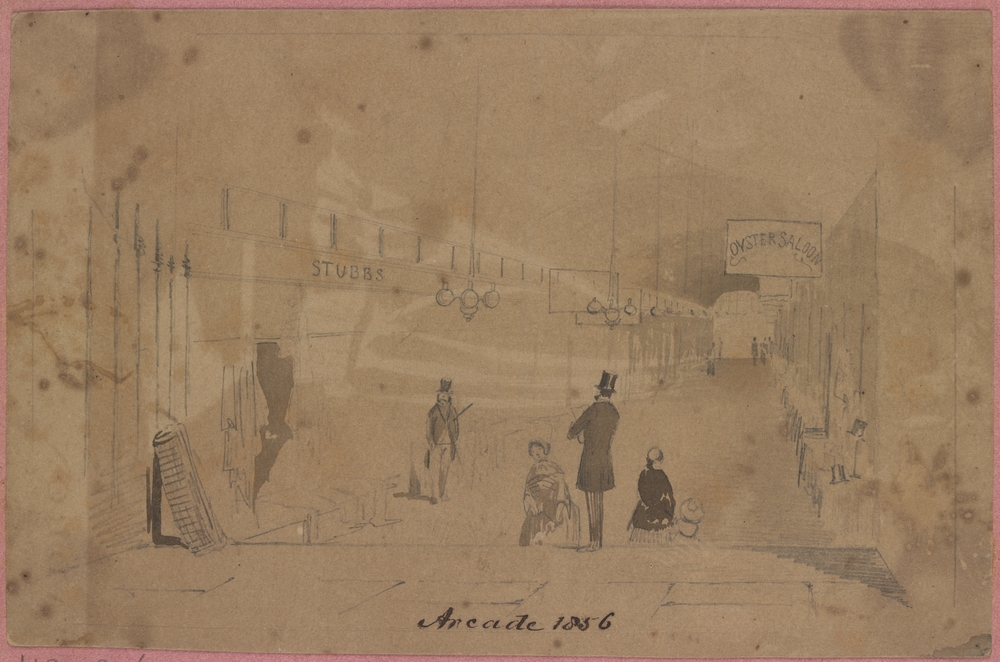
But frustratingly, I could never find anything else. Until the other day. I just decided to randomly look on the State Library of Victoria’s site again and up popped a new image of the interior of an arcade from 1856 – the Queen’s Arcade. The image shows its curved corrugated iron roof (one of the first galvanised iron structures made locally in Melbourne) as well as the lighting, which was achieved using clerestory windows rather than a glass ceiling. This was a simple interpretation of the arcade form, inspired by European examples but built using local materials.

Queens Arcade, Melbourne, Interior. St Gill, 1856. State Library Victoria
Queens Arcade, Melbourne, Interior. ST Gill, 1856. State Library Victoria.

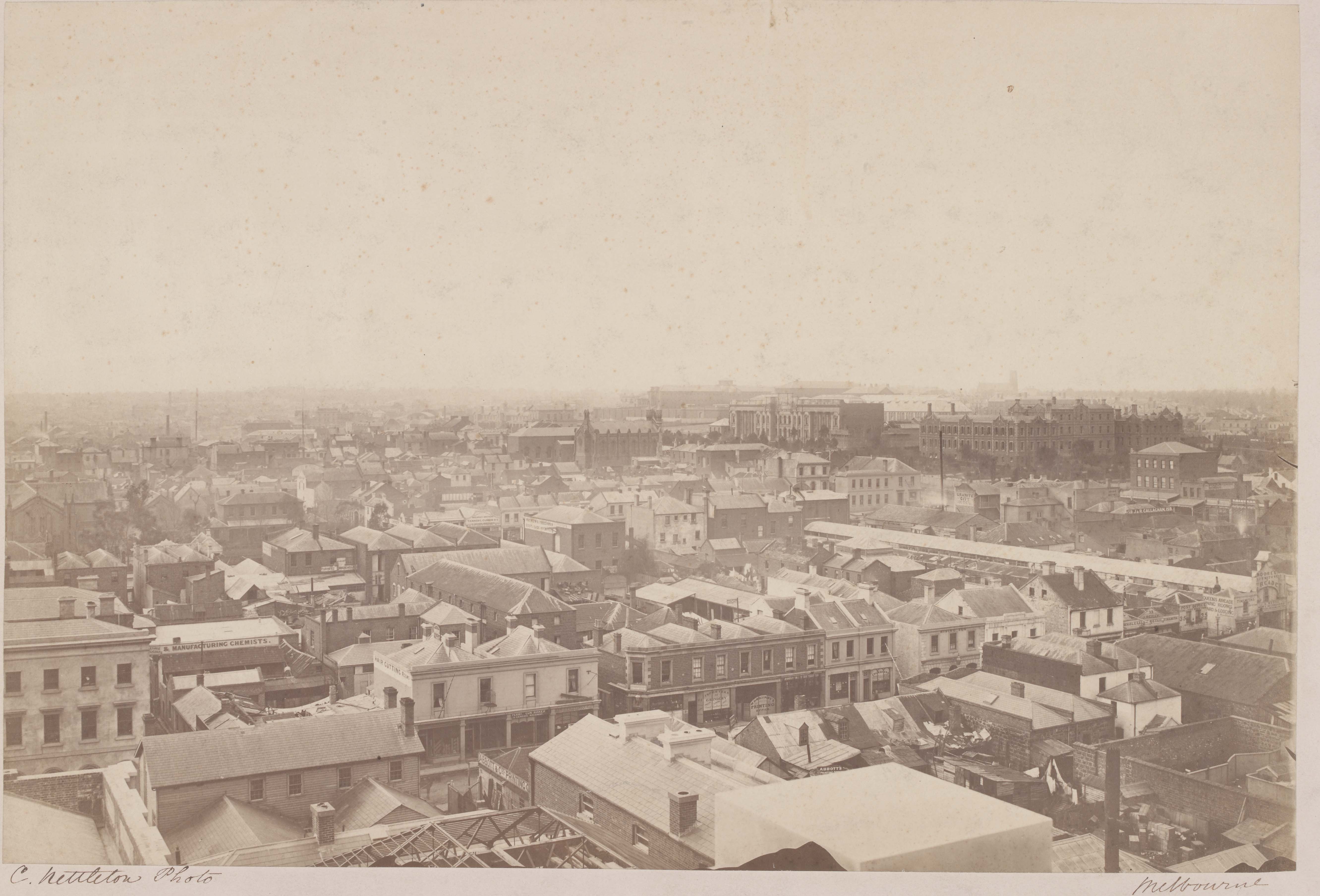
Additionally the description of this item mentioned another image – a panorama of Little Collins Street by Melbourne photographer Charles Nettleton – that also shows the arcade from its back entry at far right. I may have looked at this photograph before but never picked up on the arcade being in it – it also didn’t come up in searches, as the description is not labelled it with the name of the arcade. Here you can see clearer the curved roof and clerestory windows, as well as the rather ornate back entrance on Little Bourke Street.

SLV H23929 Bourke Street Looking NE
Bourke Street Looking NE. Charles Nettleton, 1860. State Library Victoria.

SLV H23929 Bourke Street Looking NE detail
Bourke Street Looking NE (detail). Charles Nettleton, 1860. State Library Victoria.

The image of the interior was by celebrate illustrator ST Gill, who captured the life and rhythm of mid- to late nineteenth-century Melbourne and Ballarat. Currently the library is hosting a fantastic exhibition of Gill’s work, which I’ve lately found to be one of the visual inspirations for my thesis in the way it brings to life the city streets and their inhabitants. The Gill drawing probably went up online as part of the library’s research for the exhibition and my finding of it shows that its worth (re)searching again and again for images (and other historical information), as institutions like the library are always working on new exhibitions and research and, therefore, putting up new digitised images and other information for us to discover.

Addendum: ST Gill also drew this illustration of Melbourne’s second arcade, the 1854 Victoria Arcade, which doesn’t have appeared to have lasted long and may have never really got off the ground.

Victoria Arcade, Bourke Street Melbourne. ST Gill for JS Campbell & Co, Lithographers, 1853. State Library Victoria

Part of my intent in undertaking this project is to use the arcade as lens through which to explore the history of the Australian city and its inhabitants. Within the arcades we find goods, ideas and people that came from all over the world, encapsulating ideas of global trade and migration, and even political and social changes, into a contained space.

The fourth chapter of my thesis is going to do address the people of these arcades and do what a lot of urban histories often don’t – putting people back into the place. The city isn’t just an accumulation of buildings, roads and structures but a living breathing space where people live, love and laugh. One of the ways that we can explore this is to focus on individual lives within the sweep of broader histories of the the city and the world. Within this context I want to look at the lives of a variety of people who were involved with, encountered and inhabited the arcades, many of whom have often been forgotten about in the discussions of the architecture and goods to be found in the arcade spaces – the owners, architects, shopkeepers, customers, workers, and undesirable others.

What some of my initial examinations of a handful of these people have revealed is that many of these characters, particularly in the early years of the arcades’ histories, hailed from all over the globe. Along with the display of goods and ideas (of architecture, culture, consumption) that exhibited international origins and/or influences, many of those who inspired and brought these spaces were also evidence of Australia’s close connections with the rest of the world.

In the mid- to late nineteenth century, people were constantly arriving in (and leaving) the Australian colonies and a large percentage were overseas born. Recently, studies have explored the idea of combining aspects of historical biography, architectural history, cultural practices and material culture, in order to reveal new ways of thinking about history. These studies have also taken a decidedly transnational turn, in order to reveal the broader stories of nation, empire and global events through the lives of individuals whose lives were ‘formed … across a global canvas’ (Deacon, Russell & Woollacott 2010, 2).

To look at some of these ideas I’ve so far examined the lives of several people – Fong Fat, a Cantonese immigrant who opened a fancy goods store in the Eastern Arcade; Hiram Crawford, owner and tenant of the same building; Henry Morwitch, the builder of the Brisbane arcades, who lived a highly mobile life moving multiple times between colonies and continents; and Herr Rasmussen, the Danish medical botanist, who sold his Danish vitality pills to Sydney in the Central Arcade, George Street. I’ll be posting a more detailed look at the life of one of these very soon.

One of the things I really got excited about was trying to identify some images of some of these characters. I haven’t had any luck so far with those mentioned above but there was one valuable resource that I was made aware of recently. A number of these manufacturers and retailers with shops in the arcades exhibited at various international exhibitions. The State Library of Victoria has a fantastic collection of security photographs of exhibitors from the 1888 Melbourne exhibition and these include some of the people that inhabited the arcades, including the Messrs. Gaunts of Thomas Gaunts famous watch, clock and jewellery shop in the Royal Arcade, Melbourne. I’m hoping in the future I’ll be able to put some more faces to names – and people into these places –  by looking through this collection and other images yet to be found.

E. Gaunt, Album of security identity portraits of members of the Victorian Court, Centennial International Exhibition, Melbourne, 1888. State Library Victoria. H28190/2
T. Gaunt, Album of security identity portraits of members of the Victorian Court, Centennial International Exhibition, Melbourne, 1888. State Library Victoria. H28190/2

E. Gaunt, Album of security identity portraits of members of the Victorian Court, Centennial International Exhibition, Melbourne, 1888. State Library Victoria. H28190/256

References:

Desley Deacon, Penny Russell and Angela Woollacott, ‘Introduction’, in Desley Deacon, Penny Russell and Angela Woollacott (eds.) Transnational Lives Biographies of Global Modernity, 1700-present (London: Palgrave Macmillan, 2010), 2

I have a friend in Sydney who I met through Flickr. He’s a postcard collector and a very generous one at that! A couple of years ago he sent me a fantastic one of Birmingham’s City Arcade, which is the header for this site. In the mail the other day I got the lovely surprise of two fantastic vintage postcards. One shows the Passage du Commerce in Niort, Western France and the other the Mutual Arcade in Port Elizabeth, South Africa.

Passage du Commerce, Paris. c1912. Photographer unknown. Carte de Visite, front.

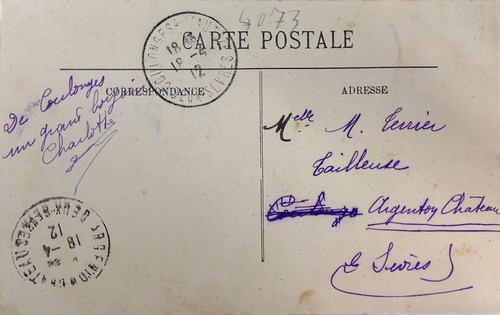
Passage du Commerce, Paris. c1912. Photographer unknown. Carte de Visite, back.

The Passage du Commerce is a version of the famous Parisian arcades, translated to the provincial town of Niort in western France. Many regional French towns quickly followed the fashion of the capital and constructed arcades, especially in the early decades of the nineteenth century. Niort was no different and a 1820 Royal decree ordered the construction of a communicating passage between The Rue des Halles and La Place de la Préfecture  on the site of a tavern, des Trois-Pigeons (the Three Pigeons). The arcade was completed in 1829 with 20 shops in total. Despite twice falling victim to fire, Passage du Commerce still exists today.

83223. Arcade Interior, Port Elizabeth by T. D. Ravenscroft (c.1900)

The South African arcades are really interesting. In the nineteenth-century some, such as the Johannesburg Arcade were shipped in pieces from Great Britain. This arcade was built around 1898 and designed by English expatriate architect William Stucke. It shows some of the interesting features that are typical of these later turn of the century arcades – where the shopping section itself is becoming less important than the buildings within which it’s being built.

This later leads to the arcades really being subsidiary to the rest of the building and developing into arcades with fake glass roofs – or none at all. Australia and South Africa can often provide interesting comparisons on the urban development of different British colonies and it will be great to delve into this a little more.

These postcards now take pride of place on my wall at work – and are a not subtle reminder to me each day that I need to write!

Below is another of PellethePoet’s arcade postcards: the exterior of the Block on Collins Street, Melbourne.

But, you MUST check out his Flickr Photostream to see more of his astonishing collection of vintage postcards!

300223. The Block, Collins Street, Melbourne (c.1910)

On 8 March it was International Women’s Day and the AFL kicked off with the NAB Cup … In honour of these, a bit of trivia:

In 1911 & 1912 both suffragist Vida Goldstein & the Victorian Football League had offices in the Block Arcade Melbourne. You can find information about these and many other tenants of buildings throughout the state in the Sands & McDougall Directory of Victoria at the State Library of Victoria.

The Argus, 25 April, 1912, p5. Accessed on Trove at  http://trove.nla.gov.au/ndp/del/article/11670383
The Argus, 25 April, 1912, p5. Accessed on Trove at http://trove.nla.gov.au/ndp/del/article/11670383