Eastern Arcade, Bourke Street, Melbourne, 1875, with banner for US Minstrels and images depicting the players. Photographer: NJ Caire/Anglo-Australasian Photo Co. State Library Victoria, H84.3/11

The Queen’s Arcade on Lonsdale Street in Melbourne, after renovations, reopened to great fanfare in March 1856, with a military band and a fountain of eau de cologne supplied by arcade fancy goods’ dealer Levy Bros, as well as

musical entertainments … varied by the performance of a powerfully toned apollonicon [a large barrel organ], which is intended in future to play at stated periods during the day, and thus prove a continual attraction to the passer-by to make use of this elegant avenue as a lounge


Age, 17 March 1856, 4

Arcades are often thought of purely as places of commodity exchange or places to eat and drink, with retail shops and tearooms often the focus of discussions both popular and academic. As I argue in my thesis, the arcades in fact reflected broader social and cultural aspects of urban life, with a wide variety of entertainments, including theatres, dance halls, hotels, balls and music in the promenades, and amusement parlours. As I note in Chapter Five, following James Lesh, arcades ‘catered for colonial Australian thirst for “amusements, performances and hospitality: novel forms of leisure and entertainment”[1] that were part of the global experience of modernity, many of which they might find within’ [2].

The entertainments in the arcades ranged in type. While there were more refined shows, such as art shows and elegant balls, displays at the ‘cheap amusement’ end of the spectrum were also found in these buildings, demonstrating the appetite for ‘new and innovative entertainments, many of which utilised new technologies in their presentation’ [3] but might also utilise the fantastical or seemingly strange to amuse patrons. While spectacle was a key component, these amusements might also be considered educative, about current or historic people and events, or new ideas and technologies.

The Queen’s Arcade was a regular site of such amusements, which also might play at other locations around Melbourne and Australia. These included models and panoramas of current events, such as important moments and sites in the war in the Crimea in the mid-1850s, including a model of the Sevastopol and Kronstadt naval bases, as well as St Petersburg. In 1855 and 1858, there featured an ‘exhibition of dissolving views‘ using a calcium light to project photographs, in the first case, including ‘places such as the Arctic regions, Turkey, Italy, Netley Abbey, and Walmer Castle‘, with the commonly applied entry fee of a shilling for adults and children at sixpence.

In the Eastern Arcade in Bourke Street Melbourne, there were a variety of such cheap amusements, as well as businesses that straddled the line between entertainment and health and wellbeing, such as phrenologists and fortune tellers. As these latter characters are the focus of the work of other scholars [4], I’ll focus here on the other amusements present in this building, but in another post, I might talk about these people in other arcades!

One of the other business-owners in the building also thought of innovative ways to attract people to the building. In 1879 fancy goods dealer Isaac Solomons hosted the Great American Pantechnetha in conjunction with a fancy bazaar, which featured panoramas of ‘the Prussian & Russian wars and views of the principal cities in Europe – surpassing anything ever seen in the Australian colonies’. He also later paid Dominick Sonsee, ‘the smallest man in the world’, to appear and hold an ‘at home’, where he chatted with visitors about politics and current events. Sonsee later, however, took publican Thomas Bentley to court over non-payment of the fee from Solomons, which Bentley had allegedly accepted on Sonsee’s behalf but not passed on, with newspapers rueing that Sonsee had been taken advantage of and portraying him in a pitying light.

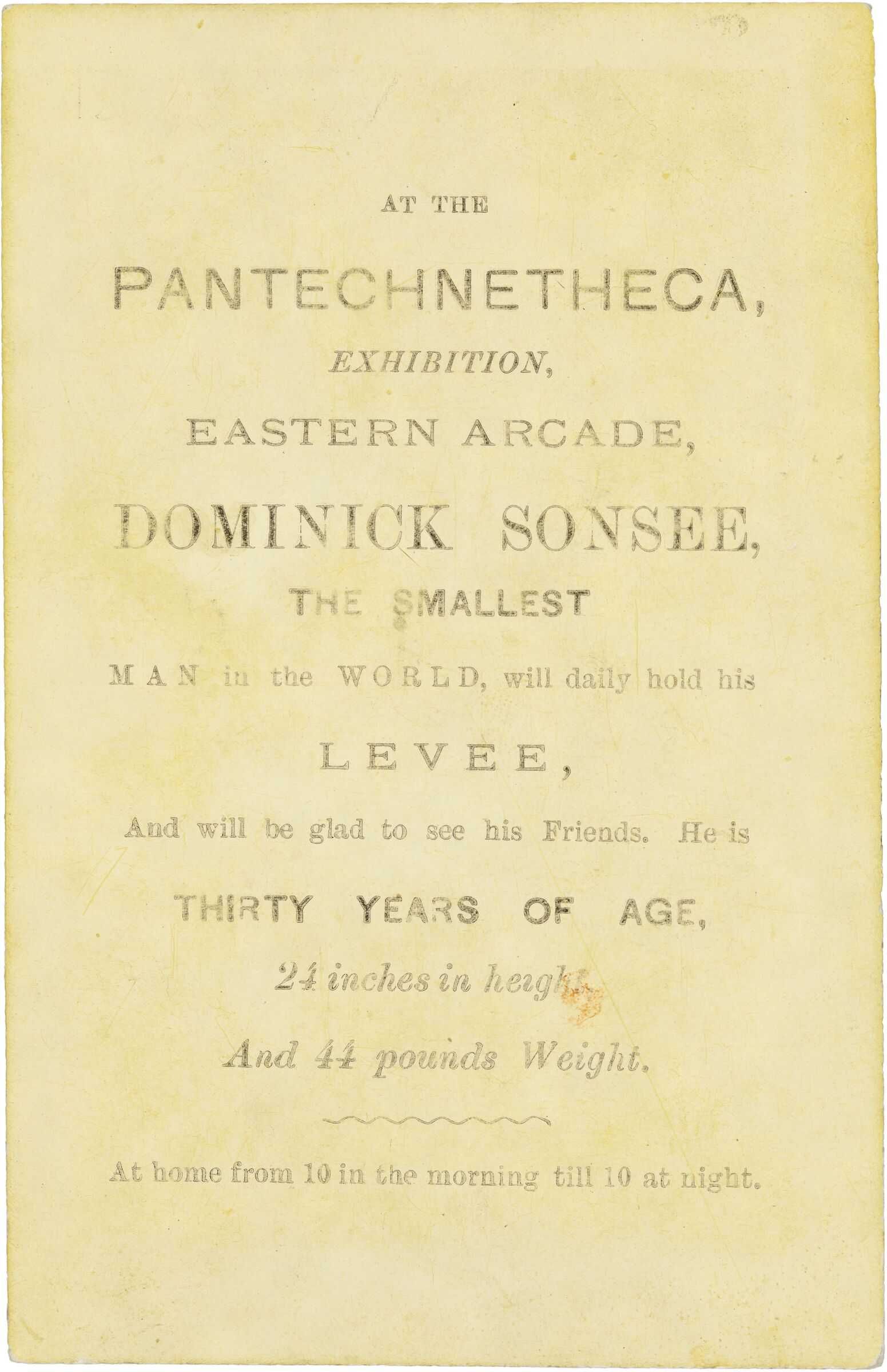
 

Carte de visite advertisement for appearance of Dominick Sonsee at the Eastern Arcade, c1880.
Photographer: William Burman. National Portrait Gallery, 2014.5

The Eastern Arcade also had two dedicated entertainment spaces which featured entertainments such as the US Minstrels and Lady Court Minstrels (the latter also played at the Victoria Arcade & Academy of Music in 1884), and Kate and James Kelly, siblings of bushranger Ned, who held a rather grim entertainment where patrons could see and talk to them for one shilling prior to their brother’s execution in November 1880. In the same arcade in 1914, Seattle-born George and Leo Whitney, who had been leaseholders of Luna Park, Melbourne, opened the Joy Parlour amusement arcade in nine of the arcade shops, ‘entertaining hundreds of people both day and night with all kinds of amusement and picture shows. … Beautifully lit with electric light, and music always‘. According to the oral testimony of George K Whitney, his father (also George) ran the shooting and amusement section of the arcade, while his uncle ran the photography studio, before moving back to the US in the 1920s.

Bourke Street in the area of the arcade was well-established as the heart of Melbourne’s popular entertainment during the late 1800s. The atmosphere was beautifully described around 1912 by future journalist, Hugh Buggy: ‘a non-stop vaudeville show … [with] its music halls or “academies” of music, its billiard parlours, its shooting galleries, and a waxwork chamber of horrors … it was the heart of Theatreland and the stomping ground of sports.'[5] Both the Eastern and the Victoria Arcade and Academy of music on the next block contributed much to this atmosphere. These entertainments and others at the Eastern Arcade show that the life of the surrounding streets entered the once-imagined refined confines of the building and may have contributed (along with larrikins, phrenologists, fortune tellers, theatre connections, and murders) to its poor reputation from the 1890s to 1920s.
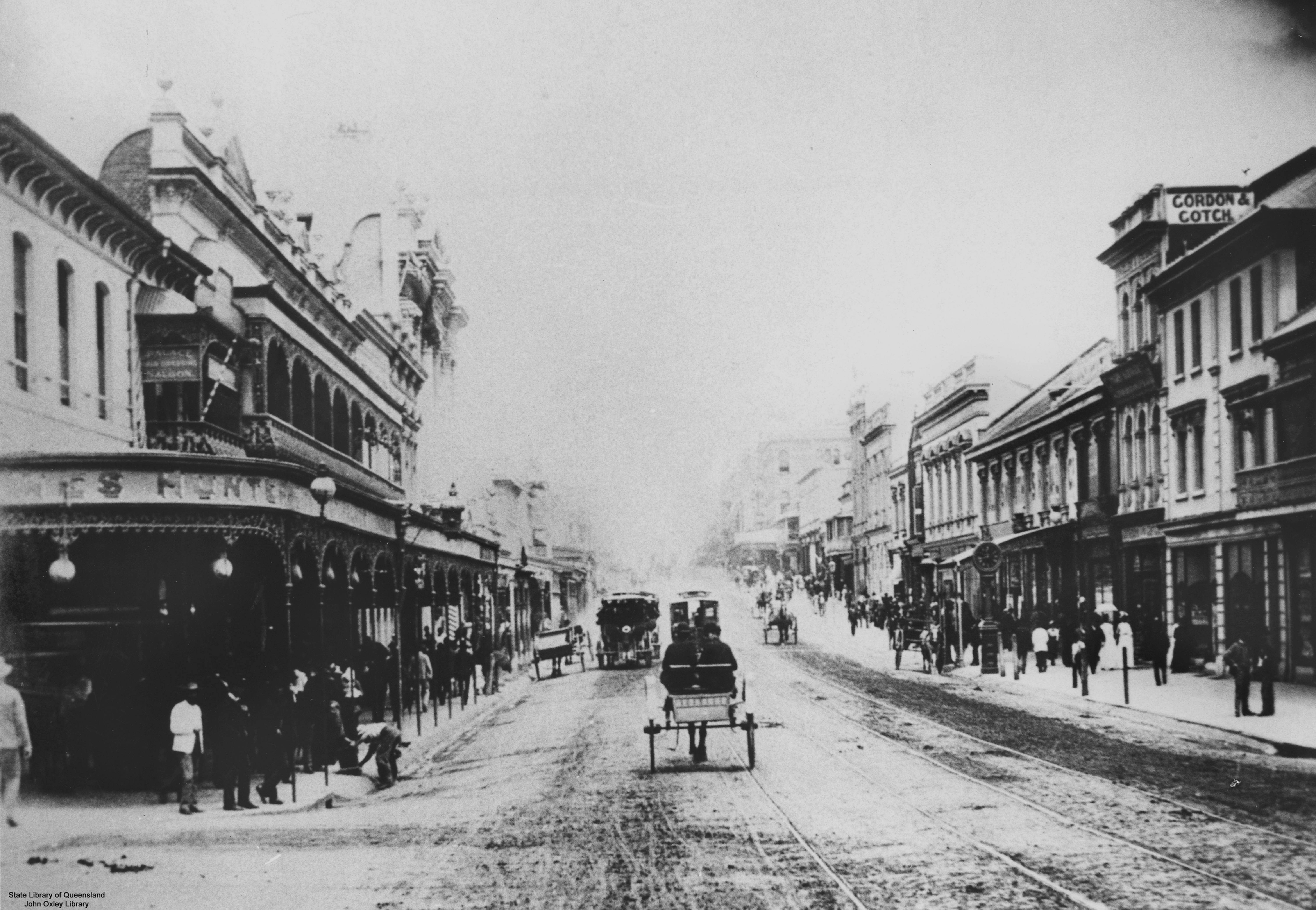
Grand Arcade (second from corner at left), c1889. Photographer unknown. State Library Queensland, Negative: 100723

Heading north to Brisbane, Henry Morwitch’s Grand Arcade, which seemed to have a regular program of public events, hosting ‘a variety of entertainments and amusements on offer ranging from carnivalesque to the refined’. [6] In 1889, it featured a sideshow-type performer, Fedor Jeftichew, who experienced hypertrichosis, leading to excess body hair, billed as ‘Jo-Jo the Russian dog-faced boy‘. Demonstrating the transnational movements of so many of these entertainers across the globe, Russia-born Jeftichew toured England, Europe and Australia, originally with US showman and circus owner, PT Barnum, who satisfied the public appetite for shows featuring those advertised as ‘monsters’.

Shows that incorporated or featured new technologies also took place in the Grand, including Woodroffe’s glass-blowing exhibition in 1889. Born in the US, Charles Woodroffe exhibited in the States before coming to Australian in the 1860s under the patronage of entertainment entrepreneur George Coppin. Woodroffe’s shows featured glass-blowing combined with technologies such as steam engines made from glass. These shows were popular travelling entertainments and we see Woodroffe exhibiting throughout Australia, as well as presenting his more scientific glass aparatus at international exhibitions. The glassblowing shows were part informative and part show and, as Rebecca C Hopman tells us, ‘delight[ed] spectators with lampworking displays, fabulous models, and tables crowded with glass trinkets’. [7] In 1897 and 1898, new technology again featured, when Lumiére’s cinematograph of moving pictures was exhibited, producing images of the Queen Victoria’s Diamond Jubilee and the Melbourne Cup, as well as ‘other exciting events’.

Description of Charles Woodroffe’s show in Maryborough, Queensland. Maryborough Chronicle, 30 August 1887, 2.
Poster for Woodroffe’s brother’s show in Utica New York, 1881. Rakow Research Library Special Collections, Corning Museum of Glass, Flat Files (Unit 31, Drawer 6)

Like those in Melbourne and Brisbane, Sydney’s arcades also hosted a variety of similar amusements. From October 1893 to around December 1894, the basement of the Strand Arcade played host to the Crystal Maze Palace of Amusement, in the Strand Arcade basement. The newspapers tell us that it included entertainments such as ‘Madame Paula, the scientific palmist’, a mirror maze, and mechanical novelties, gaining ‘a large measure of popularity as a holiday resort‘. The next year the arcade had a model of the Tower of London made entirely of cork (one million pieces!), and from 1896 to 1897, Sawyer’s Australian Waxworks, featuring celebrities of the day such as Sarah Bernhardt. These exhibits attained popularity in the nineteenth-century with contemporary and historical personalities rendered in wax, arguably the most famous today being Madame Tussauds, with branches all over the world (including Sydney). Waxworks seems to have tried to attract broad audiences, being advertised in numerous newspapers, including the Guang yi hua bao/The Chinese Australian Herald.

While these are just a snippet of the types of ‘cheap amusements’ that could be found in the Australian arcades in the nineteenth and early twentieth centuries, they demonstrate the diversity of the types of entertainments that were available. Their presence indicates that arcades were not just sites that would attract the town elites but had a wider class of visitor. While the Eastern Arcade spatially was embedded in Melbourne’s entertainment district, the Strand was in a more apparently refined location on Pitt Street, in the shopping heart of Sydney, although relatively close to the theatre district on King Street. The presence of such amusements widen our understanding not only of the types of businesses found within arcades but also their visitors, breaking down the idea that these buildings were only the preserve of middle-class or elite shoppers and tea-drinkers.

At the same time, these examples also give insight into the global exchanges that took place in the arcades beyond those of commodities. These travelling entertainers often hailed from North America, Europe or Britain, and elsewhere across the the globe, and travelled independently or as part of troupes, sometimes managed by entertainment entrepreneurs such as Coppin or Barnum. They utilised a variety of genres and techniques, including music and dance, as well as technologies driven by steam and electricity [8], wax modelling, and glassblowing in order to amuse and delight their audiences within the arcades.

Learn more

On 31 October 2023, Dr Alexandra Roginski, a fellow Professional Historians Association (Vic & Tas) member, and Professor Andrew Singleton from Deakin University are presenting ‘An Evening of Mystery in the Eastern Arcade: Phrenologists & Spiritualists’ at the Victorian Archives Centre and online. It should be a great talk, so book via Eventbrite! I’m so looking forward to it!

Footnotes

  1. James Lesh, ‘Cremorne Gardens, Gold-rush Melbourne, and the Victorian-era Pleasure Garden, 1853-63’, Victorian Historical Journal 90.2 (2019): 219–252. https://search.informit.org/doi/10.3316/INFORMIT.893493942124131.  
  2. Nicole Davis, Nineteenth-century Arcades in Australia: History, Heritage & Representation (PhD Thesis, University of Melbourne, 2023), 165.
  3. Ibid. 186.
  4. Alexandra Roginski, Science and Power in the Nineteenth-Century Tasman World: Popular Phrenology in Australia and Aotearoa New Zealand (Cambridge, 2022), in which she talks about the Eastern Arcade.
  5. Hugh Buggy, The Real John Wren (Widescope International, 1977), quoted in Otto, Capital, 47–48.
  6. Davis, ‘Nineteenth-century Arcades in Australia’, 192.
  7. Rebecca C Hopman, ‘Demonstrations Gain Steam’, Journal of Glass Studies 62 (2020): 281.
  8. See for example: Henry Reese, ‘”The World Wanderings of a Voice”: Exhibiting the Cylinder Phonograph in Australasia’, in A Cultural History of Sound, Memory, and the Senses, edited by Joy Damousi & Paula Hamilton (Routledge, 2017)

Other Sources & Further Reading

Mimi Colligan, Canvas Documentaries: Panoramic Entertainments. inNineteenth-Century Australia and New Zealand (Melbourne University Press, 2002).

Corning Museum of Glass, ‘The Grand Bohemian Troupe of Fancy Glass Workers|Behind the Glass Lecture’, 19 January 2019. YouTube.

Clay Djubal, ‘What Oh Tonight: The Methodology Factor and Pre-1930s’ Australian Variety Theatre (with Special Focus on the One Act Musical Comedy, 1914–1920)’ (PhD Thesis, University of Queensland, 2005).

Harry Gordon, ‘Buggy, Edward Hugh (1896–1974)’, Australian Dictionary of Biography.  

Andrew May, ‘Bourke Street’, eMelbourne: The City Past and Present.

Official Record Containing Introduction, History of Exhibition, Description of Exhibition and Exhibits, Official Awards of Commissioners and Catalogue of Exhibits. (Melbourne: Mason, Firth & McCutcheon, 1882), 434, 648.

Kristin Otto, Capital: Melbourne When it Was the Capital City of Australia, 1901–27 (Text Publishing, 2009), 47–75.

Henry Reese, ‘Spectacular Entertainments at Edison Lane’ (parts one and two), State Library of Queensland Blog, 20 December 2022.

Henry Reese, ‘Settler Colonial Soundscapes: Phonograph Demonstrations in 1890s Australia’, in Phonographic Encounters: Mapping Transnational Cultures of Sound, 1890–1945, edited by Elodie A Roy and Eva Moreda Rodriguez (Routledge, 2022), 60–77.

‘The Great Exhibition, 1851: Philosophical instruments by Deleuil 1851’ [photograph], Claude-Marie Ferrier, RCIN 2800038, Royal Collection Trust.  

Richard Waterhouse, ‘The Internationalisation of American Popular Culture in the Nineteenth Century: The Case of the Minstrel Show’ Australasian Journal of American Studies 4.1 (1985): 1–11.

Richard Waterhouse, From Minstrel Shows to Vaudeville: the Australian Popular Stage 1788–1914 (NSW University Press, 1990)

Richard Waterhouse, Private Pleasures, Public Leisure: A History of Australian Popular Culture Since 1788 (Longman, 2005).

Alexa Wright, Monstrosity: The Human Monster in Visual Culture (Bloomsbury, 2013), 84–85.
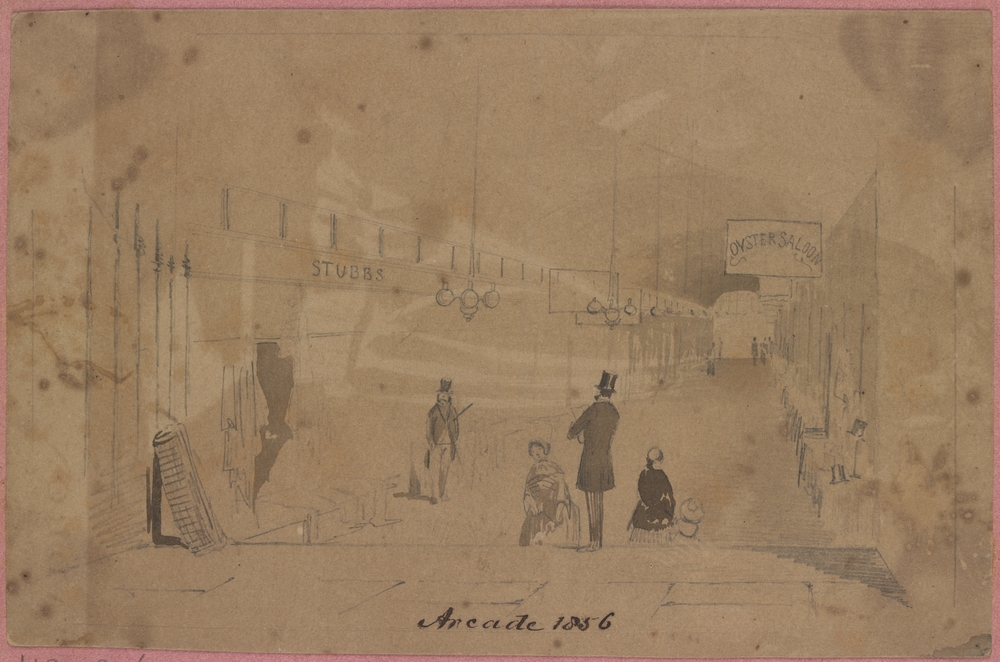
Queens Arcade Melbourne
Queen’s Arcade, Melbourne, Interior. St Gill, 1856. State Library Victoria

I know I’ve been very very quiet lately! I actually have lots of prepped posts but have been super busy over the last six months madly writing my thesis plus conference papers plus journal articles (this is good!). Today I’m writing Chapter Two and came across just the best advertisement for the Queen’s Arcade, placed in the newspaper in its opening days in October 1853.

Nineteenth-century newspaper advertisements were often entertaining and appealed to the reader through a variety of methods, including in this case … rhyme. It shows that the arcade’s owners, a consortium of well-off middle-class Melbourne businessmen, aimed provide a the wide variety and mix of tenants and produce for the consumer who visited.

Much like today’s modern shopping mall, everything shoppers desired could be found at the arcade – clothing and accessories, fabrics jewellery, musical wares, art materials, luxury consumables and onsite refreshment rooms. This gave them (ideally) no cause to go elsewhere, and the diversity and variety available seemed to place the new novelty of the arcade in an ideal position to become the centre of shopping and social life in Melbourne.

THE QUEEN’S ARCADE.

THE Belles and Beaux of Melbourne’s Town to aid,
What can be better than the Queen’s Arcade for
A pleasant lounge in summer’s sultry days,
Well shelter’d from old Sol’s o’powering rays;
And when the hot winds drive dust helter skelter
What place than this more cool and fit for shelter?
When the wet season makes our town a swamp.
The Queen’s Arcade is dry and free from damp;
And here the Melbourne belles may walk at ease,
And choose what rare commodities they please.
I’ll run them over with your kind permission
First, we’ve G. Goldsmith’s Bonnet Exhibition,
To suit complexions whether dark or fair;
Jewels and ornaments, both rich and rare;
Scents of all kinds, exquisite and recherche,
With papier mache, too, and gutta percha;
Drapery, hosiery, splendid silks, and satin,
With books in English, French, German, and Latin.
“Music hath charms to soothe the savage breast,”
And fewer bosoms. Here you’ll find the best
Quadrilles by Jullien, D’Albert’s waltzes fast,
The Arcade Polka, Winterbottoms’s last,
Bijouterie and articles of dress
On your attention, ladies, let me press,
That everything for widow, wife, or maid,
Is to be met with in the Queen’s Arcade;
And if the ladies’ smiles we only win,
Of course the gentlemen will soon drop In,
And they will find that them we’ve not forgot,
Havannahs and cheroots, a splendid lot,
With meerschaums, cutties, snuffs of every kind,
In short, all tastes will here be pleased; you’ll find
Rings, watches, pins, and studs in rich array.
Coats, trousers, vests of patterns neat or gay,
Canes, riding whips, and boots of patent leather,
With Mackintoshes to resist the weather.
To sum up all, an Universal Mart,
We mean to be a Gallery of Art,
And every exertion will be made
To please the public, in the Queen’s Arcade.
Refreshments of the best and choicest kind.
Will also be provided; you will find
Confectionery, pastry, jellies, ice,
Crackers, bon-bons, and everything that’s nice;
And taste it once, you’ll say such lemonade
You never drank but in the Queen’s Arcade.

The Banner, Melbourne, 7 October 1853 (via Trove)

Save

Adelaide Arcade, between Rundle & Grenfell Streets, 1886 Adelaide Arcade, between Rundle & Grenfell Streets, 1886. State Library of South Australia (click image to view in Flickr, for further information & a link to the catalogue record).

It’s been a while between posts I know! But I have been busily writing. Here’s the introduction to Chapter One, which is being handed in soon for my confirmation! Gives a bit of an idea of what I’ve been researching for the last year (FT equivalent – really 2 1/2 years!). Please feel free to skip the footnotes. A couple of things need fixing up but here goes!

[the] arcades … in their physiognomy, remind you, now of the Burlington … and now of the Passage des Panoramas … in Paris, but which, nevertheless, possess a distinctive stamp and character of their own.[1]

English journalist George Augustus Sala, visiting Australia in 1885 as a correspondent for the Daily Telegraph, wrote a series of syndicated articles, The Land of the Golden Fleece, describing the land, peoples and cities of the continent.[2] In Part Eight, ‘Arcadia in Australia’, he explored its shopping arcades, along with other public spaces, and their inhabitants, with a specific focus on Melbourne. In this passage Sala compares these arcades to several of the oldest and most elegant of their European counterparts and likewise sung the praises of some of the city’s other public spaces, where ‘you might, without any very violent stretch of the imagination, fancy on a fine night that Bourke-street was one of the Paris boulevards instead of being a road hewed not 50 years ago out of the trackless bush’.[3] Sala’s narrative suggests that these were one of a number of sites through which nineteenth-century urban developers utilised public spaces and architecture to express a colonial identity that partly relied on emulation of European forms. Arriving in the midst of rapid population and urban growth, he paints a picture of booming and elegant antipodean cities, tinged with slight incredulity at how far these cities had come in such a short time period.[4]

This relatively brief characterisation highlights the inextricable connection of the history of the Australian shopping arcades (and other urban forms) with their European origins. The comparison of Australian cities to those in Europe, America and other continents has long been part of the way that Australians and visitors have conceived of the country’s place within the global context.[5] Nineteenth-century Australia was part of ‘a vast transcontinental movement of people and information at intensely parochial and inherently cosmopolitan’[6] that looked to other cities for inspiration and emulation. One such idea embraced by Australian entrepreneurs was the shopping arcade, a structure considered representative of urban modernity, with their innovative organisation of semi-public retail and leisure space and use of new technologies in their construction.[7]

From 1786 to the late 1930s, a period Bertrand Lemoine defined as l’Ère des passages (the Arcade Era), thousands of glass-roofed shopping arcades were built throughout the world. A direct derivative of an architectural form that had first been invented in Paris almost a century before, by Sala’s time they were a common feature of many urban centres. While they were, in their origins and in public perception, a very European form of architecture and social space, the arcades were in fact a global phenomenon, adopted as a popular architectural solution in European-influenced cities throughout North and South America, Russia, Turkey, South Africa, Asia, Australia, New Zealand during the nineteenth and early twentieth centuries.

German theorist Walter Benjamin, writing in the 1930s, described the shopping arcade as ‘a city, a world in miniature’,[8] and used them as a lens through which to explore the story of nineteenth-century Paris, the ‘Capital of the Nineteenth Century’. Within his essays on the city and in his major work, The arcades project, Benjamin explored facets of urban modernity – technological advances, commodity consumption, the transience of the modern city, changes in urban space – that were to be found represented within these buildings.[9] As Dana Arnold has suggested, they are not merely a way to view the history of Paris, but it is also ‘possible to narrate the history of other cities, including provincial ones, through the lens of the arcades’.[10] While Arnold considered the arcade as a pan-European phenomenon, observing that it could be used as an analogy for any of the cities of that continent, they should, as I have argued, be more correctly viewed as a pan-global one. With their widespread adoption in cities and towns on six continents, the arcade might arguably be utilised to explore the history of any urban space in which one was located, including Australian cities and towns.

These architectural forms incorporated and were inspired by technological and industrial advances that characterised modern urban spaces in the nineteenth-century, such as the introduction of gas lighting and electricity and developments in iron, steel and glass construction. They were an economic and social centre, both a product and a representation of diverse strands of social, cultural and political changes, which occurred in different cities and nations at different times throughout the world.[11] The retail aspect of the arcades was incontestably a crucial one. Lining the pedestrian ways that were the heart of these buildings were individual stores that provided specialised goods and services intended to attract the custom of the rising middle classes to whose identity the conspicuous consumption of luxury goods sold in such establishments was central.[12] While they are primarily associated today with their retail function – as a place to shop – they contained a wide assortment of spaces and tenants that made them a social, cultural and business hub, an extension of the street outside.[13] The arcade was much more than just a place to buy goods – it was also a site for business, leisure and pleasure. Most were truly intended to be cities in miniature, housing an enormous diversity of spaces including refreshment rooms, offices, studios, theatres, galleries and more. With opulent decorations, bountiful products on display, diverse entertainments, and refreshment rooms, they were intended as enclosed and rarified spaces removed from the outside world in which to indulge the senses.

Patricia Morton wrote that ‘the arcades both represent the development of the nineteenth-century economy and are transformed as it changes’, capturing the inextricable link between the history of the arcade form and the history of modernity in that century.[14] Arguably the arcade can also be used as a lens through which to view the history of the twentieth and twenty-first centuries. As Lynda Nead has discussed with her work on mid-Victorian London, the history of modernity is multi-layered, with ‘varied and uneven strands and … multiple levels of representation and experience’ and, following Benjamin, that ‘the city was an accumulation of historical traces …’[15] The glass-roofed arcade influenced and gradually gave way to new forms of similar pedestrian passageways as the twentieth century advanced. Other forms of retail space with which the arcade form had synergies – the department store, the shopping mall – developed and arose.[16] So too the arcades constructed during the nineteenth century underwent changes that reflected the ever-changing nature of urban life. Some arcades lost popularity relatively rapidly, while others, never quite achieved it. Stores and goods found in them changed with the changes in consumption and fashion. Changes were made to the physical fabric of the buildings in order to attempt to make them viable or in step with architectural fashion. Some continued to be well-frequented shopping locations, meeting place or thoroughfares, while others became down at heel and empty. Numerous examples ceased to function as arcades at all and were gutted to become carparks or liquor stores,[17] while over time many were gradually demolished altogether to make way for more modern buildings high rise buildings that were able greater income for the owners. The architectural form of the arcade is part of the story of modernity and the city but, like the historical process of modernity itself, the history of the arcade is not one of linear progression and development.[18]

The global shopping arcade phenomenon transcended time and space and ‘needs to be situated in the wider context of intellectual and architectural discourses which extend beyond local and national boundaries … part of a wider economic, geopolitical and cultural system’.[19] But particular arcades were also products of their own time and place, with specificity unique to a particular moment and affected by local events and personalities. The urban dweller of different epochs had their own unique experience of their particular period with its own ‘set of historical discourses and processes’.[20]

From the first example, the Queen’s Arcade, constructed in Melbourne in 1853, arcades in Australia provided an obvious point of comparison between the colonial cities and others in which they were located worldwide, particularly those of London and Paris. As with other forms of Australian urban life, contemporary nineteenth-century writers often equated the arcades with their European and other international counterparts, contextualising them within a wider global context of economic, social and cultural exchange.[21] The history of these spaces is multilayered, with development and influences that followed diverse vectors. A comparison of the use of the arcade in the contemporary discourses of other cities and nations in order to construct their identities and explore their global relationships may also reveal commonalities with the Australian experience.[22] Thus these Australian arcades must necessarily be viewed through a transnational lens, not only in order to examine exchanges of international ideas and influences but also to illuminate their own particularities influenced by their specific location and period and what gave them ‘a distinctive stamp and character of their own’.[23]

To this end this chapter will explore the broader history of the arcade phenomenon in a twofold manner. First, it will briefly explore the chronological development of the shopping arcades from their origins in pre-Revolutionary eighteenth-century Paris to the spread and development of this architectural form throughout Europe and the rest of the world during the course of the nineteenth century and into the twentieth. In order to gain an overview of their origins and diffusion, such chronological signposts are necessary to understanding the various events and strands that impacted on the arcades in different times and places. The chapter goes on to discuss specific aspects of the history of the arcade, including origins and influences, architectural forms and uses. It will explore the importance of arcade as an architectural, social, celebratory, business, political, economic space and its multiplicity of meanings and uses within the city and introduce themes that are more will be more fully explored in later individual chapters on the Australian arcades.

Footnotes

[1] George Augustus Sala, The Argus (Melbourne, Vic.: 1848 – 1956), 22 August 1885, p5, viewed 17 October, 2011, http://nla.gov.au/nla.news-article6092118

[2] These articles also appeared at the time in numerous Australian newspapers, including Melbourne’s Argus.

[3] Sala, The Argus, 22 August 1885.

[4] Each of the colonial capitals had generally experienced rapid growth in population since their founding and saw massive urban growth in the 1880s boom period. Melbourne had grown rapidly since its founding in 1832. Spurred by the 1852 Victorian Gold Rush, the population jumped from 29,000 to 125,000 in 1851-1861 (McCann, 2004, 15) [Miles Lewis says 126,000 – five times what it was in 1851 (Melbourne – the city’s history and development), the fastest growing city in the world at the time. When Sala arrived the city was in the midst of another boom driven by immigration, investment, development and trade. In the decade from 1881-1891 the population almost doubled from 268,000 to 473,000 and by the end of it, Melbourne was the largest city in the Southern Hemisphere. It’s growth and population outstripped Sydney during the decades 1850-1880, with the latter growing from c 54,000 to c 96,000 in 1851-61 and c 225,000 to c 383,000 in 1881-1891. While far smaller, Brisbane had similarly rapid relative growth, from 2,097 to 6,051 (1851-1861) and 37,000 to 100,000 from 1881-1891. Earlier visitors had expressed surprise at how urbanised the population of the Australian colonies was.

[5] Newspaper articles, travelogues and other forms of literature often compared the Australian cities to those of both Britain and mainland Europe. Marcus Clarke frequently used such comparisons in his work, viewing the urban landscape of Melbourne and its architectural forms, including arcades, as representative of European metropolitan life. See Andrew McCann, Marcus Clarke’s Bohemia:Literature and Modernity in Colonial Melbourne (Melbourne, 2004): Melbourne University Press) 52-53. For other nineteenth-century contemporary accounts cf. Tim Flannery, The Birth of Melbourne, 2002 where a large number of the excerpts written by immigrants, visitors and native-born Australians compare Melbourne to the cities of Europe and, to a lesser extent, the United States. Graeme Davison, ‘The European City in Australia’, Journal of Urban History, 27.6 (2001), 779-793; Ben Schrader, ‘Paris or New York? Contesting Melbourne’s Skyline, 1880-1958’, Journal of Urban History, 36.6 (2010), 814-831 discusses the long debate over which ideal urban landscape – Paris with its height limits or New York with its skyscrapers – that of Melbourne should be modelled on.

[6] Kirsten Mackenzie, Scandal in the Colonies: Sydney and Cape Town, 1820-1850 (Melbourne: Melbourne University Press, 2004), 9.

[7] Other European urban forms of architecture, leisure and entertainment were emulated in the cities of colonial Australia, including cafes, theatres, panoramas, waxworks, museums, art galleries, International Exhibitions, Turkish baths, libraries and more, marking them as modern metropolitan cities.

[8] Walter Benjamin, ‘Paris, the Capital of the Nineteenth Century’ (Exposé of 1935) in The Arcades Project (Cambridge and London: Harvard University Press, 1999), 3. He saw them as ‘the most important architecture of the nineteenth century’ in Das Passagen Werk, 1002, (translated by Patricia A. Morton in ‘The Afterlife of Buildings: Architecture and Walter Benjamin’s theory of history’, in Dana Arnold, Elvan Altan Ergut and Belgin Turan Özkaya, eds, Rethinking Architectural Historiography, (London and New York: Routledge, 2006)).

[9] Key works on Benjamin’s Arcades Project include Susan Buck-Morss, The Dialectics of Seeing: Walter Benjamin and the Arcades Project Cambridge, Massachusetts and London: MIT Press, 1989) and Peter Buse, Ken Hirschkop, Scott McCracken, Bertrand Taithe, Benjamin’s Arcades: An unGuided Tour (Manchester and New York: Manchester University Press, 2005).

[10] Dana Arnold, ‘Panoptic visions of London: possessing the metropolis’, Art History, Vol 32 No 2. April, 2009, 332-350, 349 note 2.

[11] Morton, ‘The Afterlife of Buildings’, 361, quotes Benjamin: ‘I pursue the origins of the forms and changes in the Paris arcades from their beginning to their decline, and grasp them through economic facts. These facts, seen from the point of view of causation … wouldn’t be primal events; they only become that insofar as, in their own progress – unfolding would be a better word – they allow the whole series of the arcades’ concrete historical forms to emerge, like a leaf unfolding all the wealth of the empirical world of plants (N2a, 4) and M says ‘Economic facts do not directly determine the life history of the arcades … Rather, Benjamin posits a more complex relationship between economy and the history of Ur-phenomena such as the arcades, in which their forms develop out of changes to their economic foundation’.

[12] Davison, Rise and Fall of Marvellous Melbourne, 200-202; Linda Young, Middle class culture in the nineteenth-century America, Australia, and Britain (New York: Palgrave Macmillan, 2002), 88-94.

[13] Hannah Forsyth‘‘‘Making night hideous with their noise”: New Year’s Eve in 1897’, History Australia, Volume 8, Number 2, 66-86, 78; Benjamin,

[14] Morton, 361.

[15] Lynda Nead, Victorian Babylon: People, streets and images in nineteenth-century London (New Haven: Yale University Press, 2000) p6. James Winter, London’s Teeming Streets (London and New York: Routledge, 1993) 12.

[16] As will be explored in the literature review, histories of the department store and the shopping mall recognise the arcade as the antecedent of the department store and the shopping mall. See Henderson-Smith ‘From Booth to Shopping Mall’, 40, 52, 55-58; Bill Lancaster, The department store: a social history, 8, who calls the arcade a ‘proto shopping mall’; Geoffrey Crossick and Serge Jaumain, ‘The world of the department store: distribution, culture and social change’, in Geoffrey Crossick and Serge Jaumain (eds) Cathedrals of consumption: The European department store 1850 – 1939 (Aldershot: Ashgate Publishing Company, 1999) 1-45, 10; Matt Bailey, ‘Bringing “the city to the suburbs”: Regional shopping centre development in Sydney, 1957-1994’, PhD thesis, Macquarie University, 2010, 22-23.

[17] The Galerie Vivienne in Paris was turned into a carpark, while a garage operated out of the Eastern Arcade, Melbourne in the late 1920s; the 1889 Prahran arcade on High Street, Prahran in inner suburban Melbourne became a giant liquor store in the 1960s; the 1899 Queen Victoria Markets in Sydney were reused numerous times, including to house a council library and electricity office; and the 1889 Royal Arcade in Charters Towers, Queensland became the towns stock exchange after a year.

[18] Morton.

[19] Felix Driver and David Gilbert ‘Imperial cities: overlapping territories, intertwined histories’, in Felix Driver and David Gilbert, Imperial Cities: landscape, display and identity, (Manchester: Manchester University Press, 1999) 8

[20] Nead, 7.

[21]Driver and Gilbert, ‘Imperial Cities: overlapping territories, intertwined histories’, 4: ‘urban economies were integrally related to a wider global economic system’.

[22]For example, the form of the arcade was used in contemporary discourse in Russia & Turkey to explore these countries complicated relationship to Europe and the adoption of European culture and ideas. They might be very different to those of these countries but also might utilise both European and local ideas to produce an architecture and process of thought that melded the two. [Ref here].

[23] Most authors writing on individual arcades or those of specific cities and countries prefaces their work with a brief or long discussion of the general history of the arcade form. Hollington ‘Dickens, Sala & the London Arcades’, Dickens Quarterly, 273 stresses the relationship of the London arcades to their predecessors in Paris and the indivisibility of the British from the Parisian history of the arcades. Driver and Gilbert ‘Imperial Cities: overlapping territories, intertwined histories’, 4: ‘identity of places … is constituted as much by their relation with other places as by anything intrinsic to their location’.