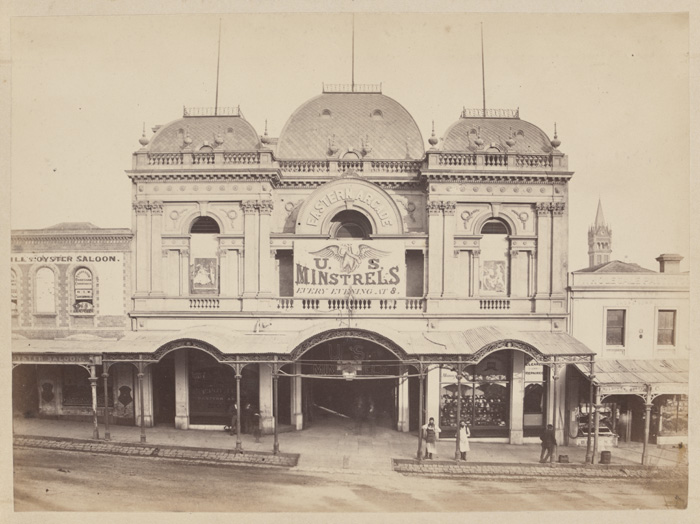
Eastern Arcade, Bourke Street, Melbourne, 1875, with banner for US Minstrels and images depicting the players. Photographer: NJ Caire/Anglo-Australasian Photo Co. State Library Victoria, H84.3/11

The Queen’s Arcade on Lonsdale Street in Melbourne, after renovations, reopened to great fanfare in March 1856, with a military band and a fountain of eau de cologne supplied by arcade fancy goods’ dealer Levy Bros, as well as

musical entertainments … varied by the performance of a powerfully toned apollonicon [a large barrel organ], which is intended in future to play at stated periods during the day, and thus prove a continual attraction to the passer-by to make use of this elegant avenue as a lounge


Age, 17 March 1856, 4

Arcades are often thought of purely as places of commodity exchange or places to eat and drink, with retail shops and tearooms often the focus of discussions both popular and academic. As I argue in my thesis, the arcades in fact reflected broader social and cultural aspects of urban life, with a wide variety of entertainments, including theatres, dance halls, hotels, balls and music in the promenades, and amusement parlours. As I note in Chapter Five, following James Lesh, arcades ‘catered for colonial Australian thirst for “amusements, performances and hospitality: novel forms of leisure and entertainment”[1] that were part of the global experience of modernity, many of which they might find within’ [2].

The entertainments in the arcades ranged in type. While there were more refined shows, such as art shows and elegant balls, displays at the ‘cheap amusement’ end of the spectrum were also found in these buildings, demonstrating the appetite for ‘new and innovative entertainments, many of which utilised new technologies in their presentation’ [3] but might also utilise the fantastical or seemingly strange to amuse patrons. While spectacle was a key component, these amusements might also be considered educative, about current or historic people and events, or new ideas and technologies.

The Queen’s Arcade was a regular site of such amusements, which also might play at other locations around Melbourne and Australia. These included models and panoramas of current events, such as important moments and sites in the war in the Crimea in the mid-1850s, including a model of the Sevastopol and Kronstadt naval bases, as well as St Petersburg. In 1855 and 1858, there featured an ‘exhibition of dissolving views‘ using a calcium light to project photographs, in the first case, including ‘places such as the Arctic regions, Turkey, Italy, Netley Abbey, and Walmer Castle‘, with the commonly applied entry fee of a shilling for adults and children at sixpence.

In the Eastern Arcade in Bourke Street Melbourne, there were a variety of such cheap amusements, as well as businesses that straddled the line between entertainment and health and wellbeing, such as phrenologists and fortune tellers. As these latter characters are the focus of the work of other scholars [4], I’ll focus here on the other amusements present in this building, but in another post, I might talk about these people in other arcades!

One of the other business-owners in the building also thought of innovative ways to attract people to the building. In 1879 fancy goods dealer Isaac Solomons hosted the Great American Pantechnetha in conjunction with a fancy bazaar, which featured panoramas of ‘the Prussian & Russian wars and views of the principal cities in Europe – surpassing anything ever seen in the Australian colonies’. He also later paid Dominick Sonsee, ‘the smallest man in the world’, to appear and hold an ‘at home’, where he chatted with visitors about politics and current events. Sonsee later, however, took publican Thomas Bentley to court over non-payment of the fee from Solomons, which Bentley had allegedly accepted on Sonsee’s behalf but not passed on, with newspapers rueing that Sonsee had been taken advantage of and portraying him in a pitying light.

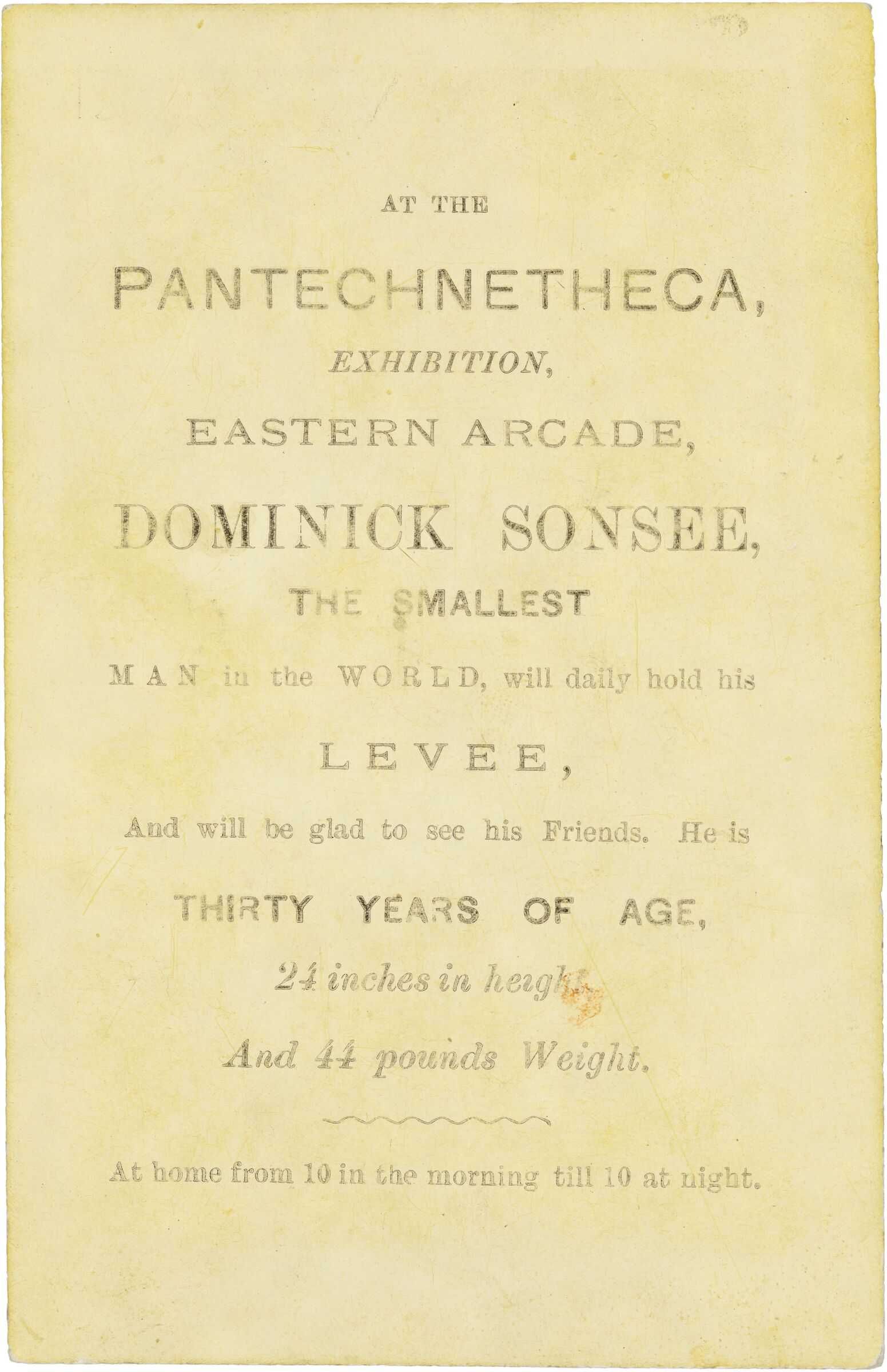
 

Carte de visite advertisement for appearance of Dominick Sonsee at the Eastern Arcade, c1880.
Photographer: William Burman. National Portrait Gallery, 2014.5

The Eastern Arcade also had two dedicated entertainment spaces which featured entertainments such as the US Minstrels and Lady Court Minstrels (the latter also played at the Victoria Arcade & Academy of Music in 1884), and Kate and James Kelly, siblings of bushranger Ned, who held a rather grim entertainment where patrons could see and talk to them for one shilling prior to their brother’s execution in November 1880. In the same arcade in 1914, Seattle-born George and Leo Whitney, who had been leaseholders of Luna Park, Melbourne, opened the Joy Parlour amusement arcade in nine of the arcade shops, ‘entertaining hundreds of people both day and night with all kinds of amusement and picture shows. … Beautifully lit with electric light, and music always‘. According to the oral testimony of George K Whitney, his father (also George) ran the shooting and amusement section of the arcade, while his uncle ran the photography studio, before moving back to the US in the 1920s.

Bourke Street in the area of the arcade was well-established as the heart of Melbourne’s popular entertainment during the late 1800s. The atmosphere was beautifully described around 1912 by future journalist, Hugh Buggy: ‘a non-stop vaudeville show … [with] its music halls or “academies” of music, its billiard parlours, its shooting galleries, and a waxwork chamber of horrors … it was the heart of Theatreland and the stomping ground of sports.'[5] Both the Eastern and the Victoria Arcade and Academy of music on the next block contributed much to this atmosphere. These entertainments and others at the Eastern Arcade show that the life of the surrounding streets entered the once-imagined refined confines of the building and may have contributed (along with larrikins, phrenologists, fortune tellers, theatre connections, and murders) to its poor reputation from the 1890s to 1920s.
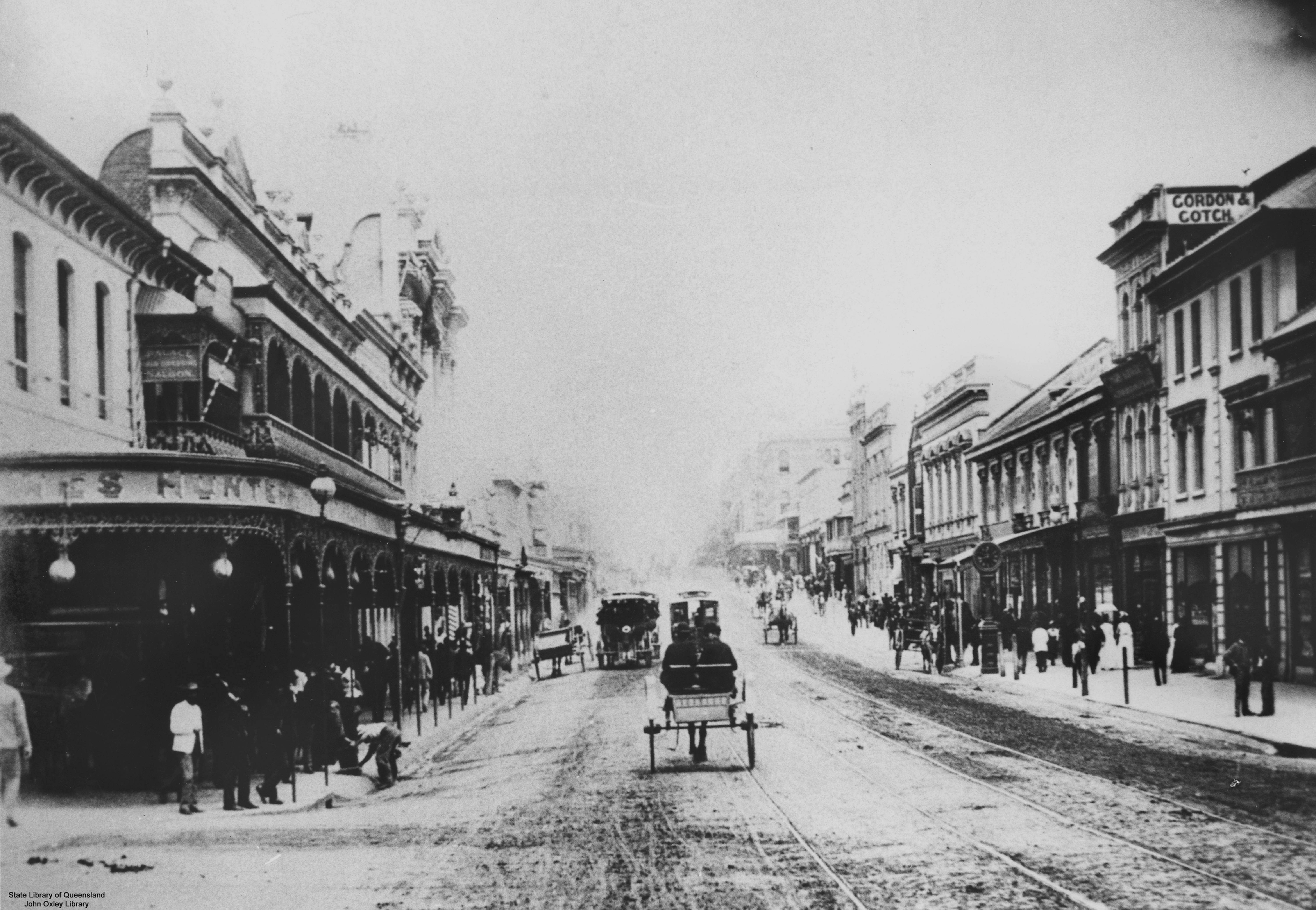
Grand Arcade (second from corner at left), c1889. Photographer unknown. State Library Queensland, Negative: 100723

Heading north to Brisbane, Henry Morwitch’s Grand Arcade, which seemed to have a regular program of public events, hosting ‘a variety of entertainments and amusements on offer ranging from carnivalesque to the refined’. [6] In 1889, it featured a sideshow-type performer, Fedor Jeftichew, who experienced hypertrichosis, leading to excess body hair, billed as ‘Jo-Jo the Russian dog-faced boy‘. Demonstrating the transnational movements of so many of these entertainers across the globe, Russia-born Jeftichew toured England, Europe and Australia, originally with US showman and circus owner, PT Barnum, who satisfied the public appetite for shows featuring those advertised as ‘monsters’.

Shows that incorporated or featured new technologies also took place in the Grand, including Woodroffe’s glass-blowing exhibition in 1889. Born in the US, Charles Woodroffe exhibited in the States before coming to Australian in the 1860s under the patronage of entertainment entrepreneur George Coppin. Woodroffe’s shows featured glass-blowing combined with technologies such as steam engines made from glass. These shows were popular travelling entertainments and we see Woodroffe exhibiting throughout Australia, as well as presenting his more scientific glass aparatus at international exhibitions. The glassblowing shows were part informative and part show and, as Rebecca C Hopman tells us, ‘delight[ed] spectators with lampworking displays, fabulous models, and tables crowded with glass trinkets’. [7] In 1897 and 1898, new technology again featured, when Lumiére’s cinematograph of moving pictures was exhibited, producing images of the Queen Victoria’s Diamond Jubilee and the Melbourne Cup, as well as ‘other exciting events’.

Description of Charles Woodroffe’s show in Maryborough, Queensland. Maryborough Chronicle, 30 August 1887, 2.
Poster for Woodroffe’s brother’s show in Utica New York, 1881. Rakow Research Library Special Collections, Corning Museum of Glass, Flat Files (Unit 31, Drawer 6)

Like those in Melbourne and Brisbane, Sydney’s arcades also hosted a variety of similar amusements. From October 1893 to around December 1894, the basement of the Strand Arcade played host to the Crystal Maze Palace of Amusement, in the Strand Arcade basement. The newspapers tell us that it included entertainments such as ‘Madame Paula, the scientific palmist’, a mirror maze, and mechanical novelties, gaining ‘a large measure of popularity as a holiday resort‘. The next year the arcade had a model of the Tower of London made entirely of cork (one million pieces!), and from 1896 to 1897, Sawyer’s Australian Waxworks, featuring celebrities of the day such as Sarah Bernhardt. These exhibits attained popularity in the nineteenth-century with contemporary and historical personalities rendered in wax, arguably the most famous today being Madame Tussauds, with branches all over the world (including Sydney). Waxworks seems to have tried to attract broad audiences, being advertised in numerous newspapers, including the Guang yi hua bao/The Chinese Australian Herald.

While these are just a snippet of the types of ‘cheap amusements’ that could be found in the Australian arcades in the nineteenth and early twentieth centuries, they demonstrate the diversity of the types of entertainments that were available. Their presence indicates that arcades were not just sites that would attract the town elites but had a wider class of visitor. While the Eastern Arcade spatially was embedded in Melbourne’s entertainment district, the Strand was in a more apparently refined location on Pitt Street, in the shopping heart of Sydney, although relatively close to the theatre district on King Street. The presence of such amusements widen our understanding not only of the types of businesses found within arcades but also their visitors, breaking down the idea that these buildings were only the preserve of middle-class or elite shoppers and tea-drinkers.

At the same time, these examples also give insight into the global exchanges that took place in the arcades beyond those of commodities. These travelling entertainers often hailed from North America, Europe or Britain, and elsewhere across the the globe, and travelled independently or as part of troupes, sometimes managed by entertainment entrepreneurs such as Coppin or Barnum. They utilised a variety of genres and techniques, including music and dance, as well as technologies driven by steam and electricity [8], wax modelling, and glassblowing in order to amuse and delight their audiences within the arcades.

Learn more

On 31 October 2023, Dr Alexandra Roginski, a fellow Professional Historians Association (Vic & Tas) member, and Professor Andrew Singleton from Deakin University are presenting ‘An Evening of Mystery in the Eastern Arcade: Phrenologists & Spiritualists’ at the Victorian Archives Centre and online. It should be a great talk, so book via Eventbrite! I’m so looking forward to it!

Footnotes

  1. James Lesh, ‘Cremorne Gardens, Gold-rush Melbourne, and the Victorian-era Pleasure Garden, 1853-63’, Victorian Historical Journal 90.2 (2019): 219–252. https://search.informit.org/doi/10.3316/INFORMIT.893493942124131.  
  2. Nicole Davis, Nineteenth-century Arcades in Australia: History, Heritage & Representation (PhD Thesis, University of Melbourne, 2023), 165.
  3. Ibid. 186.
  4. Alexandra Roginski, Science and Power in the Nineteenth-Century Tasman World: Popular Phrenology in Australia and Aotearoa New Zealand (Cambridge, 2022), in which she talks about the Eastern Arcade.
  5. Hugh Buggy, The Real John Wren (Widescope International, 1977), quoted in Otto, Capital, 47–48.
  6. Davis, ‘Nineteenth-century Arcades in Australia’, 192.
  7. Rebecca C Hopman, ‘Demonstrations Gain Steam’, Journal of Glass Studies 62 (2020): 281.
  8. See for example: Henry Reese, ‘”The World Wanderings of a Voice”: Exhibiting the Cylinder Phonograph in Australasia’, in A Cultural History of Sound, Memory, and the Senses, edited by Joy Damousi & Paula Hamilton (Routledge, 2017)

Other Sources & Further Reading

Mimi Colligan, Canvas Documentaries: Panoramic Entertainments. inNineteenth-Century Australia and New Zealand (Melbourne University Press, 2002).

Corning Museum of Glass, ‘The Grand Bohemian Troupe of Fancy Glass Workers|Behind the Glass Lecture’, 19 January 2019. YouTube.

Clay Djubal, ‘What Oh Tonight: The Methodology Factor and Pre-1930s’ Australian Variety Theatre (with Special Focus on the One Act Musical Comedy, 1914–1920)’ (PhD Thesis, University of Queensland, 2005).

Harry Gordon, ‘Buggy, Edward Hugh (1896–1974)’, Australian Dictionary of Biography.  

Andrew May, ‘Bourke Street’, eMelbourne: The City Past and Present.

Official Record Containing Introduction, History of Exhibition, Description of Exhibition and Exhibits, Official Awards of Commissioners and Catalogue of Exhibits. (Melbourne: Mason, Firth & McCutcheon, 1882), 434, 648.

Kristin Otto, Capital: Melbourne When it Was the Capital City of Australia, 1901–27 (Text Publishing, 2009), 47–75.

Henry Reese, ‘Spectacular Entertainments at Edison Lane’ (parts one and two), State Library of Queensland Blog, 20 December 2022.

Henry Reese, ‘Settler Colonial Soundscapes: Phonograph Demonstrations in 1890s Australia’, in Phonographic Encounters: Mapping Transnational Cultures of Sound, 1890–1945, edited by Elodie A Roy and Eva Moreda Rodriguez (Routledge, 2022), 60–77.

‘The Great Exhibition, 1851: Philosophical instruments by Deleuil 1851’ [photograph], Claude-Marie Ferrier, RCIN 2800038, Royal Collection Trust.  

Richard Waterhouse, ‘The Internationalisation of American Popular Culture in the Nineteenth Century: The Case of the Minstrel Show’ Australasian Journal of American Studies 4.1 (1985): 1–11.

Richard Waterhouse, From Minstrel Shows to Vaudeville: the Australian Popular Stage 1788–1914 (NSW University Press, 1990)

Richard Waterhouse, Private Pleasures, Public Leisure: A History of Australian Popular Culture Since 1788 (Longman, 2005).

Alexa Wright, Monstrosity: The Human Monster in Visual Culture (Bloomsbury, 2013), 84–85.

In October last year, along with other members of the Melbourne History Workshop (MHW), I presented at a public seminar, ‘Untimely Ends: Using Inquests for Family and Local History‘, at Public Record Office Victoria (PROV), which focused on a specific collection of documents at PROV. We looked at the broader details of information you can find in these Inquests (Series VPRS 24) and how to use them in historical research. You can find more information on the MHW website, including the PowerPoint of the talk, which is full of useful material.

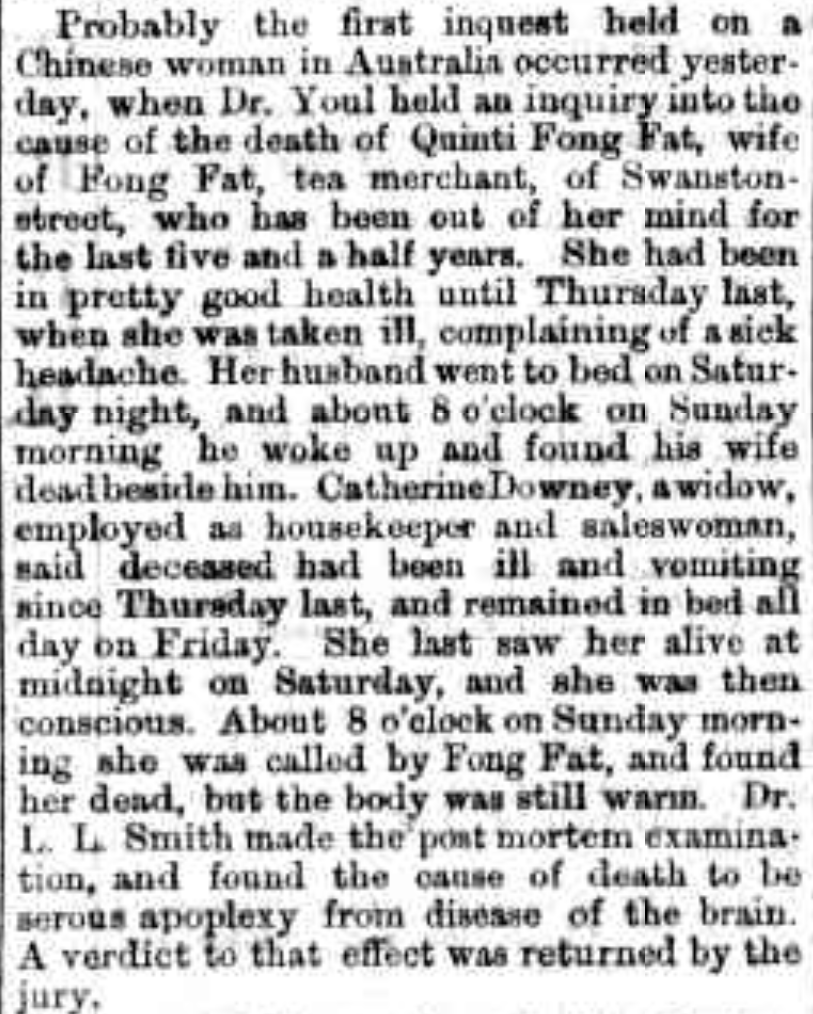
For my specific section, I talked about some research that I have been doing on Fong Fat, the Chinese owner of several Fancy Goods stores: two on Swanston Street and one in the Eastern Arcade in the 1860s and 1870s (although not all at the same time). The inquests research revealed more about his story but, more significantly, gave some greater detail about the women in his family: his daughter, Ah Chow; his first wife, Chinese-born Quinti; and his second wife, English immigrant Catherine Downey, formerly the family’s housekeeper and shop assistant.

In the last post on Fong Fat, I wrote about English-born New Zealander Charles Rooking Carter‘s comment on the shopping opportunities in the city of Melbourne in 1869:

he could find only one handsome Chinese shop in all Melbourne, and that was kept by ‘celestial’ individual rejoicing in the name of Fong Fat. He indeed, had an excellent display of Chinese fancy goods, in the way of carved ivory work, ebony work, porcelain baskets — besides tea and tobacco.

Carter, Victoria: The British ‘El Dorado‘ (1870)

Fong Fat’s shop, at 96 Swanston Street, near Little Bourke, was joined by another at 48 Bourke Street, in 1871 and then by another, in 1872, in the new and prestigious Eastern Arcade on Bourke Street. It was this shop that led me to Fong Fat and his story. In my research work on nineteenth-century Australian shopping arcades I came across advertisements for the wares that Fong Fat sold in the arcade, including imported Chinese homewares, bric-a-brac, fireworks, tea, and tobacco.

Advertisement for Fong Fat’s Eastern Arcade store, Herald, 20 December 1872, 4

While we imagine arcades in this period, and indeed Melbourne itself, as rather heterogenous and white, Chinese, Indian, Afghani and other non-European shops appeared in them to satisfy the taste for, to European eyes, exotic products from these regions. These shops and the stories of their proprietors demonstrate that Australia and its urban centres were more cosmopolitan that we often imagine.

The image we often have of the Chinese in Australia is of goldfields immigrants, sojourners that return or intend to return to China after making their money, who send their profits home, and whose Chinese wives that are left behind with the extended family. But, as scholars of the Chinese-Australian experience such as Sophie Loy-Wilson and Kate Bagnall, have explored, the story is far more complex. Many also decided to remain in Australia, becoming an integral part of Australian urban and regional life.

Fong Fat’s life is a one of those that little different to the Chinese sojourner trope, as is that of his family. Born in Canton around 1820, he came to Australia about 1857, presumably for gold, and established himself as a shopkeeper. He died in Stawell in 1884 after having married English-born widow Catherine Downey in 1872. This aspect of his story is really interesting, although not so highly unusual for Chinese-Australian men of the period; quite high numbers began relationships and had children with non-Chinese women. What intrigued me even more though was the story of his first family.

As I searched through Trove, as you do, for newspaper reports on him, I found some intriguing articles about two inquests in which he gave evidence. The first was that of four-month-old Ah Chow, the child of Fong Fat, who died in 1865 of inflammation of the lungs. The second, was that of his Chinese wife Quinti whose death, five years later, was caused by a stroke, and the newspapers claimed was probably the first inquest on a Chinese woman in the Australian colonies. These stories really intrigued me because our general story is that almost no Chinese women were present in Australia during this period. The Victorian census records indicate that there were eight Chinese women in 1861 (although 7% of the total population was China born), which grew to 31 in 1871. But there were a very very small number, of which Quinti was one .

Report on the inquest of Ah Chow, The Age, 10 July 1865, 4
Report on the inquest of Quinti, The Age, 17 May 1870, 3. The report mentions Catherine Downey, who was soon to become Fong Fat’s second wife

Interested in finding more, I obtained the inquest records (now almost all digitised!) from PROV, which told us a little more about the findings of the coroner, although the majority of the information was really quite well reported in the newspapers. But the inquests help to personalise this much more as we read the words of Fong Fat’s testimony for both his little daughter’s and wife’s deaths (the second was given through a translator). Like many testimonies, they seem dry, but we can imagine the probable distress of the father and husband at these events. Of Ah Chow’s death he stated:

The deceased female infant Ah Chow was my child. She was 28 days old. She was healthy up to the day before yesterday. She was in bed with her mother when I went home at 12 o’clock at night. My wife was crying. I saw blood coming from the child’s mouth. I went for a doctor but he was not at home. The child was alive then but lived only two hours.

Inquest deposition of Fong Fat in the death of his daughter Ah Chow. Public Records Office Victoria, VPRS 24 P0000 Unit 167, 4

The inquests are also interesting as they not only have testimonies from Fong Fat but also non-Chinese associates. This includes, in the inquest of Quinti, their housekeeper and shop assistant in Fong Fat’s store, Catherine Downey. Name sound familiar? Yes, this is the English-born widow that he married in 1871 and was his wife until her death fifteen years later!

I approach the history of urban Australia often in through the avenues of family history such as this. Using the personal stories of individual personalities to tell bigger histories and revealing larger events, such as the goldrush and its aftermath, Chinese migration to Australia, and the history of the city. Someone like Fong Fat, making his way in a city we often envisage as European and the presence of his Chinese wife and child, gives a different complexion to our imagination of Australia during the period.

Once I had found the inquests, I sourced as many other documents as I could to build a picture of these people and their lives – more newspaper reports, including advertising for the shops, stories about a court case Fong Fat’s second wife brought against someone, records of Catherine’s burial in the Melbourne General Cemetery and the gold that is the death certificates of Ah Chow and Quinti, which told us a little about them. Quinti, we find was born in Canton in around 1846 and had come to Victoria in around 1864 or 5, presumably to be a wife to Fong Fat. She quickly bore her only child, Ah Chow, in the colony, only to lose her, and then to die herself five years later.

The inquests themselves are only suggestive of what life would be like for Chinese women in Australia. Unfortunately, there is not a lot of detail in these particular ones but … in many other inquests we would receive a wealth of other detail about individuals. The death certificates reveal a little more, but they add to the story we are building. Importantly to me they also disrupt the idea that Chinese women were not present in Australia at all and the trope of the single sojourner Chinese man.

I think they also put a human slant on the often racialised and sensationalised newspaper reports about the Chinese community in the colonial city.  Together with all these other documents, the inquests provide another window into the lives of Fong Fat, Quinti and their baby daughter, as well as his second wife, and show how these types of records can provide more detailed information and illuminate the stories of Australian families.

I could find only one handsome Chinese shop in all Melbourne, and that was kept by a ‘celestial’ individual rejoicing in the name of Fong Fat. He indeed, had an excellent display of Chinese fancy goods, in the way of carved ivory work, ebony work, porcelain baskets — besides tea and tobacco. (Carter 1870, 54).

Eastern Arcade
View of the Eastern Arcade, Bourke Street, Melbourne, 1877. Photographer: NJ Caire. State Library Victoria, H84.3/11.

In 1873, four businesses in the Eastern Arcade, Bourke Street, Melbourne, were listed as fancy goods dealers. Popular in arcades and in locations on the city streets, fancy goods stores had a wide variety of products for the home and personal use.

One of these was occupied by Chinese merchant and importer, Fong Fat, whose store occupied two shopfronts – numbers 11 and 13 – but his fancy goods were a little different to many of the products to be found in similar stores in colonial Melbourne and, indeed, in the Eastern Arcade.

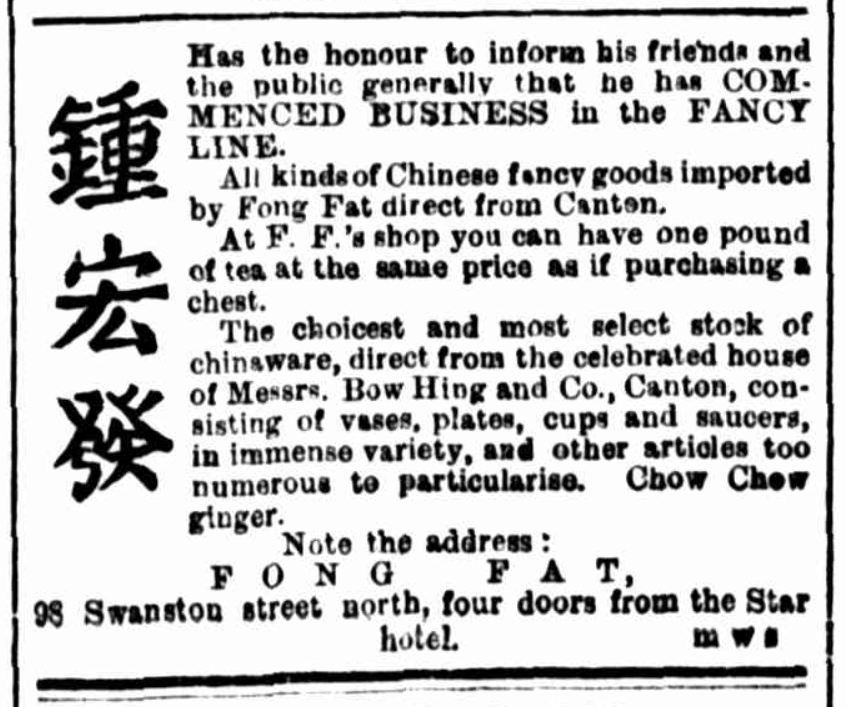
Fong Fat was already well-established in the city as a fancy goods dealer, having run such a business at 98 Swanston Street since July 1868 (Herald, 18 July 1868, 1), before opening this second branch in the ostensibly prestigious location of the Eastern Arcade, in December 1872 (Argus, 18 December 1872, 2).

Screen Shot 2018-11-01 at 7.56.22 pm
Advertisement for Fong Fat’s Fancy Goods at 98 Swanston Street, Herald, 18 July 1868, 1.

In his stores, he carried Chinese (and some Japanese) products, including manufactured goods, such as carved ivory and ebony ware, porcelain crockery, silk and cotton, dress trimmings, fans, workboxes, tea caddies firecrackers, baskets, slippers, bamboo blinds and fishing rods, Japanese toothpowder, and Chinese crackers, but also consumables such as tea, tobacco, coffee, sugar, and spices.

Advertising indicates that he utilised connections in mainland China to import these treasures himself, for ‘All kinds of Chinese fancy goods [were] imported by Fong Fat direct from Canton … [including] chinaware, direct from the celebrated house of Messrs. Bow Hing and Co.’ for his Swanston Street store (Herald, 18 July 1868, 1). Later ‘he obtained all the newest novelties in China goods expressly for’ his new store in the arcade in 1872 (Argus, 18 December 1872, 2).

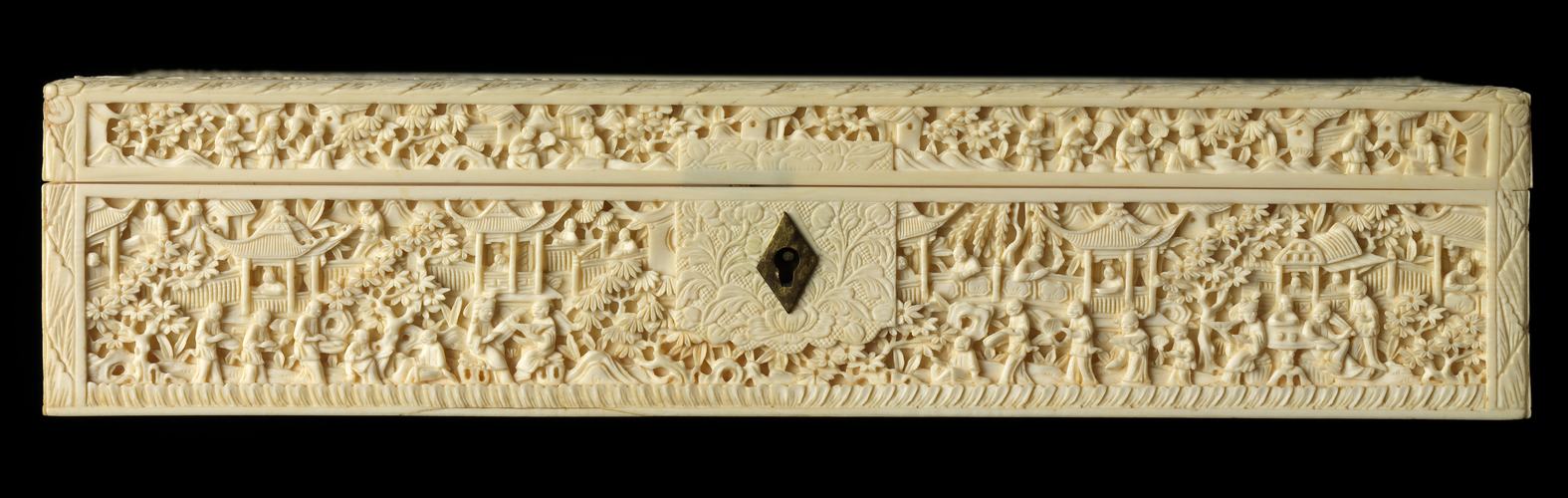
We gain an idea of what some of these goods may have looked like by taking a glance some of the imported Chinese items in the collection of Museums Victoria, including an ivory fan box, a silk and ivory fan, and a carved bone fan. Although these objects are of a slightly later date (1880), they perhaps represent some of what customers might be able to buy in Fong Fat’s shops.


563289-small
Fan Box – Ivory, Carved Village Scenes, China, late Qing Dynasty, c1880. Museums Victoria, HT 22577.

The presence of a Chinese shopkeeper in a shopping arcade, a space that is perhaps imagined as a white, elite zone of occupation and leisure, may seem unusual, but such goods fed the desire for ‘Oriental’ and exotic goods in demand in Britain and Europe. But they were also desired, and available, in regional and metropolitan Australia during the latter half of the nineteenth century into the twentieth (e.g., Loy-Wilson 2014, 2017).

We can see from newspaper advertising that a surprising number of shops and businesses in the Australian arcades captured the Orientalist desires of the consumer in the settler colonial landscape. These included importers of Japanese and Chinese silks, furniture and other wares, Indian and Chinese tea shops, Oriental Bazaars, Turkish baths, and more. Many, but not all, were owned and run by non-British or European Australians like Fong Fat.

Fong Fat only lasted a year in the Eastern Arcade, vacating when his lease ran out at the end of 1873. The last we hear of him, as a fancy goods seller at least, is at his Swanston Street store in December 1874.

download
Swanston Street, 1872. Photographer unknown. State Library Victoria, H96.160/1721. Fong Fat’s store was four doors down from the Star Hotel, and is possibly that indicated with the arrow.

Who was Fong Fat and what happened to him after this last mention? Is he the man of the same name running a Chinese lottery and gambling den in Little Collins Street in 1875 (Weekly Times, 10 July 1875, 11)? Is he the Fong Fat who was fined for creating noxious gas in 1876 from his opium refinery? (PROV, VPRS 3181/PO/660/473)? Is he the Fong Fatee that appears with his wife on the Melbourne stage in the 1880s? Do we see him donating fruit and tea to the hospital fete committee in Hay, New South Wales, in 1893?

I’m asking these and other questions during the next few weeks, as I try to piece his story together. I have found some interesting information about his personal life already, gleaned from court records, newspapers, inquests, and other documents that I’ve been scouring. In Part Two of this post I’ll talk more about Font Fat’s Chinese wife, Quinti, and their daughter, Ah Chow, as well as his shop assistant, who was later his wife, Catherine Downey.

Select Bibliography

Public Record Office Victoria, VPRS 3181 [Melbourne City Council] Town Clerk’s Files, Series I

Charles Rooking Carter, Victoria, the British ‘El Dorado’: Or: Melbourne in 1869 (London: Edward Stanford, 1870)

Sophie Loy-Wilson, ‘Rural Geographies and Chinese Empires: Chinese Shopkeepers and Shop-Life in Australia’, Australian Historical Studies 45.3 (2014): 407–424.

Sophie Loy-Wilson, Australians in Shanghai: Race, Rights and Nation in Treaty Port China (London & New York: Routledge, 2017)

Allom Lovell & Associates, The Royal Arcade: Conservation Management Plan (Melbourne: Allom Lovell &​ Associates, 1995)

Barbara Salisbury, The Strand Arcade: A History (Marrickville: Southwood Press, 1990)