Rundle Street, Adelaide, looking east, 1888. The Adelaide Arcade with its great dome can be seen at right centre. Photographer unknown. State Library, B2898

The arcades were a significant component of the leisure and commercial life of the nineteenth-century Australian city. In Adelaide, an adjoining complex of two arcades was constructed in 1885: Adelaide Arcade and Gay’s Arcade. These still exist today and have become an iconic part of the city’s urban environment.
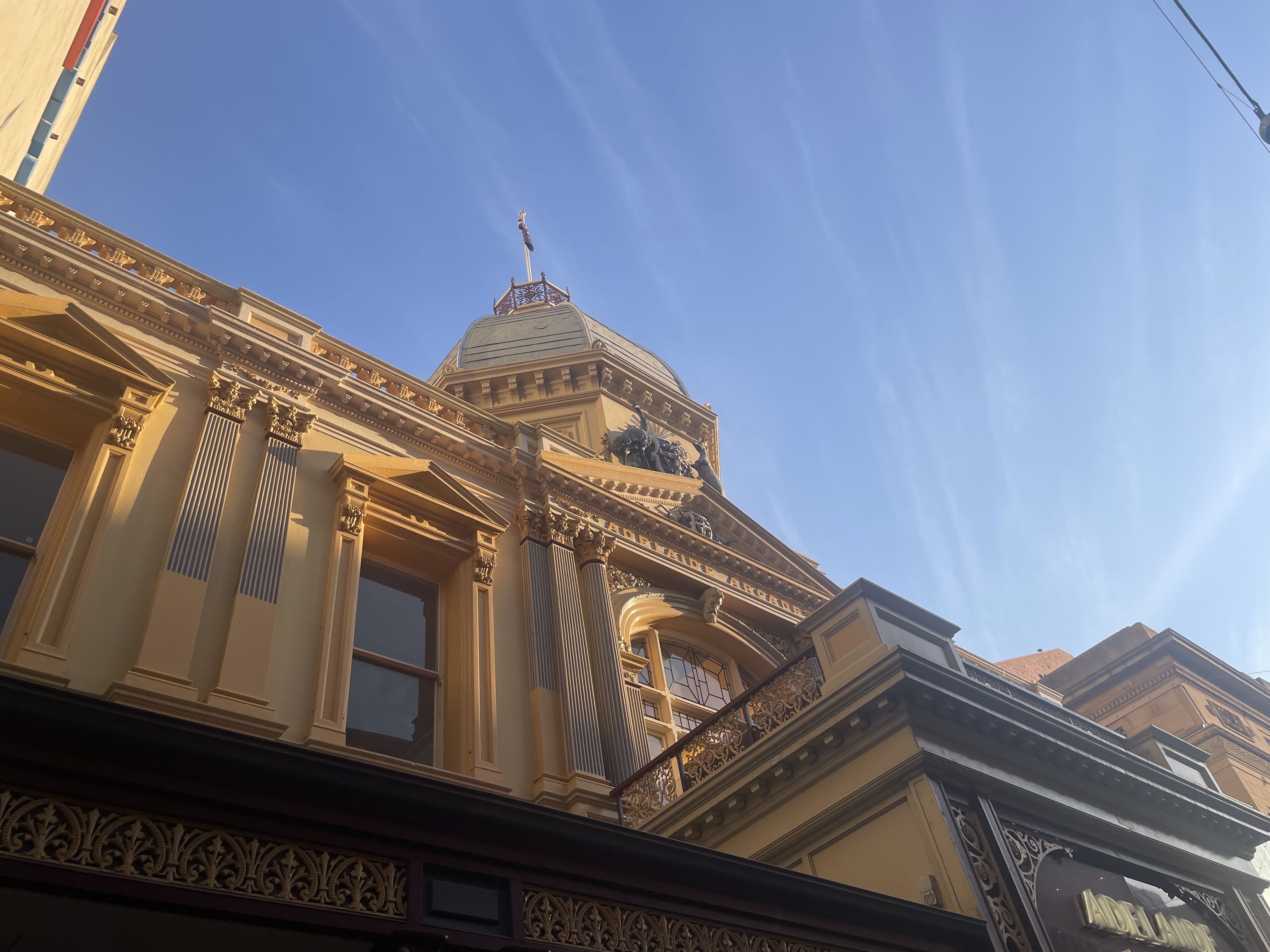
Adelaide Arcade, Rundle Street Mall, 2023. Photographer: Nicole Davis

Last October I travelled to Adelaide for research as one of the fortunate recipients of a 2023 Jack Cross Fellowship from the Friends of South Australia’s Archives (alongside Robyn Dunlop from University of Newcastle). The organisation inaugurated the fellowship in 2022 in honour of Jack Cross, their longest-serving President. This post is an edited version of the article I wrote for their December 2023 newsletter, which explained that the ‘Fellowships are awarded annually to support researchers of South Australian history to pursue research in archives, with a focus on the use of South Australian resources.’

Architectural Plan for Adelaide Arcade, 1885, Withall & Wells Architects. State Library of South Australia, PRG 1431/1/2

As part of my 2022 thesis on Australia’s nineteenth-century arcades, I did some extensive research into these buildings but in-person archival research was stymied by COVID-19. The generosity of the FSAA gave me the opportunity to begin to undertake an initial scoping visit, which will add nuance to the book I’m writing based on my thesis.
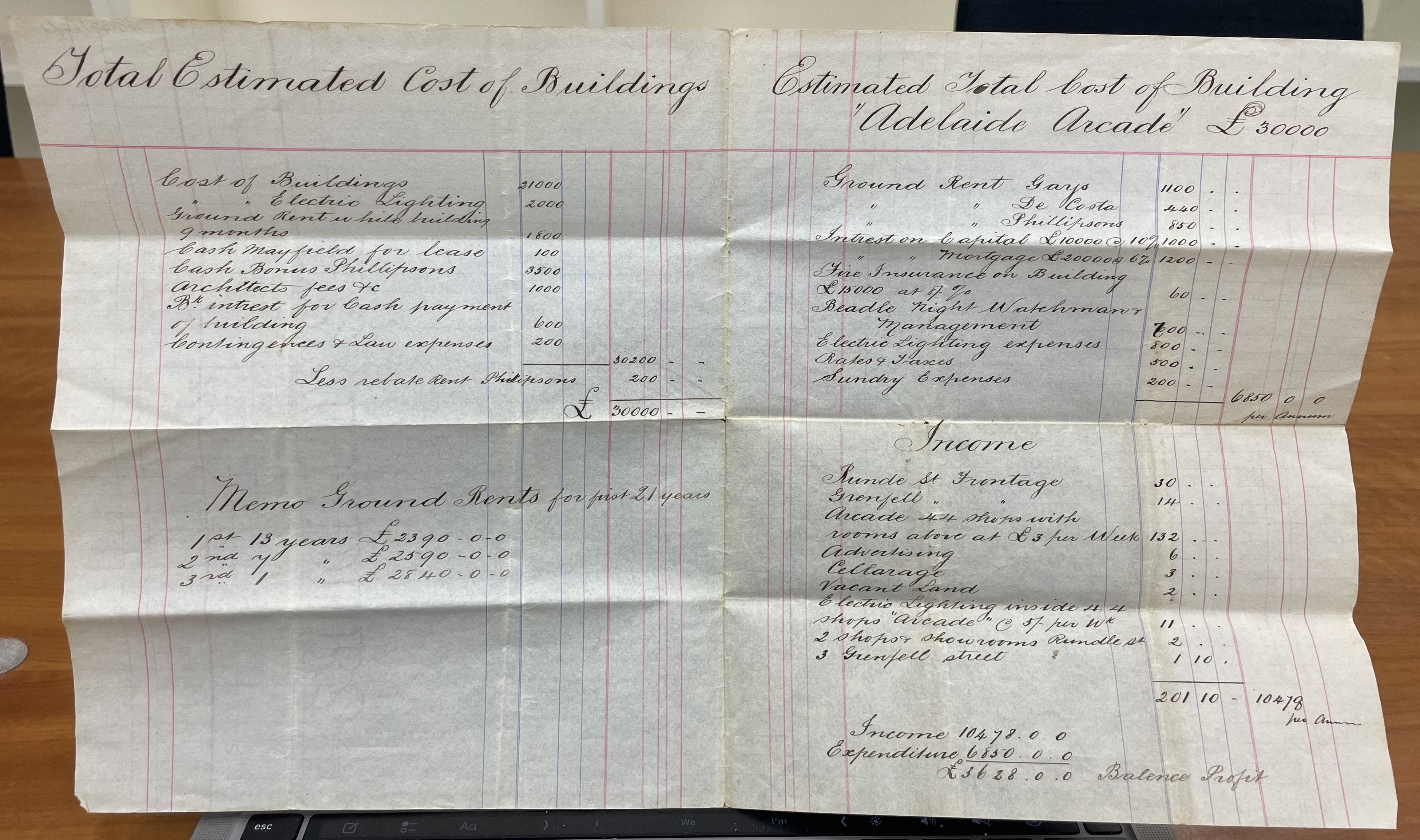
 Cost sheet for Adelaide Arcade, with estimate of total cost of buildings (30,000 pounds), with price of fixtures, architectural fees and estimates of rent, 1885. State Library South Australia, PRG 1431/2/1

During the visit I examined the resources available in some of the Adelaide archives, which will allow me to further explore the histories of this site and those who were connected with it – architects and owners, shopkeepers and workers, shoppers, and other visitors – during the nineteenth and early twentieth centuries, as well as its businesses and the goods and services traded within. 


Cash books relating to the management of Adelaide Arcade by Bullock & Wilkinson, Land Agents, 1924–1927. State Library of South Australia, BRG 64/23/1 & 2

Although this was intended as a scoping visit, it was a very fruitful and yielded a rich range of material. I spent a week in Adelaide, visiting State Library South Australia, the City Archives, the Architecture Museum at University of South Australia, and special collections at University of Adelaide. During my visit, I was able to digitise a large amount of primary manuscript and published material relating to the long history of the sites, including original plans, images, letters, and other sources not available online. I also accessed a wide range of publications from the twentieth century to today that revealed the importance of this heritage site to Adelaide, its history, and present day placemaking.
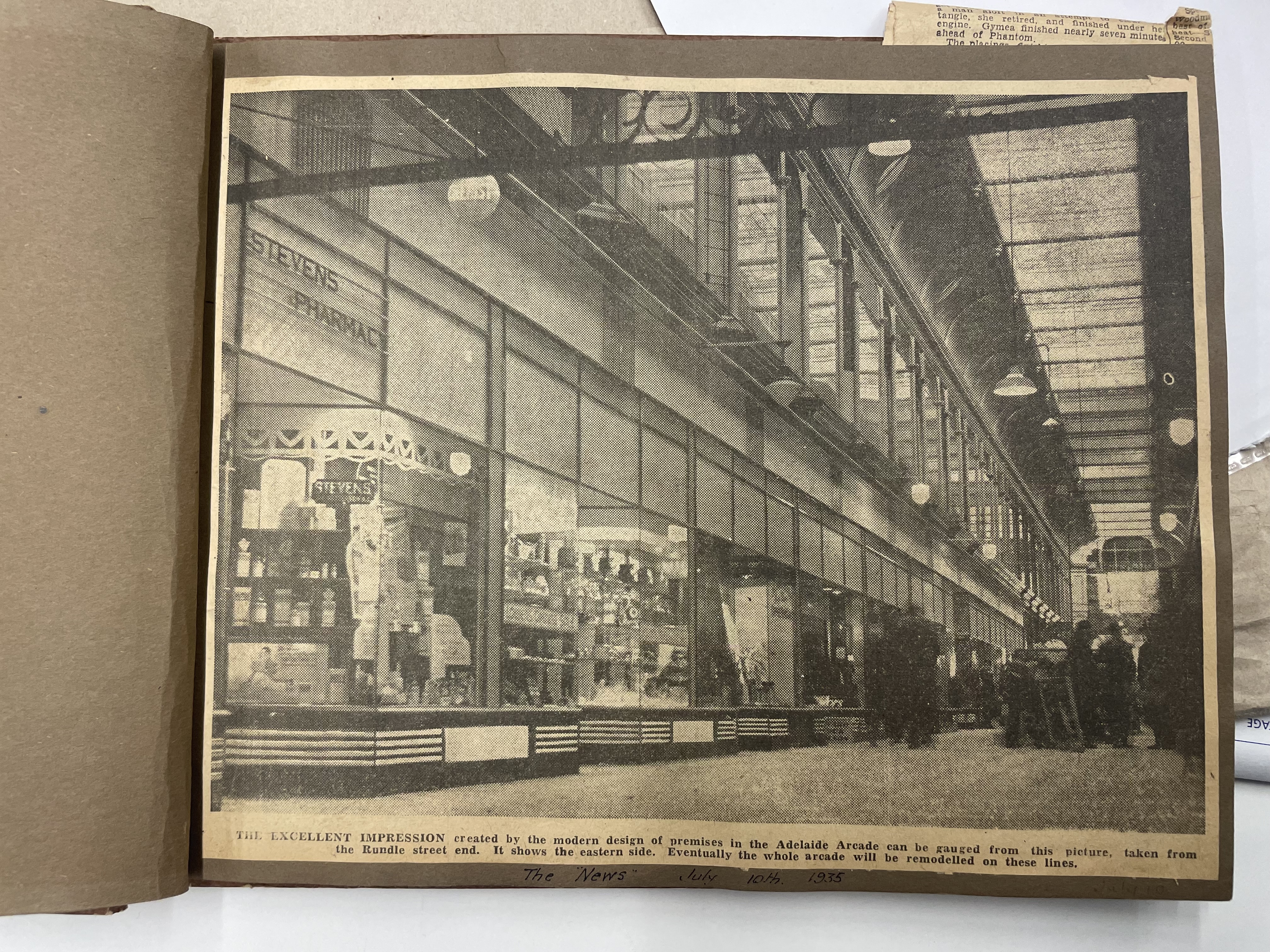
Newsclippings from The News, 10 July 1935, showing impression of the proposed remodel of the Adelaide Arcade, with new shopfronts replacing the nineteenth-century originals. Architecture Museum, University of South Australia, GRIGGS, Harold Thomas COLLECTION S167/4241

Although time did not permit me to visit State Records South Australia, I plan to return in 2024 to examine their small collection of related records, as well as to delve further into the City Archives, which has a large amount of material but requires some intensive investigation and sifting through indexes and boxes to find the relevant information. Also, the National Trust of South Australia, while they did not have any records of relevance, suggested that I visit the South Australian Heritage Council, which will also be in the plan for next visit.

Objects in the museum, Adelaide Arcade, 2023. Photographer: Nicole Davis

Two other valuable contributions arose from the work. The first was the ability to (finally!) visit the arcades in-person for the first time since the very beginning of my thesis. I closely observed the architectural details, the changes made to the site over the years, and some of the similarities with one of Melbourne’s (sadly demolished) arcades, the Eastern on Bourke Street. Experiencing the site in person provided a more complex understanding of its place in the city and also allowed me to view the museum, which has printed material and objects related to the arcade, the latter of which are often very difficult to find or identify.

Adelaide Arcade viewed from upper level at Rundle Street end, c1885 (probably opening day, 12 December 1885). The man at right is likely the Arcade’s caretaker, Francis Cluney, who died in 1887 in the arcade in an industrial accident. Photographer: Samuel White Sweet (arcade tenant). State Library South Australia, B7496
Central promenade of Adelaide Arcade, 2023. Note the gallery/balcony, added during renovations during the 1960s. Photographer: Nicole Davis

It was also great to see what shops are there today and notice the people enjoying the building. Secondly, I met library and archives staff who were wholly generous with their time, expertise, and knowledge of the city. They picked out material and publications for me to view that I hadn’t already identified and were really valuable to the research. It was also really fantastic to immerse myself for almost a week in the lovely city that is Adelaide!
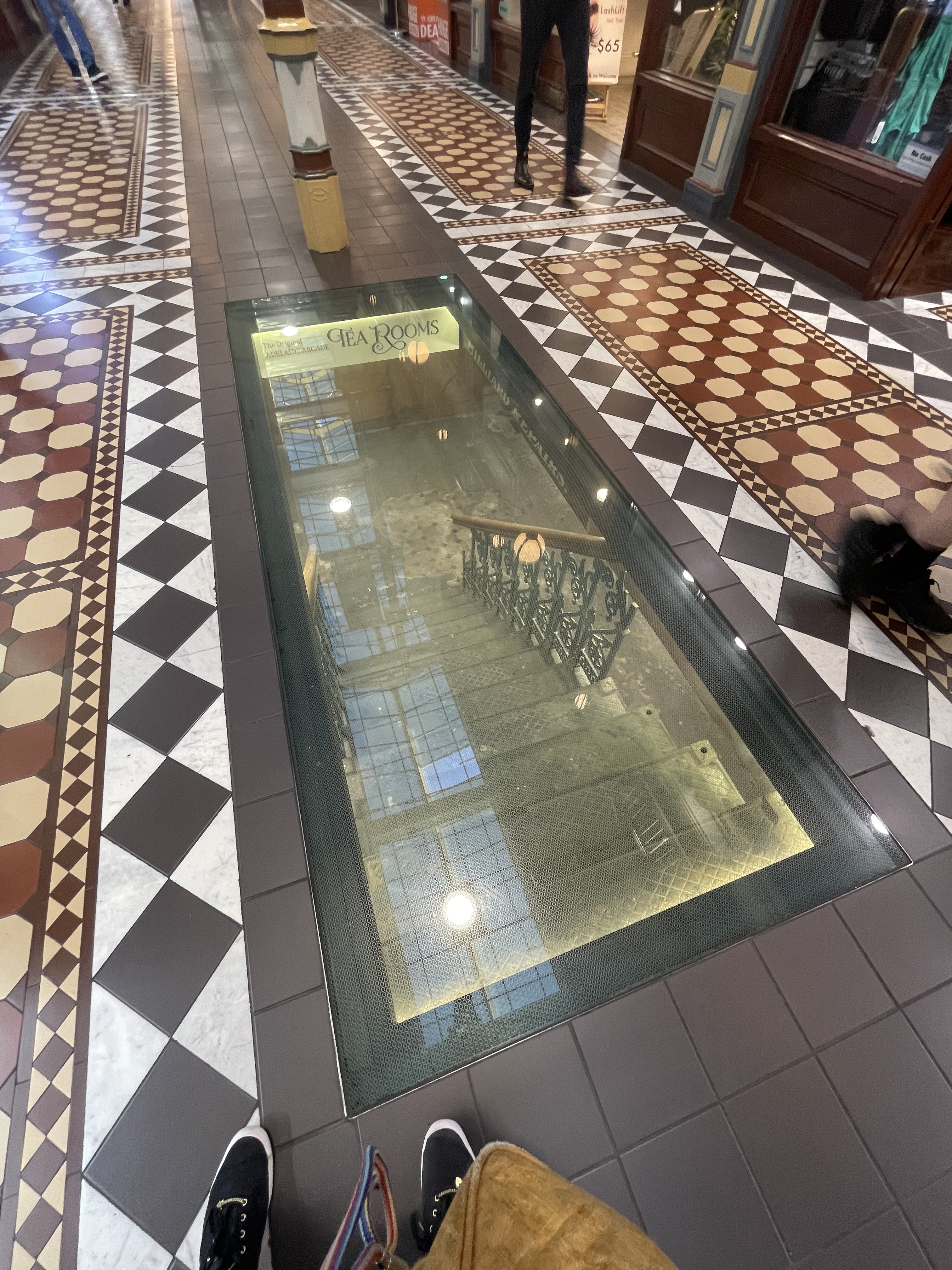
The disused basement, formerly tearooms, still visible through glass, Adelaide Arcade, 2023. Photographer: Nicole Davis

From here, I intend to further explore this topic and analyse the large amount of material that I collected while in Adelaide, which will contribute to my book on Australia’s arcades, as well as an online exhibition and website project that I hope to produce in the next year. The research conducted in Adelaide will also likely provide evidence to support a larger application for funding to delve further into the history of the arcades and the next phase of research to be conducted in 2024.

Adelaide Arcade, Rundle Street Mall, 2023. Photographer: Nicole Davis

I am greatly appreciative to the Friends of South Australia’s Archives for the Jack Cross Fellowship and will keep you up to date with further work on my research and, in the future, you’ll see an article on the arcades and their history right here.
Hi everyone. Well, it’s been a crazy busy few months. When is it not?

So much has happened that I want to quickly tell you about.

Well, I had my first holiday in about five years, when I travelled to Ireland, Scotland and England in July. I mostly did lots of hiking, did some pilgrimages to places where my family emigrated from and looked at many many many museums and built and natural heritage sites, which was really inspiring for my thoughts on, practice in and teaching for that space.

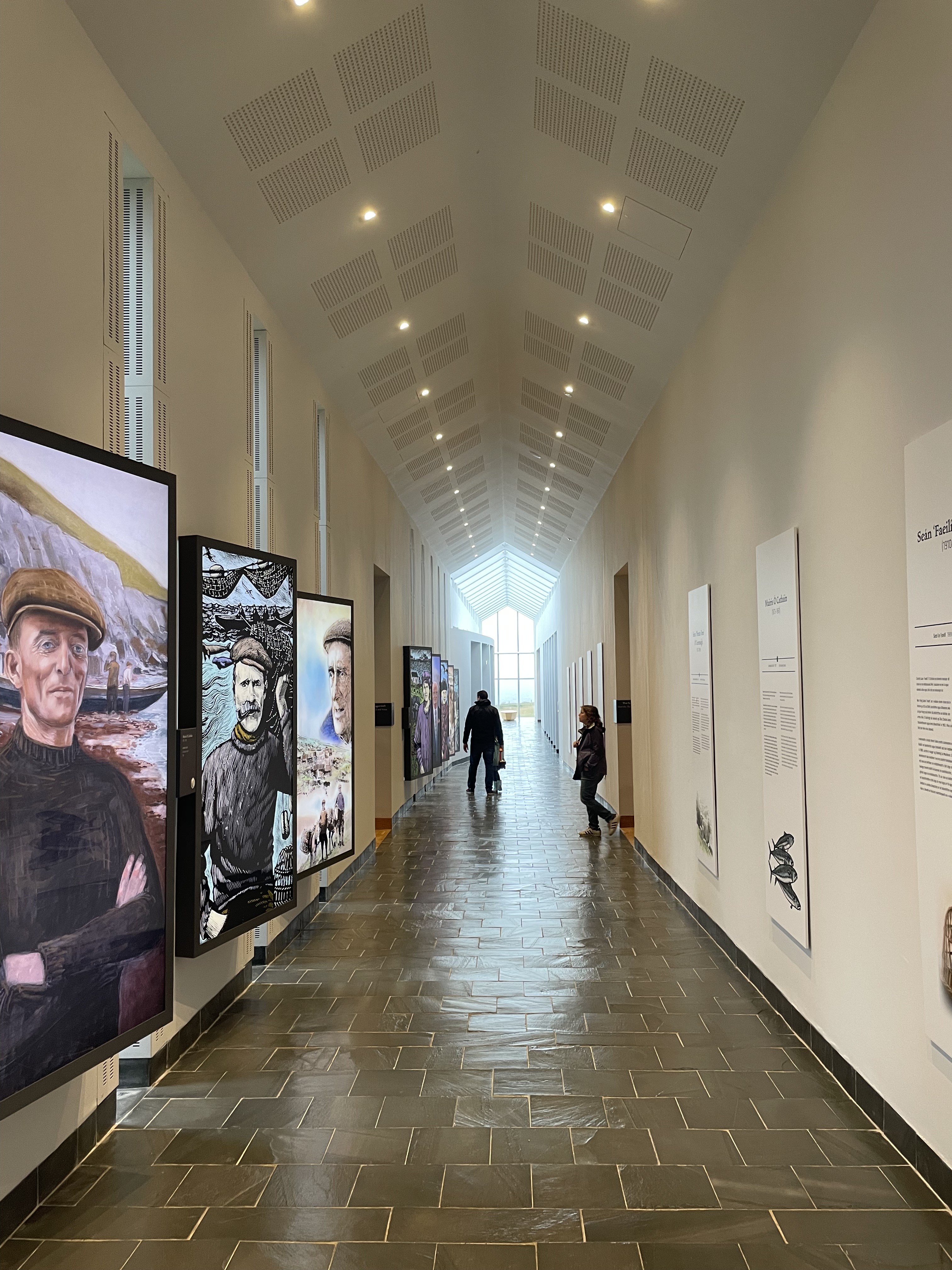
The amazing Great Blasket Centre, a museum in Dingle, Ireland, about the now largely abandoned islands just off the coast. Probably one of my favourite museums ever. So well designed and curated, with stories and objects that really get to your heart, especially if, like me, you have family connections with the region.

I also presented a paper at the fiftieth anniversary conference of the Urban History journal, The State of Urban History: Past, Present, Future, in Leicester. Invited to be part of a panel on Globalising Australian Urban History, I presented some work from my thesis research that didn’t quite make it into the thesis in much detail.

It was fantastic to speak about new work along with other historians of Australian urban landscapes: Simon Sleight, James Lesh, Anna Tenby. Most of us stayed onsite and agreed that it was one of the best conferences we’d been to in a long time. My paper, ‘Arcadian Dreams: Regionalising Australian Urban History’, examined nineteenth-century Australian urbanity through the lens of the arcades, often viewed as a symbol of urban life throughout the globe during this period.

It explored several case studies of these buildings constructed in towns and cities outside the colonial capitals in this era, including their architecture, the shops and other businesses they contained, and the language that surrounded them in print media. I ask in it if, by looking at and comparing these sites across the regional/metropolitan divide, we can gain a better and more nuanced understanding of what it meant to live and be urban in nineteenth-century Australia. 

Inside courtyard of Leicester’s wonderful fourteenth-century Guildhall

After the conference we also got to have a little tour around Leicester on the final day and see their amazing fourteenth-century Guildhall (and the carpark where Richard III’s remains were found, which is a site of pilgrimage itself). After that, I had a well-deserved six weeks off and largely spent my time hiking in the Scottish Highlands, followed by a few days in London, and one little visit to the archives in Bedford to research for a paper I’m giving in October.

The luckiest shot ever. Torridon Estate, a National Trust for Scotland natural heritage site. There is a deer park and museum there but this was in a random carpark I pulled in to so I could take a photo of the mountains. This deer was VERY comfortable with cars and people!
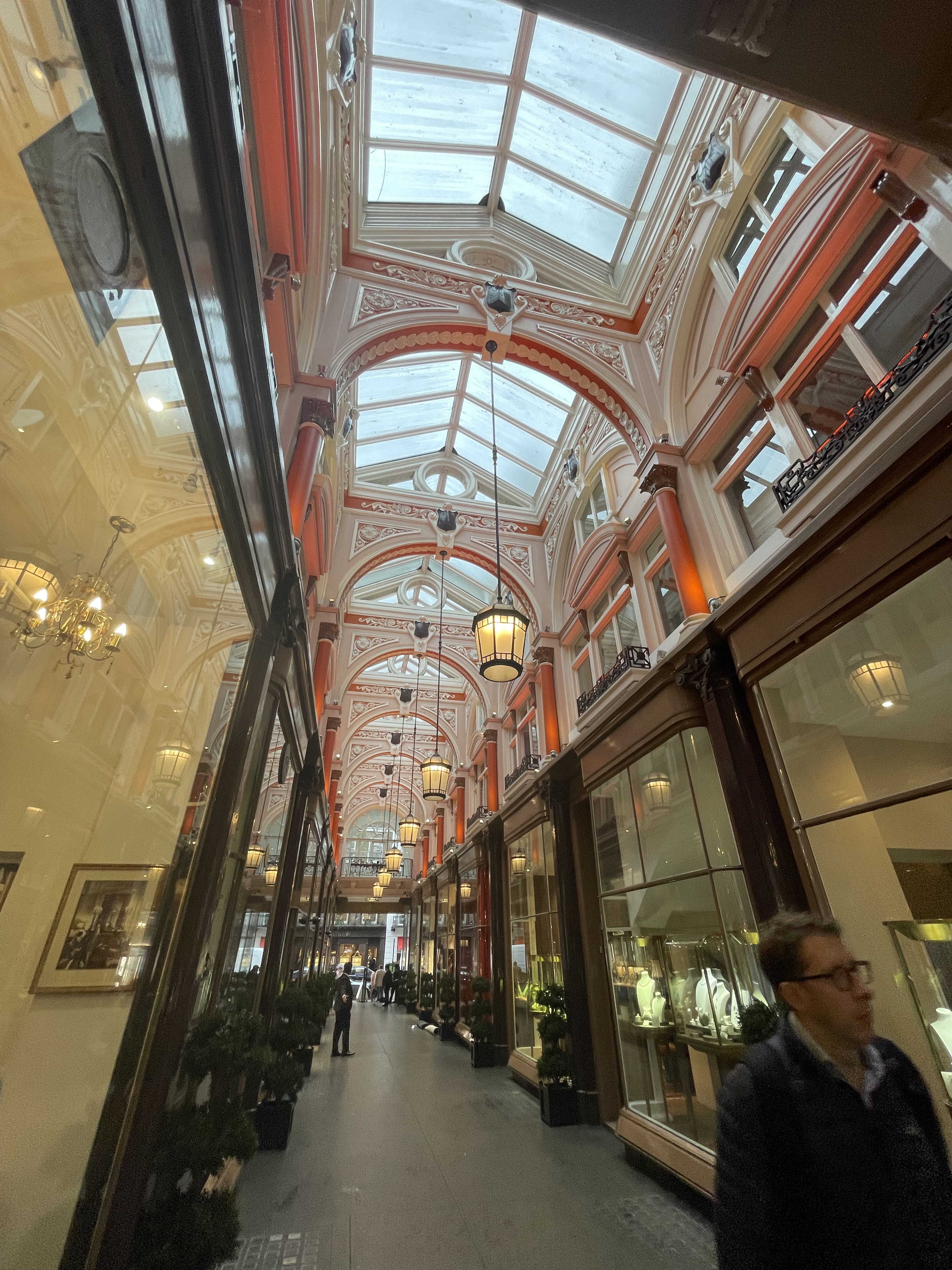
The fabulous 1879 Royal Arcade in London. Less well-known than the nearby and much older Burlington, it’s nevertheless also spectacular and really reminds me of some of the aspects of both the Block and Royal in Melbourne

In August I also presented a longer version of the Leicester paper for the University of Melbourne, School of Historical & Philosophical Studies Brown Bag Seminar Series, and am currently working on it for a journal submission. I also presented a new paper in September, ‘One of the Sights of the Colony: Australian Ninteenth-Century Arcades’, at the European Association for Urban History Online Symposium, Exchanges: European Cities and the Wider Urban World. Based on one of my thesis chapters, this is coming out soon as an article in the History of Retailing and Consumption journal special issue on Australian retail history. It looks at how the arcades were represented in the print media in the nineteenth-century as sites of progress and civilisation in settler colonial Australia.

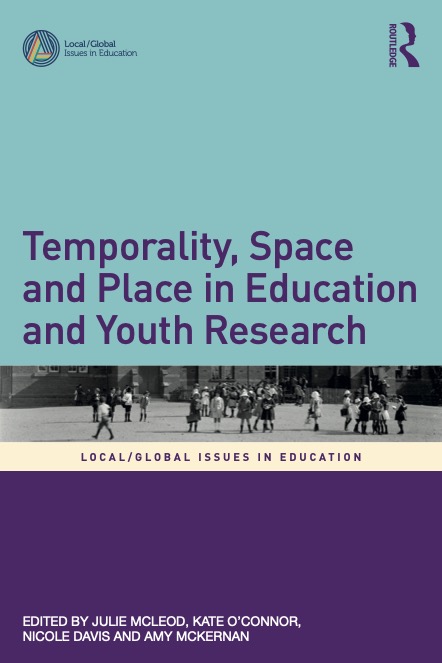
In other exciting news, at the end of June, Temporality, Space and Place in Education and Youth Research, a co-edited collection, produced with Julie McLeod, Kate O’Connor and Amy McKernan, released! A fantastic group of articles from scholars globally, ‘it explores the everyday ways in which time marks the experience of education as well as the concerns and methods of education and youth research’. We are having a launch on 26 October in Melbourne and would love to see you there. Details and bookings can be found on Eventbrite.

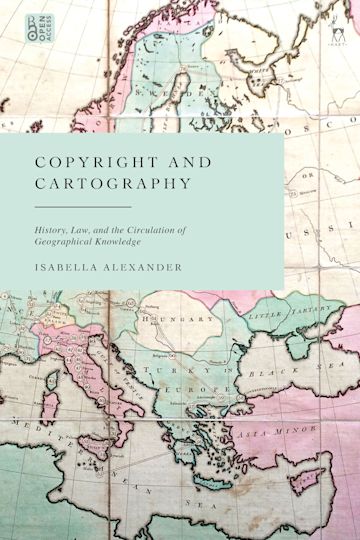
In the same month, a project that for which I was a research assistant, including deciphering the handwriting of some early nineteenth-century clerks in the Ordnance Survey Offices, culminated in a book publication. Isabella Alexander’s Copyright and Cartography: History, Law & the Circulation of Knowledge ‘explores the intertwined histories of mapmaking and copyright law in Britain from the early modern period up to World War 1, focusing chiefly on the 18th and 19th centuries’. I also did the copyedits for this publication and it was such a pleasure to see it come to fruition after being involved with it for several years.

The biggest news though, is probably, GRADUATION! That’s right. All that hard work culminated in a fantastic ceremony at the Royal Exhibition Building in Melbourne, where I got to wear the funny hat and celebrate with friends and family. It was really quite special not only graduating but in a building that is intimately related to the topic of my thesis on the arcades.

On that note, signing off for now! I’ll have some actual history writing on the arcades for you very very soon.


Feature image: Night of the referendum on Federation of Australia, Charters Towers, 1900, with Royal Arcade at far left. Marion Photos. State Library of Queensland, Negative number: 25141