Brisbane Arcade, Queen Street Entrance, 2023. Photographer: Nicole Davis

This year the wonderful Brisbane Arcade celebrates the 100th anniversary of its opening!

In February 1924 Brisbane’s Daily Mail celebrated the progress of the city through the many new buildings constructed over the previous 12 months. Only five years after the end of World War I, the enthusiasm for improvement, demolition of the old city and construction of the new was felt throughout Australia.

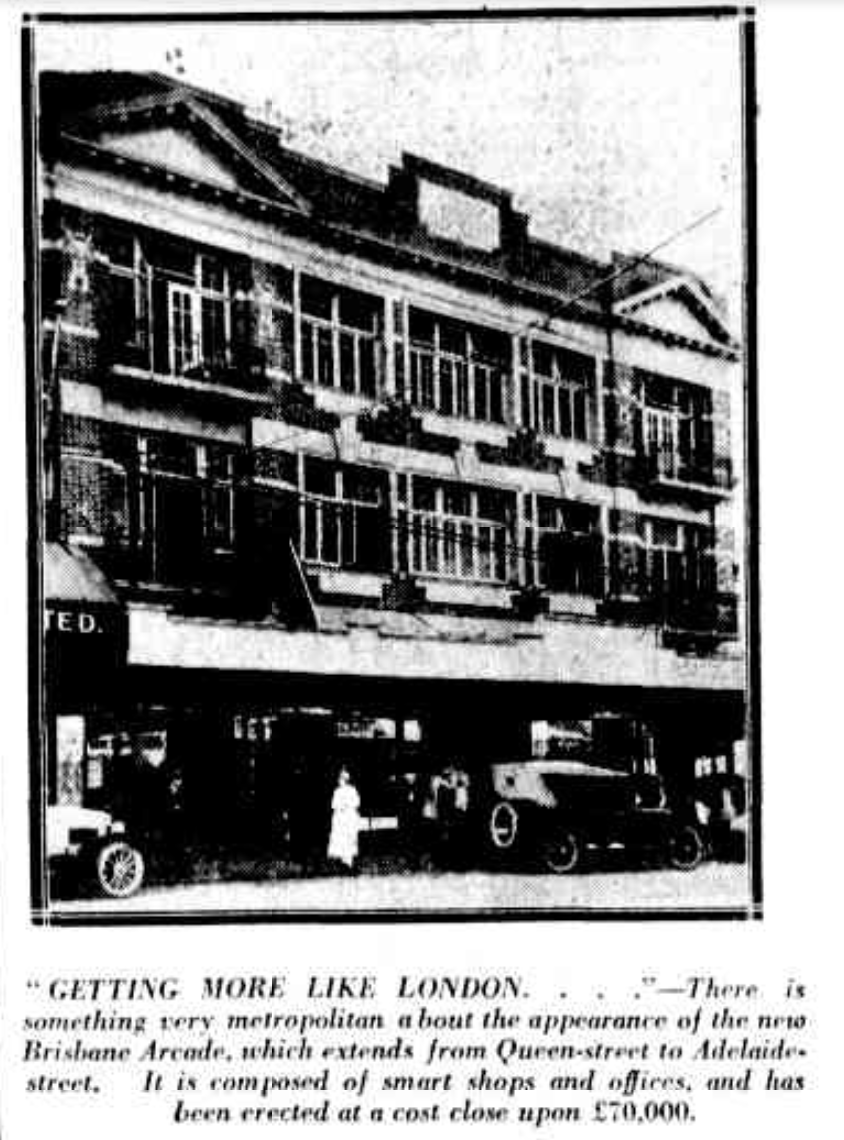
In Brisbane, this included the new Brisbane Arcade ‘of brick, with modern shops and plate-glass windows, this is considered equal to the best Sydney and Melbourne arcades, … [which] cost close upon £70,000’ (5 February 1924, 11).

A similar refrain to stories written for seventy years about arcades in Australia – comparing them to those in Britain, Europe and the United States and equating them with urban progress – is to be found in the stories surrounding this new example:

The arcade, leading from Queen to Adelaide streets, is an attractive addition to the city’s architecture. Arcades are a feature of most large American, Continental and English cities—the one now in the course of construction may one day become the Burlington of Brisbane.

Daily Standard, 3 January 1924, 7.
The Brisbane Arcade has delighted generations of Brisbane residents and visitors throughout the years. I remember walking through as a young child, thinking what a magical place it seemed to me – particularly the Darrell Lea chocolate shop!

As a teenager, it became a regular thoroughfare as I made my way to meet friends at the Hungry Jacks on the corner of Queen and Albert Streets (the regular meeting spot for generations of Brisbane kids). When I started my first job – Bookworld in the Myer Centre – at the age of 16, it again became my route to and from Central Station. It always seemed quite glam and very expensive at that time in my life but still endlessly fascinating.

Being originally an ancient historian, I sadly didn’t pay much attention to Brisbane’s heritage buildings until a few years after I moved to Sydney and morphed into a museum professional working in Australian history and heritage. It once again became a site that I visited and wandered, now taking more scholarly notice of its architecture and stories.

My PhD thesis on Australian arcades was originally planned to look at those built into the 1920s, including this wonderful arcade, the Johnston Arcade in Terang, Victoria, and the many examples built in regional towns in the early twentieth century. But the sheer proliferation of arcades built in this period meant I had to restrict my study to the five decades from 1853 (the first arcade built in Australia) to 1901 (the year of Federation).

Despite having to move away from this period, I still wanted to hear more about the stories of this building, which has always been a special place for me. This year I’m able to do that, as a Griffith University Harry Gentle Resource Centre Visiting Fellow. After a bit of a hiccupy start to the research a couple of months ago, I’m back in Brisbane beginning the project in earnest.

Group of women modelling fashions from Paul’s millinery, Brisbane Arcade, at race day fashions at Ascot races, Brisbane, 1935. Photograph: The Queenslander, 6 June 1935. State Library Queensland, Neg: 191045

The work focuses on women business owners who occupied shops in the nineteenth-century Queensland arcades, focusing on businesses present from the 1870s to 1920s. I’m hoping to uncover the histories of these women: where they came from, how they financed their businesses, what motivated them to open their own establishment, what the experience was like for them, where they got their stock from, the networks they leveraged to do all of this, what happened to them after they left the arcades and, generally, to bring their stories to a broad audience.

At the end of the research, there’ll be a public talk, a website, a journal article, and a couple of conference presentations, all talking about these women. It will also contribute to a chapter in the book I’m writing based on my PhD thesis.

Brisbane Arcade was in fact built nearly 50 years after the city’s first example, the Royal Exhibition Arcade, down the road on Queen Street, and its successor, the 1885 Grand, straddling the corner of Queen and Edward streets (Tattersalls Arcade today sits on its footprint). Also earlier in Far North Queensland were the Royal Arcade in Charters Towers, built in 1888, and the 1901 arcade built as part of the Townsville Municipal Council buildings in 1901. For more on these earlier arcades, you can see my discussion of them in some earlier blog posts.

While I’m technically not researching the 1920s arcades, I likely will research the Brisbane Arcade for the project because I’d really like to compare both the usage and representation of this arcade with its nineteenth-century predecessors. We’ve already seen above in the list of store owners, many more shops aimed at women customers than those earlier examples. I also suspect when I look at the percentages, there will be a greater number of women owners as well. Many of those discussed above were at least run by women and there is a high likelihood many were owned by them as well.

With the 100th Anniversary celebrations, this week seemed an auspicious time to start on my research, and I’ve done a little on the Brisbane Arcade over the past few days, looking at newspapers and other sources.

Like a number of earlier examples, the Brisbane Arcade had a woman owner: Mary Emilia Mayne and her brother, Dr James Mayne, commissioned architect Richard Gailey Jr to design the building, with construction beginning in 1923. The Maynes were significant benefactors in Brisbane, helping to establish the University of Queensland Medical School at Herston and, in 1926, the land at St Lucia, where the main university campus is still located today. On their deaths, in 1940 and 1939 respectively, they left the proceeds of their estates in trust for the medical school, including the income from the arcade.

Mary Emilia Mayne, 1890 [1870s?]. University of Queensland Archives, S908 p541

Nearly two months after that first article in the Daily Mail, the same newspaper informed their reader about some of the businesses about to open there (30 March 1924, 6). These included a wide variety of women’s clothes and accessories shops such as the Arcadia Shoe Salon; Myrtle Power Salon, selling frocks and table linens; Luxor Shoe Store; Miss Morrie McLoughlin, who sold frocks and gowns; Dulcie Decor’s frocks and wraps; Frank Brennan and Miss Brennan, tailoring and ready-to-wear for women; Jenny Salon, run by Esme Davis [or Davies], high-class costumier; SB Heiser, fine jewellery; Searl’s, ‘well-known Sydney florists’; The Women’s Exchange, with knickknacks and lingerie; and Britton and Williams Cutlery Co.

Unlike the arcades of the nineteenth-century, which aimed at a diversity of businesses to attract both women and men, the Brisbane Arcade seems to have focused quite closely on shops that would attract women clientele.

There is a distinct divide in the March article between the relatively feminine boutiques and the seemingly more masculine real estate agents and brokers and so forth. This may have reflected the changing idea of who a shopper was expected to be, or who the advertising and retail industries were targeting as their audiences, and the emphasis on shopping as a woman-centric pastime.

Staff behind the counter at George E Adams’s cake shop, Brisbane Arcade, c1938. Photographer unknown. State Library Queensland

Looking at the Wise’s Directory for 1924-5 demonstrates that this article gives a good overview of the tenants, but mainly those on the ground floor. There were several other businesses there also, including refreshment rooms: Mrs Edge’s White Swan Café and a restaurant run by the Misses Alford and Watts.

On the first floor this continued with more dressmakers and similar businesses aimed at women, as well as the workrooms of some of the stores on the ground floor such as those of Jenny Salon and Brennan & Co. However, there were quite a few others that would have attracted male visitors.

These included a number of agents, also listed in the newspaper article, on this level (accessed via the balcony that runs along the entire outline of the void). This included AJ Hoye, estate agent; DB McCullough, real estate; John McCormack, house, land and business agent; and Allsop and Taylor, real estate. Also to be found upstairs were Cranfield’s Sports Depot, the Committee of Direction of Fruit Marketing, the Queensland Lawn Tennis Association, the Financial Aid Co and a number of (likely men’s) tailors on the first and second floors.

It seems then that there was an apparent spatial divide along gender lines in the building, at least initially. The ground floor was largely aimed at women clientele or more ‘feminine’ pursuits and interests, while the upstairs tenancies were those more traditionally associated with males or a mixed clientele. This is not to say that men didn’t accompany their female relatives to downstairs stores or food outlets, but that the division of interests by gender was apparent.

Of relevance to my current research project, one noticeable difference between nineteenth-century arcades and the Brisbane Arcade appears to be the real shift in gender balance of those running businesses. Here we see an overwhelming majority are run by women, unusual for the arcades of the previous century, particularly those in Brisbane. We do see women-run businesses to varying degrees in those earlier arcades, but they are by no means in the majority and, in Brisbane, there are in fact far more men listed as tenants.
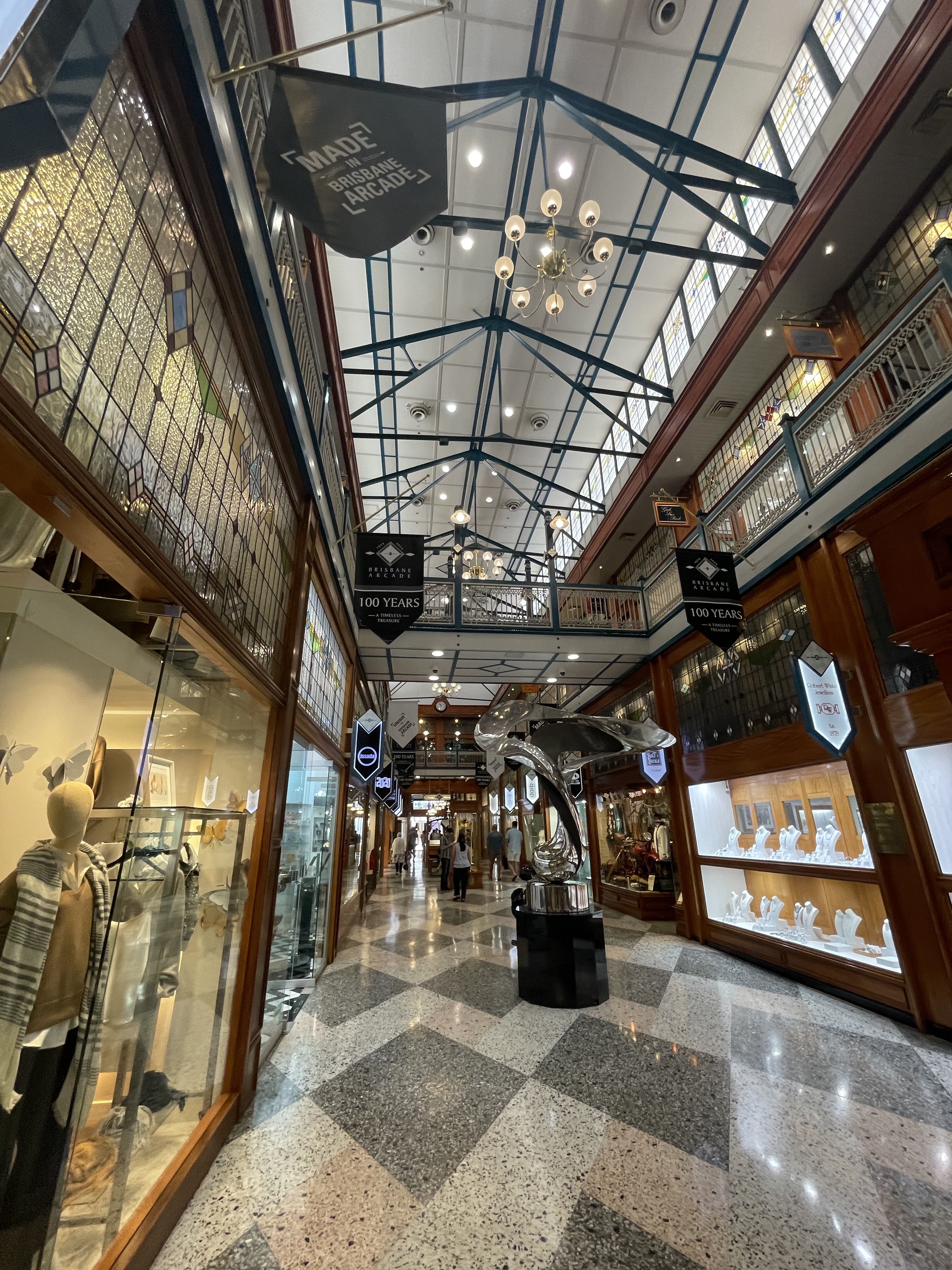
Brisbane Arcade, interior, 2024. Photographer: Nicole Davis

I’m looking forward to exploring more about these changes over time, and when, where and why differences might occur, including looking through newspapers and perhaps business records of shops or business associations, when I can find them.

For the next fortnight, I’m working in the State Library of Queensland and the Queensland State Archives to start to unpack the stories of the Queensland arcades and their businesswomen and I’m very excited to bring you along with me on this research journey. I’ll be posting on my Instagram a bit along the way, so please join me!

Meanwhile, there is loads of stuff happening to celebrate the Brisbane Arcade’s 100th birthday. They have a great range of historical stories about the building on their website, including visitors’ memories of the arcade over the years. This Friday, 19 April, will see a special celebration on the Queen Street Mall, outside the building, with a radio broadcast, special gifts, entertainment, cake (!) and more during the day to celebrate the occasion.

You’ll definitely see me there and, while Darrell Lea is sadly gone, I’ll be stopping by their successor, the Noosa Chocolate Factory. Yum!
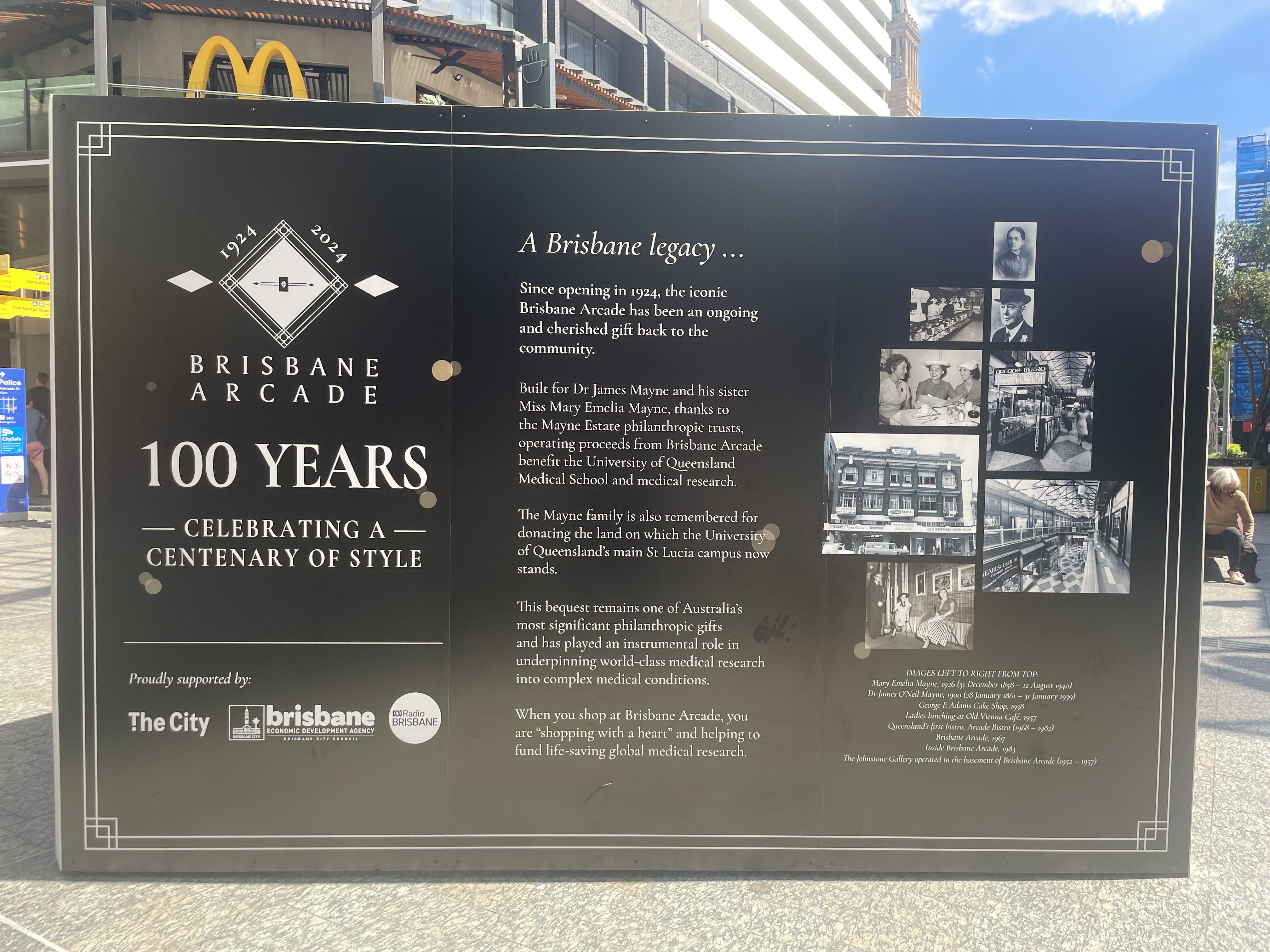
Brisbane Arcade Centenary history display, Queen Street Mall, 2024. Photographer: Nicole Davis

In October last year, along with other members of the Melbourne History Workshop (MHW), I presented at a public seminar, ‘Untimely Ends: Using Inquests for Family and Local History‘, at Public Record Office Victoria (PROV), which focused on a specific collection of documents at PROV. We looked at the broader details of information you can find in these Inquests (Series VPRS 24) and how to use them in historical research. You can find more information on the MHW website, including the PowerPoint of the talk, which is full of useful material.

For my specific section, I talked about some research that I have been doing on Fong Fat, the Chinese owner of several Fancy Goods stores: two on Swanston Street and one in the Eastern Arcade in the 1860s and 1870s (although not all at the same time). The inquests research revealed more about his story but, more significantly, gave some greater detail about the women in his family: his daughter, Ah Chow; his first wife, Chinese-born Quinti; and his second wife, English immigrant Catherine Downey, formerly the family’s housekeeper and shop assistant.

In the last post on Fong Fat, I wrote about English-born New Zealander Charles Rooking Carter‘s comment on the shopping opportunities in the city of Melbourne in 1869:

he could find only one handsome Chinese shop in all Melbourne, and that was kept by ‘celestial’ individual rejoicing in the name of Fong Fat. He indeed, had an excellent display of Chinese fancy goods, in the way of carved ivory work, ebony work, porcelain baskets — besides tea and tobacco.

Carter, Victoria: The British ‘El Dorado‘ (1870)

Fong Fat’s shop, at 96 Swanston Street, near Little Bourke, was joined by another at 48 Bourke Street, in 1871 and then by another, in 1872, in the new and prestigious Eastern Arcade on Bourke Street. It was this shop that led me to Fong Fat and his story. In my research work on nineteenth-century Australian shopping arcades I came across advertisements for the wares that Fong Fat sold in the arcade, including imported Chinese homewares, bric-a-brac, fireworks, tea, and tobacco.

Advertisement for Fong Fat’s Eastern Arcade store, Herald, 20 December 1872, 4

While we imagine arcades in this period, and indeed Melbourne itself, as rather heterogenous and white, Chinese, Indian, Afghani and other non-European shops appeared in them to satisfy the taste for, to European eyes, exotic products from these regions. These shops and the stories of their proprietors demonstrate that Australia and its urban centres were more cosmopolitan that we often imagine.

The image we often have of the Chinese in Australia is of goldfields immigrants, sojourners that return or intend to return to China after making their money, who send their profits home, and whose Chinese wives that are left behind with the extended family. But, as scholars of the Chinese-Australian experience such as Sophie Loy-Wilson and Kate Bagnall, have explored, the story is far more complex. Many also decided to remain in Australia, becoming an integral part of Australian urban and regional life.

Fong Fat’s life is a one of those that little different to the Chinese sojourner trope, as is that of his family. Born in Canton around 1820, he came to Australia about 1857, presumably for gold, and established himself as a shopkeeper. He died in Stawell in 1884 after having married English-born widow Catherine Downey in 1872. This aspect of his story is really interesting, although not so highly unusual for Chinese-Australian men of the period; quite high numbers began relationships and had children with non-Chinese women. What intrigued me even more though was the story of his first family.

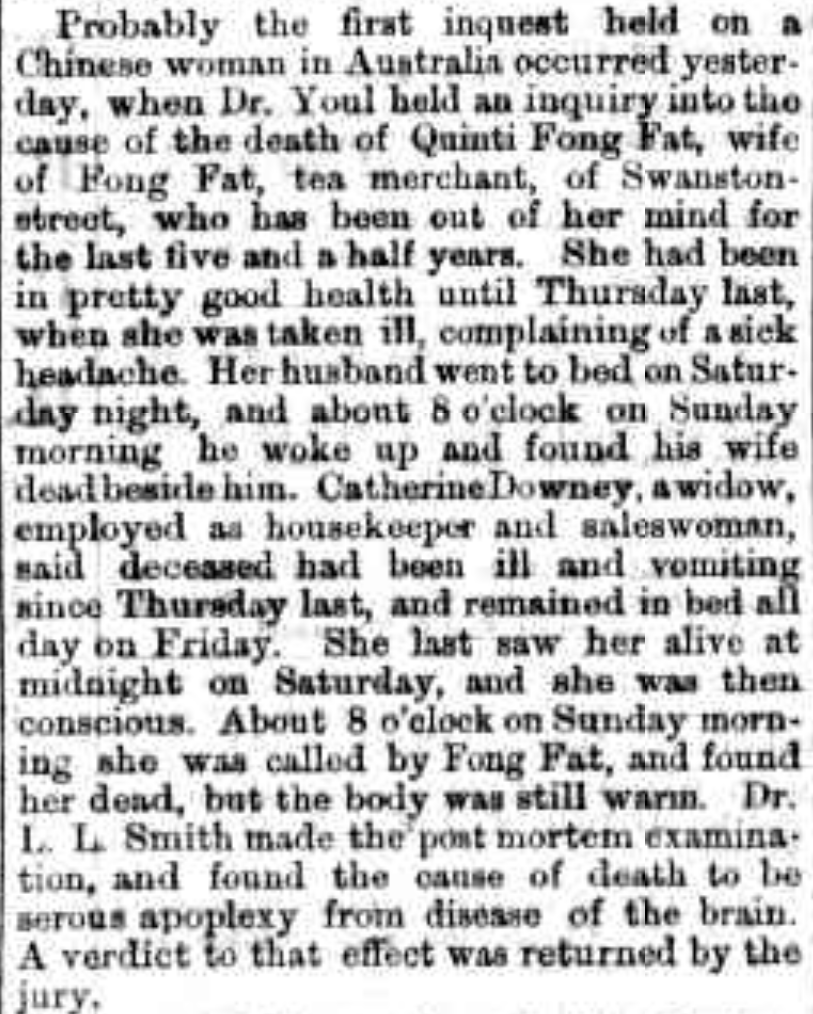
As I searched through Trove, as you do, for newspaper reports on him, I found some intriguing articles about two inquests in which he gave evidence. The first was that of four-month-old Ah Chow, the child of Fong Fat, who died in 1865 of inflammation of the lungs. The second, was that of his Chinese wife Quinti whose death, five years later, was caused by a stroke, and the newspapers claimed was probably the first inquest on a Chinese woman in the Australian colonies. These stories really intrigued me because our general story is that almost no Chinese women were present in Australia during this period. The Victorian census records indicate that there were eight Chinese women in 1861 (although 7% of the total population was China born), which grew to 31 in 1871. But there were a very very small number, of which Quinti was one .

Report on the inquest of Ah Chow, The Age, 10 July 1865, 4
Report on the inquest of Quinti, The Age, 17 May 1870, 3. The report mentions Catherine Downey, who was soon to become Fong Fat’s second wife

Interested in finding more, I obtained the inquest records (now almost all digitised!) from PROV, which told us a little more about the findings of the coroner, although the majority of the information was really quite well reported in the newspapers. But the inquests help to personalise this much more as we read the words of Fong Fat’s testimony for both his little daughter’s and wife’s deaths (the second was given through a translator). Like many testimonies, they seem dry, but we can imagine the probable distress of the father and husband at these events. Of Ah Chow’s death he stated:

The deceased female infant Ah Chow was my child. She was 28 days old. She was healthy up to the day before yesterday. She was in bed with her mother when I went home at 12 o’clock at night. My wife was crying. I saw blood coming from the child’s mouth. I went for a doctor but he was not at home. The child was alive then but lived only two hours.

Inquest deposition of Fong Fat in the death of his daughter Ah Chow. Public Records Office Victoria, VPRS 24 P0000 Unit 167, 4

The inquests are also interesting as they not only have testimonies from Fong Fat but also non-Chinese associates. This includes, in the inquest of Quinti, their housekeeper and shop assistant in Fong Fat’s store, Catherine Downey. Name sound familiar? Yes, this is the English-born widow that he married in 1871 and was his wife until her death fifteen years later!

I approach the history of urban Australia often in through the avenues of family history such as this. Using the personal stories of individual personalities to tell bigger histories and revealing larger events, such as the goldrush and its aftermath, Chinese migration to Australia, and the history of the city. Someone like Fong Fat, making his way in a city we often envisage as European and the presence of his Chinese wife and child, gives a different complexion to our imagination of Australia during the period.

Once I had found the inquests, I sourced as many other documents as I could to build a picture of these people and their lives – more newspaper reports, including advertising for the shops, stories about a court case Fong Fat’s second wife brought against someone, records of Catherine’s burial in the Melbourne General Cemetery and the gold that is the death certificates of Ah Chow and Quinti, which told us a little about them. Quinti, we find was born in Canton in around 1846 and had come to Victoria in around 1864 or 5, presumably to be a wife to Fong Fat. She quickly bore her only child, Ah Chow, in the colony, only to lose her, and then to die herself five years later.

The inquests themselves are only suggestive of what life would be like for Chinese women in Australia. Unfortunately, there is not a lot of detail in these particular ones but … in many other inquests we would receive a wealth of other detail about individuals. The death certificates reveal a little more, but they add to the story we are building. Importantly to me they also disrupt the idea that Chinese women were not present in Australia at all and the trope of the single sojourner Chinese man.

I think they also put a human slant on the often racialised and sensationalised newspaper reports about the Chinese community in the colonial city.  Together with all these other documents, the inquests provide another window into the lives of Fong Fat, Quinti and their baby daughter, as well as his second wife, and show how these types of records can provide more detailed information and illuminate the stories of Australian families.

Part of my intent in undertaking this project is to use the arcade as lens through which to explore the history of the Australian city and its inhabitants. Within the arcades we find goods, ideas and people that came from all over the world, encapsulating ideas of global trade and migration, and even political and social changes, into a contained space.

The fourth chapter of my thesis is going to do address the people of these arcades and do what a lot of urban histories often don’t – putting people back into the place. The city isn’t just an accumulation of buildings, roads and structures but a living breathing space where people live, love and laugh. One of the ways that we can explore this is to focus on individual lives within the sweep of broader histories of the the city and the world. Within this context I want to look at the lives of a variety of people who were involved with, encountered and inhabited the arcades, many of whom have often been forgotten about in the discussions of the architecture and goods to be found in the arcade spaces – the owners, architects, shopkeepers, customers, workers, and undesirable others.

What some of my initial examinations of a handful of these people have revealed is that many of these characters, particularly in the early years of the arcades’ histories, hailed from all over the globe. Along with the display of goods and ideas (of architecture, culture, consumption) that exhibited international origins and/or influences, many of those who inspired and brought these spaces were also evidence of Australia’s close connections with the rest of the world.

In the mid- to late nineteenth century, people were constantly arriving in (and leaving) the Australian colonies and a large percentage were overseas born. Recently, studies have explored the idea of combining aspects of historical biography, architectural history, cultural practices and material culture, in order to reveal new ways of thinking about history. These studies have also taken a decidedly transnational turn, in order to reveal the broader stories of nation, empire and global events through the lives of individuals whose lives were ‘formed … across a global canvas’ (Deacon, Russell & Woollacott 2010, 2).

To look at some of these ideas I’ve so far examined the lives of several people – Fong Fat, a Cantonese immigrant who opened a fancy goods store in the Eastern Arcade; Hiram Crawford, owner and tenant of the same building; Henry Morwitch, the builder of the Brisbane arcades, who lived a highly mobile life moving multiple times between colonies and continents; and Herr Rasmussen, the Danish medical botanist, who sold his Danish vitality pills to Sydney in the Central Arcade, George Street. I’ll be posting a more detailed look at the life of one of these very soon.

One of the things I really got excited about was trying to identify some images of some of these characters. I haven’t had any luck so far with those mentioned above but there was one valuable resource that I was made aware of recently. A number of these manufacturers and retailers with shops in the arcades exhibited at various international exhibitions. The State Library of Victoria has a fantastic collection of security photographs of exhibitors from the 1888 Melbourne exhibition and these include some of the people that inhabited the arcades, including the Messrs. Gaunts of Thomas Gaunts famous watch, clock and jewellery shop in the Royal Arcade, Melbourne. I’m hoping in the future I’ll be able to put some more faces to names – and people into these places –  by looking through this collection and other images yet to be found.

E. Gaunt, Album of security identity portraits of members of the Victorian Court, Centennial International Exhibition, Melbourne, 1888. State Library Victoria. H28190/2
T. Gaunt, Album of security identity portraits of members of the Victorian Court, Centennial International Exhibition, Melbourne, 1888. State Library Victoria. H28190/2

E. Gaunt, Album of security identity portraits of members of the Victorian Court, Centennial International Exhibition, Melbourne, 1888. State Library Victoria. H28190/256

References:

Desley Deacon, Penny Russell and Angela Woollacott, ‘Introduction’, in Desley Deacon, Penny Russell and Angela Woollacott (eds.) Transnational Lives Biographies of Global Modernity, 1700-present (London: Palgrave Macmillan, 2010), 2